
Stock Markets February 18, 2026

Brad Smith Warns U.S. Tech Should Be Concerned About China’s AI Subsidies

Microsoft president says state-backed support for Chinese AI firms could change competitive dynamics despite U.S. advantages in chips and innovation

By Priya Menon MSFT
Brad Smith Warns U.S. Tech Should Be Concerned About China’s AI Subsidies
MSFT

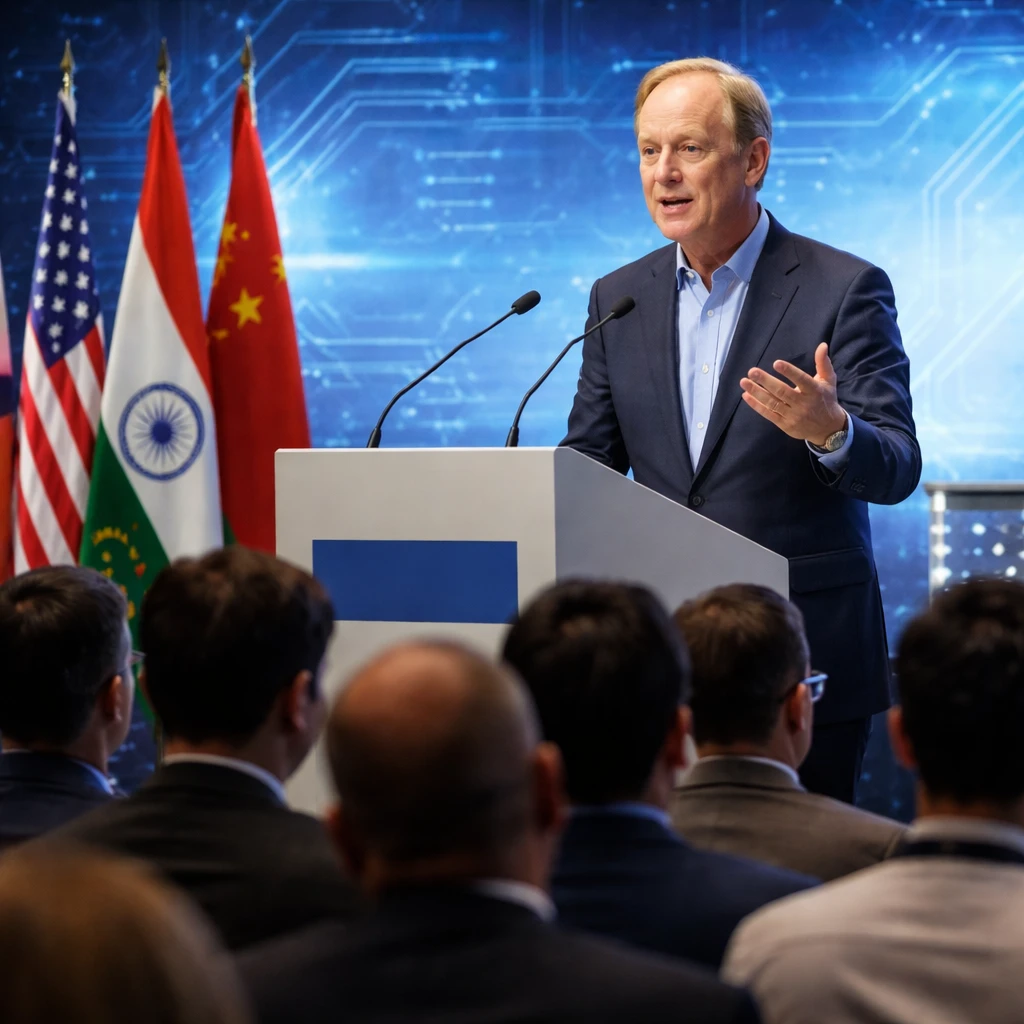
Microsoft President Brad Smith warned that American technology companies should give serious thought to the competitive edge Chinese firms gain from government subsidies in the artificial intelligence sector. Speaking at an AI conference in New Delhi and in a subsequent CNBC interview, Smith highlighted U.S. strengths in advanced chips and innovation but stressed that Chinese state support - including direct investment and energy-cost vouchers - poses a material competitive challenge, echoing the global effects seen earlier in telecommunications.

Key Points

  • Microsoft President Brad Smith warned that U.S. tech companies should "worry a little bit" about Chinese government subsidies for AI.
  • Smith noted U.S. strengths in access to leading chips and other technological innovation, but emphasized that state-backed support for Chinese firms could shift global competition.
  • Chinese firms such as Huawei and Alibaba already operate data centers overseas, and Beijing's support has included a multi-billion-dollar national investment fund and energy-cost vouchers for computing - developments that coincide with a recent flurry of AI model releases by Chinese companies.

New Delhi

Speaking at the AI Impact Summit in New Delhi, Smith acknowledged that the United States retains key technological strengths - including what he described as "an advantage in terms of access to the most powerful chips in the world" as well as "other technology innovation" - but he cautioned that state-directed financial backing for Chinese competitors cannot be ignored.

"I do think we always have to think about, maybe even worry a little bit about Chinese subsidies," Smith told CNBC in an interview following his remarks.

Smith drew a line to prior episodes in the technology sector, noting that government-supported expansion from Chinese telecommunications firms changed market dynamics overseas. "Some American companies disappeared. European companies like Ericsson and Nokia were thrown on the defensive," he said, framing the rise of those firms as a cautionary example for the AI era.

The Microsoft executive also pointed out the global footprint of Chinese cloud and data center operators, citing Huawei and Alibaba as examples of companies that already operate data centers around the world. He said that physical presence can make it straightforward for state support to extend to overseas operations.

"I think for the rest of us, we have to compete with that, and we have to be good at competing with that, with the support of our governments," Smith added, calling for competitive responses that include government backing.

The article notes that Chinese AI companies have benefited from concerted government support, including a multi-billion-dollar national investment fund and vouchers that reduce energy costs for computing. That financial assistance has come as a number of Chinese firms have introduced multiple AI models in a short span of time - described here as having released numerous AI models over the past two weeks.

Commercial commentary included with this report highlights investor tools and coverage. One service described evaluates MSFT alongside thousands of companies each month using more than 100 financial metrics and has identified prior winners such as Super Micro Computer (+185%) and AppLovin (+157%). The service offers to identify whether MSFT is included in its strategies or whether other opportunities exist in the same sector.


Context and takeaways

Smith’s comments combine acknowledgement of U.S. technological advantages with a clear warning: state subsidies in China are a competitive force that U.S. firms and policymakers should consider when planning strategy and support for the domestic AI ecosystem.

Risks

  • State subsidies in China may give Chinese AI companies a competitive advantage, potentially affecting U.S. and European firms in the technology and data center sectors.
  • Past patterns in telecommunications, where state-backed Chinese companies pressured incumbents, illustrate a risk that comparable dynamics could unfold in AI, impacting vendors, cloud providers, and related supply chains.
  • The global presence of Chinese data centers could make it easier for subsidies to support international operations, posing strategic and market-access uncertainties for Western cloud and infrastructure providers.

More from Stock Markets

UBS Sees Continued Execution at Walmart After Strong Q4; Digital and High-Margin Layers Drive Outlook Feb 21, 2026 Failed $4B Financing for Lancaster Data Center Tied to CoreWeave’s B+ Credit Score Feb 20, 2026 Raymond James Says JFrog Sell-Off Overstates Threat from Anthropic’s New Security Tool Feb 20, 2026 FERC Clears Path for Blackstone-TXNM Energy Deal, Removing Major Federal Hurdle Feb 20, 2026 Vanda Gains FDA Nod for BYSANTI, Shares Spike as Company Secures Second Approval in Weeks Feb 20, 2026