
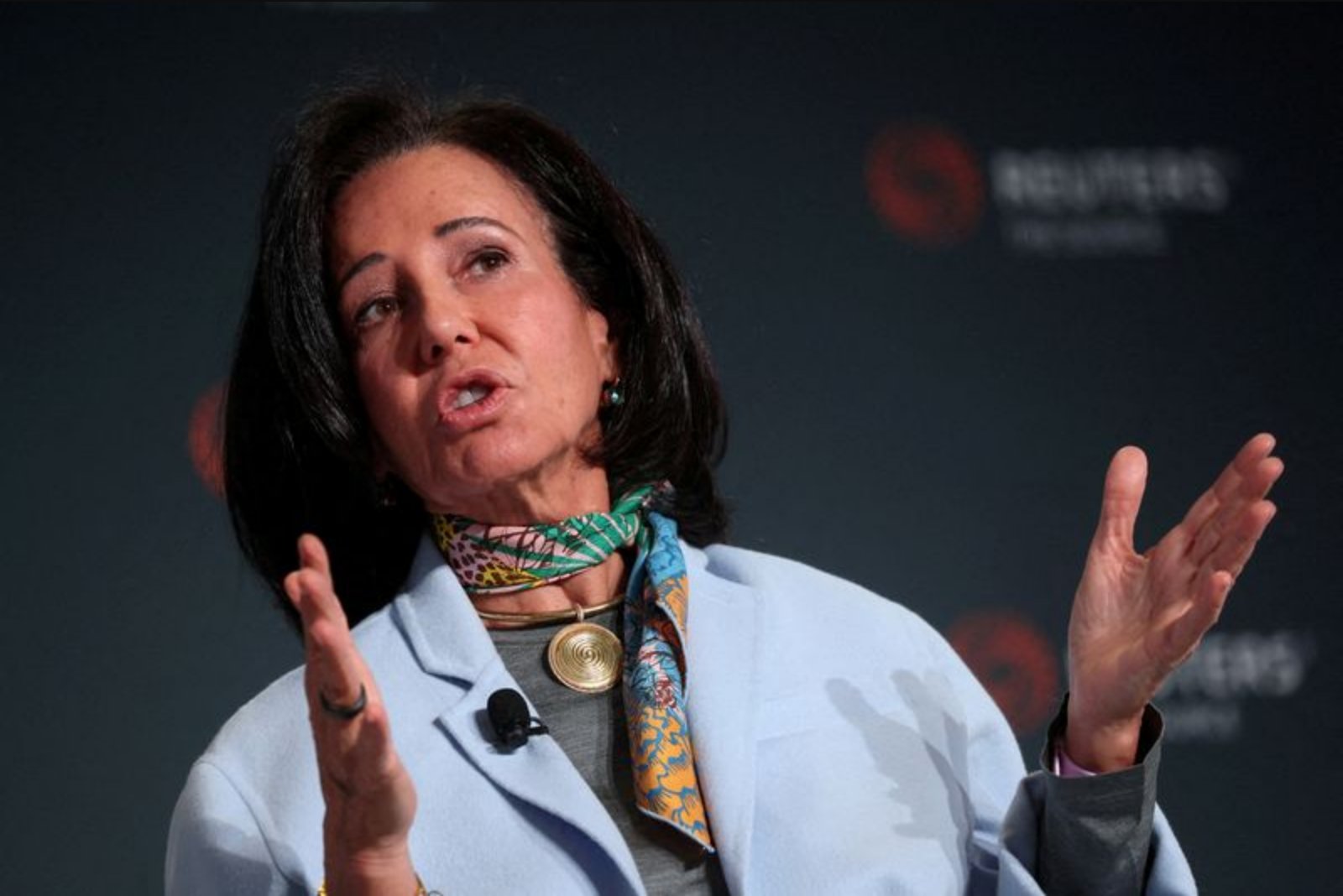
Santander’s executive leadership will present a tightened operating plan and fresh efficiency targets as part of an investor day update intended to underline the bank’s strategy of concentrating on its main developed markets, people familiar with the plans said.
The presentation, scheduled for Wednesday, will spell out expected cost savings from Santander’s ongoing digital transformation and integration work, two sources said, with Chief Executive and Executive Chair Ana Botin aiming to demonstrate that channeling resources into Spain, Britain and the United States is the most effective path for sustainable growth.
Earlier this month the bank agreed a $12.2 billion purchase of U.S. lender Webster, a transaction that intensifies Santander’s U.S. ambitions and follows last year’s acquisition of Britain’s TSB. Investors and analysts describe the deals as central steps in Botin’s longer-term program of simplifying the bank’s complex footprint and correcting underperforming units ahead of the three-year strategy update expected at the investor day.
Botin is set to present a target of lifting Santander’s profitability ratio to above 20% by 2028, up from an estimated 16.3% at present, according to the people briefed on the plans. The bank will also detail how a common IT platform and a unified global operating model should help lower service costs and improve efficiency across its networks.
For many years Santander’s broad geographic presence, spanning 10 core markets, has helped shelter the bank from localized downturns but has also exposed it to currency depreciation risk in regions such as Latin America and constrained its valuation, participants said. That picture has shifted amid strong recent earnings and an acceleration in growth in certain markets, with the stock climbing roughly 80% over the past year.
Today, Santander’s market value stands close to 160 billion euros, positioning it above UBS as the largest lender by market capitalization in continental Europe, according to the people familiar with the bank’s numbers. Rather than returning capital to shareholders through buybacks, Santander has deployed more than $15 billion on acquisitions since mid-2025 to add scale and address weaker-performing businesses.
"She has further to go but... it’s a very strong starting point," said Filippo Alloati, head of financials at Federated Hermes and an investor in Santander’s bonds, describing the bank’s increased commitment to the United States. "They are going to be a serious player, not someone flirting with the U.S."
Despite the share-price rally, investors retain a degree of caution. Santander’s shares currently trade at 1.56 times book-to-price value, a common metric used to gauge how investors value banks. Although that multiple has risen and now sits above the European banking average, it remains below some peers.
A source familiar with Santander’s strategic thinking said the investor day will focus heavily on cost reduction and efficiency gains and characterized the task as an "unfinished job," noting that Santander’s cost base remains disadvantageous compared with Spanish rival BBVA.
Early stage improvements
Portfolio managers and analysts describe the bank as still in the earlier stages of reaping benefits from the new business model. "We are at the early innings of the improvement in the business model, ... the market is still somehow sceptical," said Alberto Chiandetti, portfolio manager at Fidelity International, which holds Santander shares.
Santander has already trimmed its workforce to help reduce costs, cutting about 14,000 employees over the last two years to bring total headcount below 200,000. The cost-to-income ratio improved to 41.2% at the end of 2025, down from 44.1%, though that still compares with BBVA’s 38.8% ratio for 2025.
Andrea Filtri, head of Mediobanca Research, projects that savings tied to the bank’s recent M&A activity and its IT overhaul could permit Santander to target a cost-to-income ratio in the 30% to 39% range.
Santander’s decision to concentrate more resources in the U.S. and Britain reflects an acknowledgement from management and investors that greater scale is necessary to remedy weak profitability, they said. On a pro-forma basis, the Webster and TSB deals increase the share of Santander’s gross operating profit coming from developed markets to nearly two thirds, up from 56% without those transactions, the bank has reported.
The bank has disclosed that annual cost savings arising from Webster - a deal the bank says will also reduce its U.S. funding costs and establish it as a top-five player in the U.S. Northeast - would rise to $800 million. Synergies from the TSB acquisition are projected to generate 400 million pounds in annual savings.
Santander maintains a 50% payout policy on ordinary earnings, distributing half of ordinary earnings in cash and half in shares. Some analysts have urged a more generous dividend policy given the bank’s strong solvency ratios, but Santander and Botin have decided that deploying excess capital into M&A better supports the bank’s strategic objectives. The bank estimates the Webster deal will deliver a return-on-invested capital of roughly 19%, about six percentage points higher than the potential return from a share buyback.
Wednesday’s investor day is expected to present detailed targets and milestones for the next three years, with cost reduction and integration of the recent acquisitions at the center of the narrative as management seeks to convince skeptical market participants that the transformation can raise returns and justify the acquisitions made since mid-2025.
Key context and takeaways
Santander plans to rely on digital consolidation, global operating model standardization and recent M&A to improve profitability and achieve a target return above 20% by 2028, while increasing developed-market exposure via Webster and TSB.