
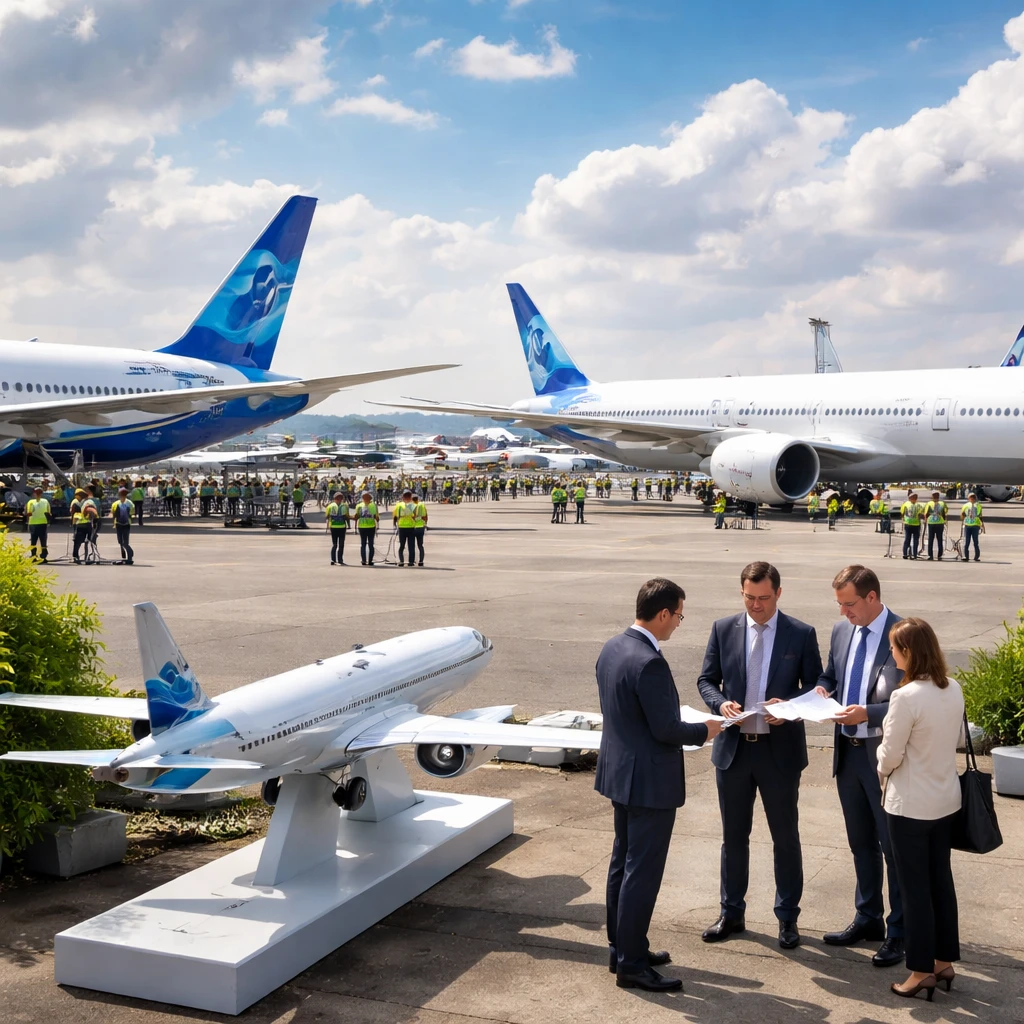
At the Farnborough Airshow this week, Boeing outpaced Airbus by a narrow margin in a restrained series of order announcements, reflecting an aerospace sector intent on resolving production bottlenecks and clearing a historically large backlog of aircraft orders. Industry observers had expected roughly 300 commitments, a number confirmed by the combined tally of the two planemakers, yet this fell short of some upbeat forecasts that had stretched as high as 800 jets.
Market enthusiasm for air-show order bursts has cooled in recent years as manufacturers cautiously manage messaging during a period of industrial recovery and as airlines continue to sit on unprecedented volumes of unfulfilled orders. "I didn’t have high expectations of big commercial orders at the show, not particularly because of the current macro or geopolitical climate, but because a lot of large orders are already out there," airline analyst John Strickland said.
According to a Reuters count of deals announced during the event, Boeing reported 173 firm and provisional orders across narrowbody and widebody types, while Airbus posted 154 such commitments, bringing the combined total to 327 aircraft. However, after removing transactions that were already recorded in manufacturer order books without the buyer being named initially - including Boeing’s portion of a large lessor order - the adjusted figure stood at 218 aircraft.
That level of activity marks a modest increase compared with the prior Farnborough in 2024 but remains well under the high-water mark seen in 2018, when orders for the two dominant manufacturers reached 1,109. The industry’s recent years of supply-chain disruption, labour shortages and manufacturing setbacks have left both firms with backlogs extending far into the next decade, and much of the industry’s near-term focus is on boosting throughput rather than generating headline-grabbing new commitments.
In remarks ahead of the show, Boeing Commercial Airplanes CEO Stephanie Pope framed the industry’s situation succinctly: "Demand is not the issue." That message underlined a central theme of the week - strong underlying need for aircraft persists, but delivery timing is constrained by production capabilities and supplier capacity.
Airbus used the event to display its A350-1000 and indicated it is studying a potential stretch of the type as a competitive response to Boeing’s delayed 777X. Boeing, by contrast, did not exhibit any of its principal commercial variants at Farnborough; three of those variants are currently in the process of certification.
Largest commercial transaction
The most sizable commercial order of the week came from SMBC Aviation, the world’s second-largest aircraft lessor, which placed a 200-plane single-aisle order and split it evenly between the two manufacturers - 100 Boeing 737 MAX units and 100 Airbus A320neo-family aircraft. The deal highlighted persistent demand for narrowbody jets, which dominate short- and medium-haul operations, even as delivery slots remain scarce and supplier bottlenecks persist.
Beyond narrowbodies, there were continued signs of appetite for widebody types. Riyadh Air and Philippine Airlines engaged with both manufacturers on widebody options, and leasing giant AerCap added more Boeing 787s to its portfolio. Regional aircraft manufacturer Embraer announced orders for 50 planes, of which 20 are freighter conversions.
Off the main aircraft stands, a standout industrial announcement was a record order from CFM International for in excess of 1,000 LEAP-1A engines intended to power 500 previously committed Airbus jets. The engine industry has been placed under heavy strain by a prior boom in aircraft orders that in part was fuelled by low interest rates, producing parts shortages and maintenance delays for engine makers and MROs. Both CFM and Pratt & Whitney, the suppliers most affected, reported that their industrial situations are improving steadily.
The deals disclosed at Farnborough were described in aggregate as being worth tens of billions of dollars. While those figures align with industry expectations for a more subdued show, they also underscore the central challenge facing carriers, lessors and manufacturers alike - reconciling robust demand with constrained production and stretched supplier networks.
As the industry works through these operational constraints, air shows may continue to play a different role than in previous cycles, serving more as venues for incremental commitments and strategic announcements rather than as stages for blockbuster, same-day order revelations.