
Overview
Bernstein has identified three Indian firms that it expects will benefit from a marked acceleration in capital spending on AI-focused data centres across India. The research house described India as the ninth-largest market by installed data centre capacity, while also noting the country ranks among the three largest customer bases for many AI platforms. Those structural elements, together with recent government tax incentives for data centre projects, have helped attract substantial investment commitments to expand local compute infrastructure.
Investment scale and context
The bank highlighted about $57 billion in announced data centre investments in India, a figure that excludes commitments from Reliance. Bernstein noted that several major hyperscalers have pledged sizable capital to build local capacity, and that a number of these commitments were revealed during the India AI Impact Summit held in New Delhi in February. According to the report, this influx of announced capital is creating demand not only for physical data centre facilities but also for the associated power and infrastructure required to operate them.
How the benefits are expected to flow
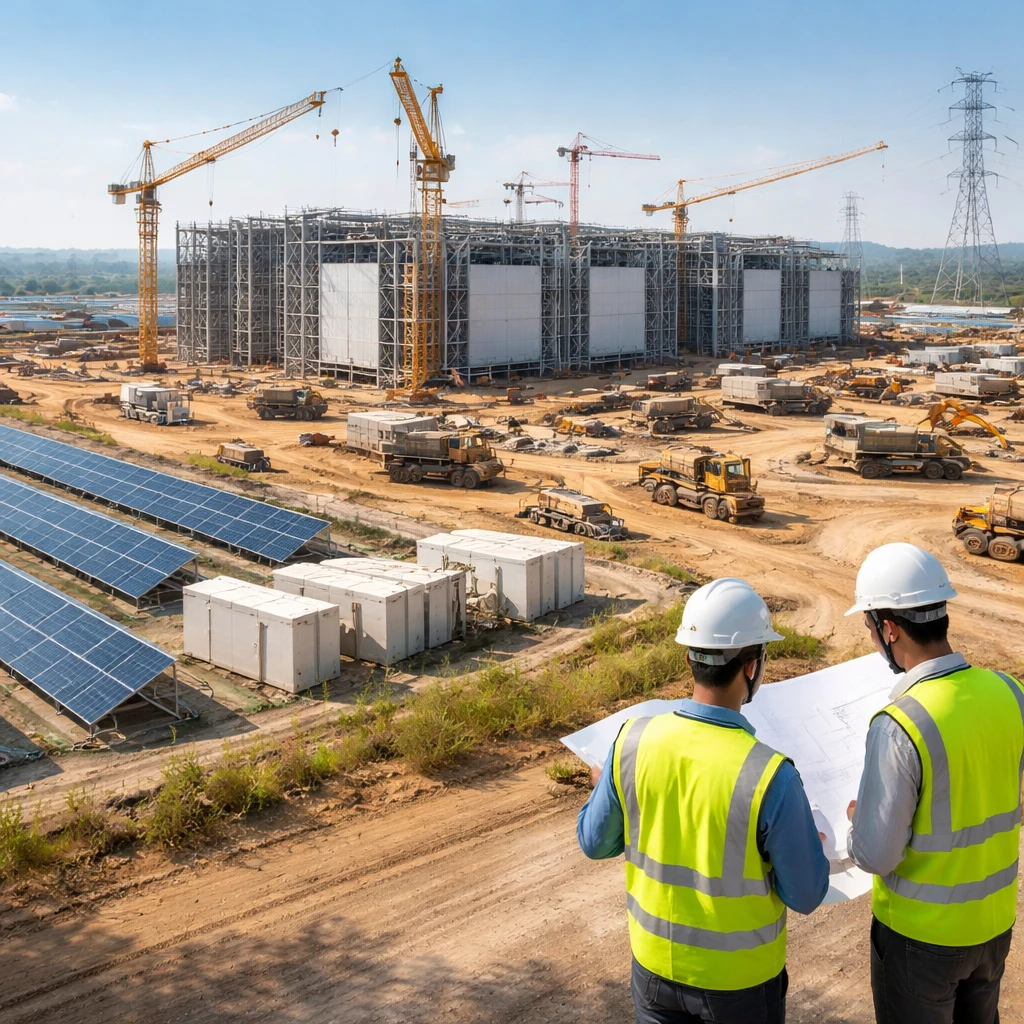
Bernstein outlined three channel points through which companies could capture value from the buildout: construction and engineering services, renewables and storage for power supply, and existing thermal generation capacity. The bank emphasized that the announced wave of spending is likely to generate opportunities across construction, engineering and power-infrastructure segments, as operators seek onshore capacity and reliable energy solutions for high-density compute loads.
Company-specific views
Larsen and Toubro - L&T - was identified as the most direct beneficiary. Bernstein, which assigned an Outperform rating to L&T, emphasized the company’s role as an engineering, procurement and construction contractor for both data centres and the supporting power infrastructure. With major hyperscalers committing capital to India, Bernstein expects L&T to capture a meaningful portion of construction and engineering contracts tied to new facilities.
Adani Green - Despite an Underperform rating on Adani Green, Bernstein acknowledged that Adani Green and its parent, the Adani Group, could be indirect beneficiaries as data centre power demand increases. The report noted that the Adani Group’s large land holdings could position it advantageously to secure solar-plus-pumped-storage or solar-plus-BESS power purchase agreements, which Bernstein anticipates will be the dominant energy model for Indian data centres. The bank also flagged potential long-term involvement by Adani Green in nuclear partnerships, but qualified that any such contribution is at least a decade away.
NTPC - Bernstein rated NTPC as an Outperform and described it as another indirect beneficiary of rising data centre-driven power demand. The bank argued that even if data centres do not sign direct coal-fired power purchase agreements, NTPC would still gain from higher overall demand, which could delay coal retirements and increase plant load factors at existing thermal capacity. Bernstein also cited nuclear power as a longer-term avenue for NTPC, while stressing that meaningful contributions from nuclear remain at least ten years out.
Implications
Bernstein’s analysis frames the AI data centre construction wave as a multi-segment opportunity spanning construction firms, renewables and storage developers, and incumbent generation companies. The research note underscores how announced capital commitments and supportive tax treatment are shaping a demand profile that touches both physical facility buildouts and the energy solutions that will power them.