
Barclays projects major market expansion for "physical AI"
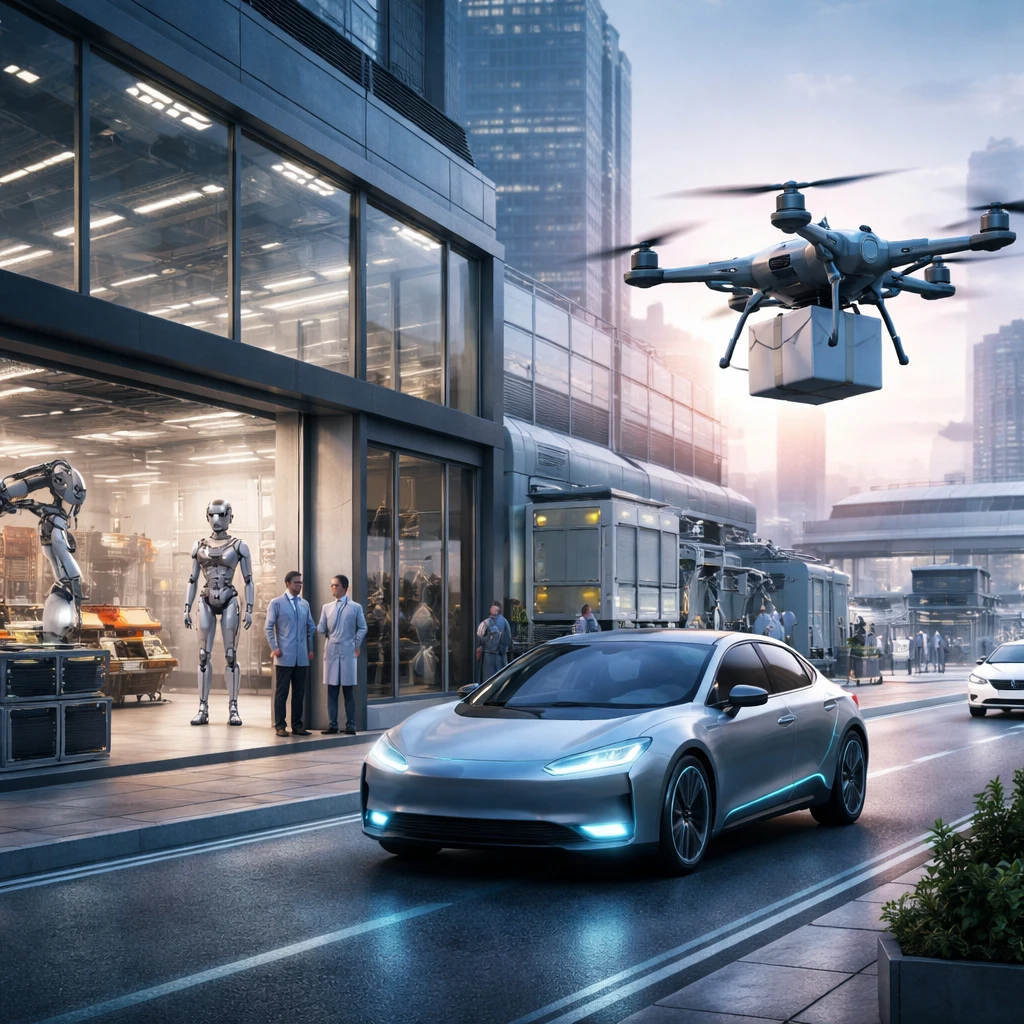
Barclays has outlined a scenario in which advances in artificial intelligence, robotics and battery technology drive a new category it calls "physical AI" toward a material market opportunity by 2035. The bank defines physical AI as intelligent systems embedded inside machines that can sense, decide and act in the physical world, moving the application of AI from purely digital tasks to machines that execute work in real-world settings.
In its assessment, Barclays estimates the addressable market for physical AI could fall between $500 billion and $1.4 trillion by 2035, with a baseline case of roughly $900 billion. The bank expects autonomous vehicles to be the largest single source of value within that range, potentially contributing up to $550 billion of the market by 2035.
The technology pillars and deployment path
Barclays frames the investment thesis around progress across four core pillars: computing "brains," mechanical "brawn," improvements in battery technology, and a set of enabling companies that support the broader ecosystem. The bank expects deployment to start with autonomous vehicles and drones, then broaden to factory automation and, at a later stage, general-purpose humanoid robots.
The report maps nearly 200 public companies across the global value chain, from component suppliers through manufacturers and software providers. Barclays notes that the opportunity set for investors expands beyond traditional technology firms to include automakers, industrial conglomerates and logistics operators, while also supporting increased demand for semiconductors and cloud infrastructure.
Geography and adoption
Barclays highlights China as the current leader in adoption. The bank estimates China accounted for more than 85% of roughly 15,000 new humanoid robot installations in 2025, and it says China installed about 55% of global industrial robot units in 2024, a share described as far ahead of the United States. The bank expects much of development and deployment activity to be concentrated in China and the United States.
Segment maturity and scaling challenges
The bank expects growth to vary by segment. Autonomous vehicles are viewed as the most mature opportunity, helped by existing automotive supply chains and large driving datasets. Industrial automation and drones are forecast to follow. Humanoid robots, by contrast, are expected to take longer to scale because of several constraints the bank identifies: limited training data, hardware integration challenges and battery limitations.
Barclays frames physical AI as a shift from using AI to perform digital tasks to embedding decision-making and action into physical systems operating in factories, transport and logistics. The bank sees this transition as having the potential to unlock productivity gains across the real economy.
Implications for investors and markets
By mapping nearly 200 public companies across the chain, Barclays indicates that investors may find exposure not only through pure-play technology names but also via automakers, industrial groups and logistics operators. The bank also flags that rising demand for semiconductors and cloud infrastructure will likely accompany broader physical AI adoption.