
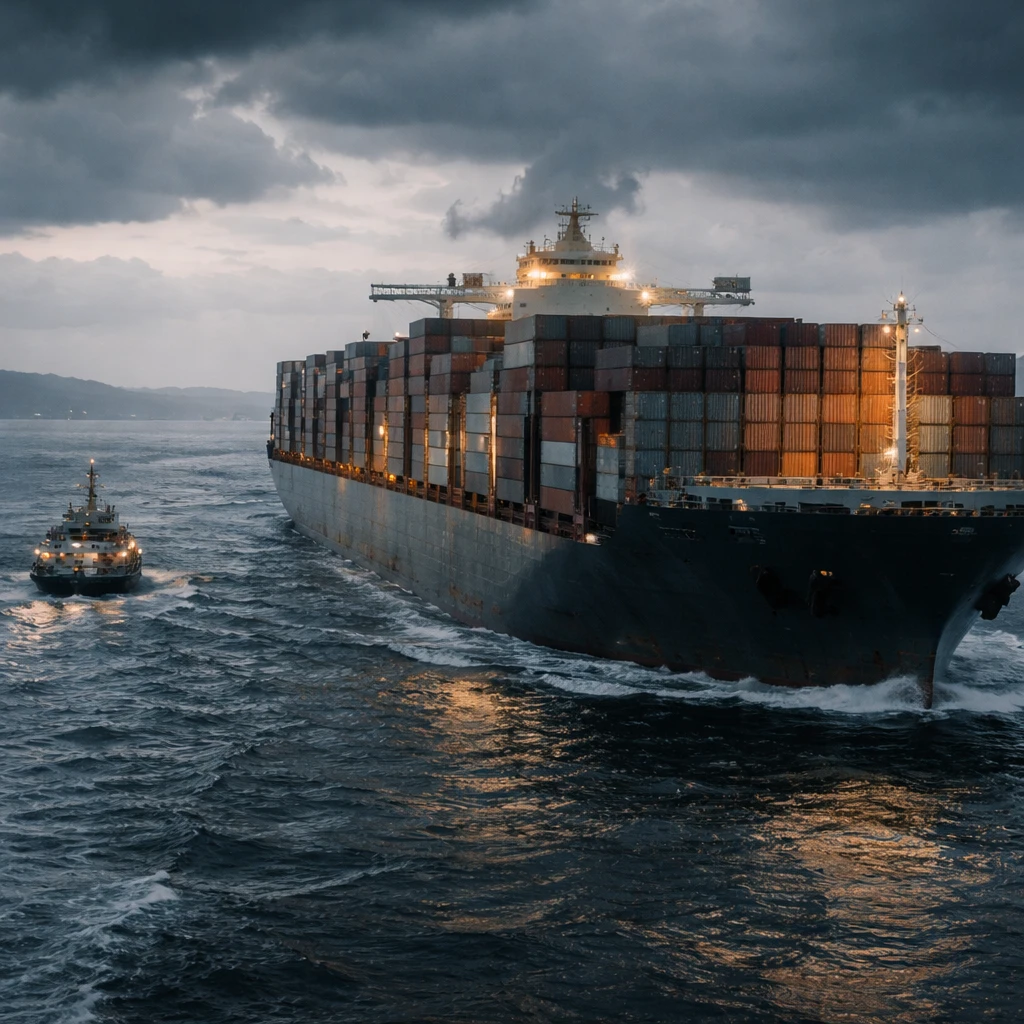
Barclays has adjusted its view of two leading European logistics companies, arguing that continuing instability around the Red Sea makes a rapid return to Suez Canal shipping lanes improbable.
The brokerage upgraded A.P. Moller-Maersk to Equal Weight from Underweight, while it retained a relative Underweight position on Kuehne + Nagel. The move reflects Barclays analysts' assessment that current geopolitical and safety challenges create durable barriers to resuming normal operations through the Suez Canal.
Analysts led by Marco Limite wrote that "We see a Red Sea reopening as unlikely in the short term - and upgrade Maersk to Equal Weight," adding that "a full and sustained level of safety and stability is required for the Suez Canal to resume normal operations." Their note emphasizes that even if local conditions improved, container carriers would have limited incentive to rush back to previous routing because the recent escalation has established "a non-negotiable safety barrier," effectively precluding a swift restoration of prior shipping patterns.
As a result of that assessment, Barclays increased its 2026 EBITDA projection for Maersk to about $8.5 billion, a figure above the company's own guidance range of $4.5 billion to $7 billion. The bank said this projection models a scenario in which the Red Sea remains closed through 2026, a circumstance that would support freight rates remaining firmer than earlier expected.
Barclays also highlighted Maersk's earnings sensitivity to freight-rate movements, estimating that each $100 rise in rates would add roughly $1.3 billion to EBITDA. That sensitivity underpins the bank's view that a prolonged rerouting of global shipping could materially boost Maersk's near-term profitability compared with previous expectations.
By contrast, Barclays remained cautious on Kuehne + Nagel. The analysts argued the company does not emerge as a clear relative beneficiary of the current disruptions. In their words, the firm "ticks all the boxes but none of them well," reflecting the view that Kuehne + Nagel is less sensitive to sea-freight disruption than Maersk and less exposed to air-cargo volatility than DHL. For those reasons, Barclays kept Kuehne + Nagel at Underweight under its relative rating framework.
Context and implications
The brokerage's moves underline how prolonged regional insecurity can shift routing economics and company profit trajectories in global logistics. Barclays' higher earnings projection for Maersk assumes persistent disruption that bolsters freight rates; at the same time, the bank's relative caution on Kuehne + Nagel signals limited conviction that the company will stand out amid the disruption.
Investors and market participants should note that Barclays' positioning is explicitly tied to the duration and severity of the Red Sea disruption and the resulting effect on freight rates and routing decisions.