
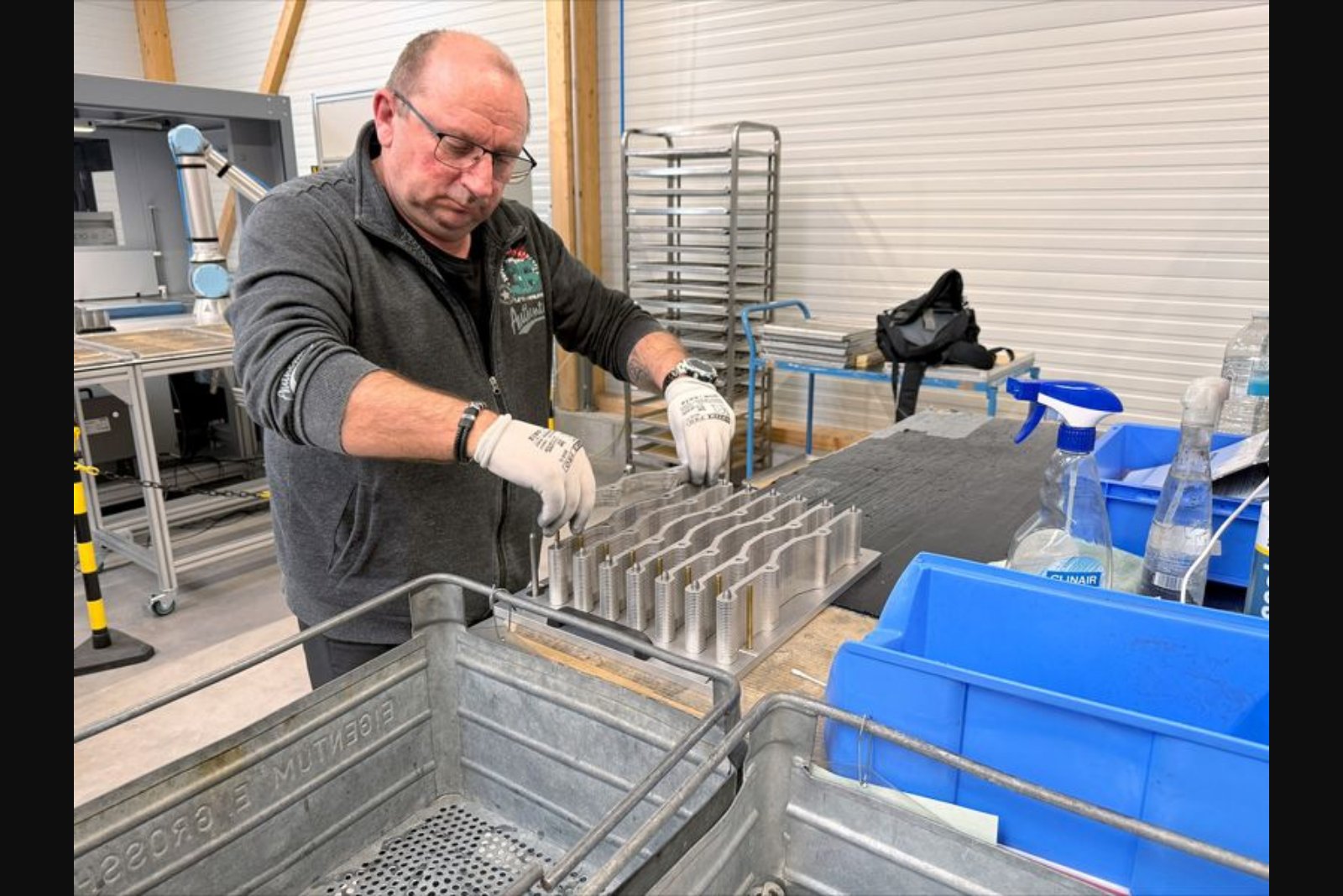
In the town of Moessingen, south of Stuttgart, a once-rapid expansion at Dostech - a niche supplier of sealant technologies - has slowed as the company’s fortunes became tied to the ebb and flow of the automotive sector. The business pivoted in 2018 after an influx of customer interest from vehicle manufacturers triggered a major electric-transport project. That decision initially produced fast growth and enabled Dostech to purchase the building it now uses for its headquarters. Today, however, the move has left the firm vulnerable to an auto industry that is struggling.
"This area is shaky," director and co-founder Steffen Braun said. "It is no longer as stable and it’s hard to make investments." Dostech has reduced headcount and seen revenues linked to automakers decline.
Those pressures are reflected more broadly across Baden-Wuerttemberg, a state preparing for an election on March 8 where economic issues top voters’ concerns. For decades the region’s identity has been intertwined with heavyweight carmakers such as Mercedes and Porsche. Now the combination of intensifying competition - particularly from China - an uneven transition to electric vehicles and rising input and operating costs has unsettled the sector. Reduced demand in the automotive supply chain is squeezing hundreds of smaller manufacturers and creating risks for jobs and the financial health of local municipalities.
Export exposure and structural shifts
Baden-Wuerttemberg is more exposed than most regions to the structural change reshaping German industry. It is Germany’s leading exporting region, accounting for 15.5% of national exports, and manufacturing contributes 38.1% of the state’s gross value added, in contrast with 28.5% for the country as a whole. These concentrations have amplified the economic effects of disruptions in global trade and sectoral realignment.
Official statistics indicate the state’s economy contracted by 0.4% in 2024, a sharper decline than the 0.2% drop recorded for Germany overall. Although the national economy returned to modest growth later, Baden-Wuerttemberg is expected to have contracted again, highlighting an uneven recovery.
External trade pressures have compounded the woes. Ifo economist Robert Lehmann pointed to U.S. tariffs and broader trade dislocations as particularly painful for export-oriented states with a large automotive footprint. "Baden-Wuerttemberg is a classic example," he said, identifying the state as vulnerable to the consequences of altered trading relationships.
Rising insolvencies and labour market strains
Signs of mounting distress are tangible. Insolvency proceedings in Baden-Wuerttemberg rose for a second consecutive year to 2,445 cases in 2024, an increase of 30% and the highest level since 2010, according to the state statistics office. A third straight annual increase is considered likely by local observers.
Cornelius Pleser, managing director of the valuation and asset-disposition firm Pleser KG, said demand for his services has surged in his home state. He noted a shift compared with a decade ago, when greater available capital often allowed investors or successors to be found in insolvency proceedings. Today, he said, the number of companies without a viable succession plan is "alarmingly high." That trend raises the probability of permanent closures rather than restructurings that preserve local industrial capacity.
Matthias Bianchi, public affairs lead at the DMB, which represents Germany’s small- and medium-sized enterprises, described a contagion effect: "There is a domino effect. This crisis in the lead industries slowly trickles down."
While unemployment in Baden-Wuerttemberg has remained below the national average, it has risen from 3.9% in January 2023 to 4.8% in January 2026. Economists attribute the relatively muted rise partly to labour hoarding - firms retaining workers despite weakening demand because of concerns over replacing skilled staff later. Braun explained that the employees they have trained are difficult to replace quickly, and that internal staff reassignments can turn into an "odyssey" of paperwork, shifting contacts at authorities and long waits for approvals.
Other labour indicators point to weakening dynamics. Hanno Kempermann, economist and managing director of IW Consult, said job vacancies in Baden-Wuerttemberg have fallen by 30% compared with 2022, and he noted plans by companies to cut 14,000 automotive jobs by 2030. "The situation is very tense," Barbara Resch, head of the IG Metall trade union in the state, said. Suppliers that invested heavily in electromobility are now facing a shortfall in demand and mounting financial pressure.
IG Metall, which represents workers at firms including Mercedes and Volkswagen, is negotiating protections such as arrangements for shortened working hours to avert mass layoffs. Resch warned that the downturn is affecting apprenticeship opportunities and placing highly qualified workers at appreciable risk.
An asymmetric regional economy
Despite the contractions in the automotive supply chain and among export-heavy industrial firms, other segments in Baden-Wuerttemberg are expanding strongly. Bianca Schmitz, founding director of the Hidden Champions Institute at ESMT Berlin, described an asymmetry within the state’s economy: while traditional manufacturing faces headwinds, companies in automation and robotics, medtech, and software and IT are among the faster growers.
The state’s heavy emphasis on innovation is evident in its research footprint. Baden-Wuerttemberg accounts for more than a quarter of Germany’s total research-and-development spending, and R&D investment amounts to about 5.7% of the state’s GDP - nearly double the national average. Those figures underline how the region’s economic model relies on innovation-intensive industries and applied research, which may provide pathways for adjustment even as legacy industries downshift.
Policy choices and local impacts
The slowdown’s effects are visible not just in major urban centres like Stuttgart and Sindelfingen but also in smaller towns and villages, where layoffs at a single supplier can ripple through local budgets and services. Friedrich Heinemann, an economist at the ZEW economic institute, noted that residents perceive the impact when municipal facility hours are cut or childcare fees rise.
Five economists interviewed by regional outlets urged caution about government intervention. They argued that subsidising uncompetitive firms to keep them afloat would be a mistake, a stance also expressed by Reint Gropp, president of the Halle Institute for Economic Research (IWH). Gropp said the economy needs to allow a competitive process - where newer ideas and business models supplant older, less viable ones - to proceed.
That leaves policymakers with a question: how should the next state government respond to revive growth while acknowledging that propping up failing firms is not the preferred route? Business leaders and many local owners converge on a practical agenda: invest in core infrastructure. They cite ultra-fast internet, improved roads and rail networks as critical enablers to attract investment and support structural change.
At the federal level, Chancellor Friedrich Merz’s government approved a 500 billion euro fund last year and reformed states’ borrowing rules. Yet economists say the planned funds have not yet begun to flow meaningfully. Of the 100 billion euros designated for the states, Baden-Wuerttemberg is to receive 13 billion euros, with 8.7 billion euros earmarked for municipalities, Kempermann noted. He described that allocation as "a bit like a drop in the ocean," insufficient to eliminate infrastructure deficits accumulated over two decades.
Heinemann suggested state budgets should be aligned with investments that underpin medium- and long-term growth - focusing on education, roads, digital networks and R&D. Schmitz summed up the strategic stakes: "We need to look into what Baden-Wuerttemberg is doing and whether they manage this very structural change. It is at the forefront of what is currently happening in Germany."
As the March election approaches, the region’s economic disquiet is shaping political discourse. Chancellor Merz’s conservative party is still viewed as likely to win, but economic anxiety and a diminished sense of regional pride are creating fertile ground for political narratives that tap into frustration. For a region whose identity has been bound to automotive prowess, managing the trade-offs between allowing market-led restructuring and shoring up the conditions for new growth will be central to its next chapter.