
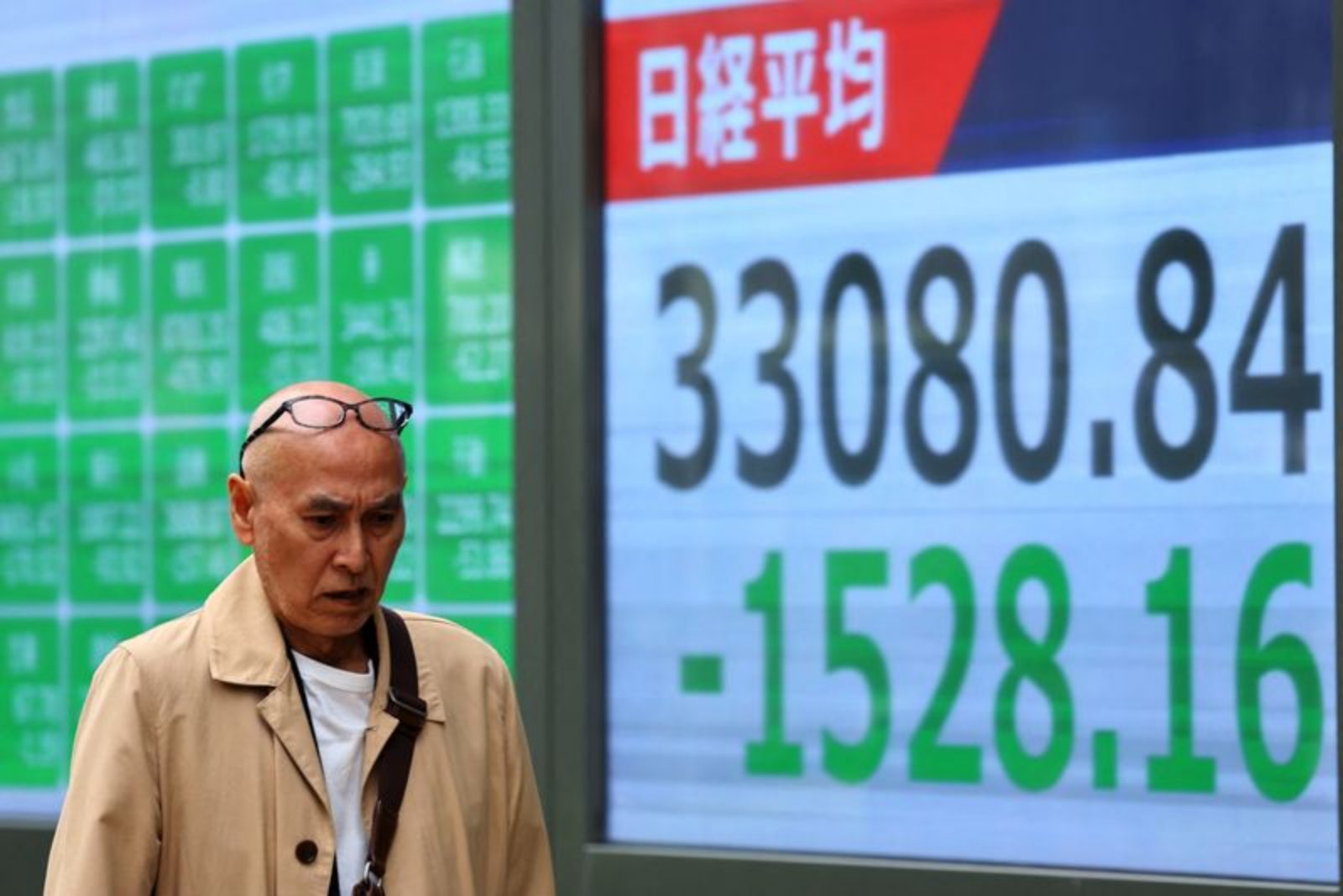
Equity markets across Asia opened the trading day in a downbeat mood on Friday as concerns over stretched valuations in technology stocks and unresolved geopolitical risks in the Middle East weighed on investor confidence.
Following a rally in U.S. tech earlier in the week, Japanese stocks moved lower in tandem with Wall Street after investors appeared unimpressed by what had been widely regarded as strong results from AI-focused chipmaker Nvidia. At the same time, the yen strengthened against the dollar and U.S. government bond yields declined, while gold held its ground after a two-day advance.
Market attention was divided between corporate earnings and diplomatic developments. An Omani official involved in mediating talks between the United States and Iran provided an upbeat assessment of recent discussions, but participants and market observers noted there was no clear breakthrough that would definitively remove the risk of potential U.S. strikes.
"AI and geopolitics remained front and centre for financial markets, prompting a retreat from risk assets and a shift towards safe havens," Mantas Vanagas, senior economist at Westpac Group, wrote in a note. He added that without major progress in the U.S.-Iran negotiations, crude oil markets were adopting a wait-and-see stance and continued to price in a material risk of military escalation between the two countries.
Indexes and major movers
MSCI’s broadest index of Asia-Pacific shares outside Japan fell 0.4% on the session, while Japan’s Nikkei index declined 0.8%.
Investors had anticipated Nvidia would deliver strong results given its prominent role in the AI sector. The company posted quarterly results that beat expectations for the January period and provided a current-quarter revenue forecast above consensus. Nonetheless, U.S. equity markets finished lower and Nvidia’s stock was flat in after-hours trading, a reaction some analysts attributed to the stock’s elevated valuation.
"It seems 'the Street' simply wanted more, or perhaps just isn’t prepared to chase the stock at its current lofty valuation," IG market analyst Tony Sycamore commented in a note regarding the company’s quarterly performance.
In derivatives trading during Asian hours, U.S. equity futures were softer, with S&P 500 E-minis down 0.41% and Nasdaq 100 E-minis weaker by 0.36%.
Fixed income, currencies and commodities
Currencies moved toward perceived safe-haven status while Treasury prices rose. The dollar index, which tracks the greenback against a basket of currencies, inched up 0.04% to 97.77. The euro was largely unchanged at $1.1797 and sterling held at $1.3482. The yen firmed by 0.2% to 155.86 per dollar.
Yields on U.S. Treasuries retreated slightly, with the 10-year note yield down 1.5 basis points at 4.002% and the 30-year yield slipping 1.3 basis points to 4.6565%.
Spot gold eased 0.23% to $5,175.03 an ounce, while U.S. crude oil ticked up 0.09% to $65.27 a barrel.
Geopolitical developments
Omani Foreign Minister Sayyid Badr Albusaidi said in a post on X that the United States and Iran plan to resume negotiations over Tehran’s nuclear program following consultations in their capitals after meetings held in Switzerland that day. While the Omani readout was characterized as optimistic, market participants noted that until clear, substantive progress is announced there remains a risk that tensions could prompt military action, a scenario markets are still pricing into energy and risk asset valuations.
Analysts observed that any tangible diplomatic advancement could reduce the probability of a threatened U.S. strike on Iran and alleviate concerns about an escalation into a broader conflict. Until such a shift is confirmed, oil and other energy-linked assets are likely to remain sensitive to the diplomatic timeline.
Regional economic and policy notes
Domestically, Japan released data showing cooler inflation in Tokyo and factory output that came in weaker than expected, raising questions about the near-term case for further policy rate hikes by the Bank of Japan. The data emerged shortly after Prime Minister Sanae Takaichi nominated two candidates to the central bank board who share her fiscally dovish stance.
In China, the central bank announced it will remove foreign exchange risk reserves for certain forward contracts, a policy shift intended to lower the cost of buying dollars. The yuan had recorded its largest annual gain versus the dollar since 2020 last year, moving past the psychologically important 7-per-dollar benchmark, and that upward trend carried into the current year.
Political watch in Britain
A closely observed by-election in Gorton and Denton, Greater Manchester, could have political implications in Britain. Polling indicated the contest was too close to call among Labour, Reform UK and the Greens. A defeat for Labour could increase pressure on Prime Minister Keir Starmer amid criticism over a series of recent policy reversals.
Cryptocurrencies
In digital assets, bitcoin slipped 0.3% to $67,290.45 and ether declined 0.68% to $2,016.78.
Market participants continue to balance the strong corporate earnings seen in parts of the technology sector against geopolitical risks and regional policy signals, a combination that has left risk appetite cautious and safe-haven assets firm.