
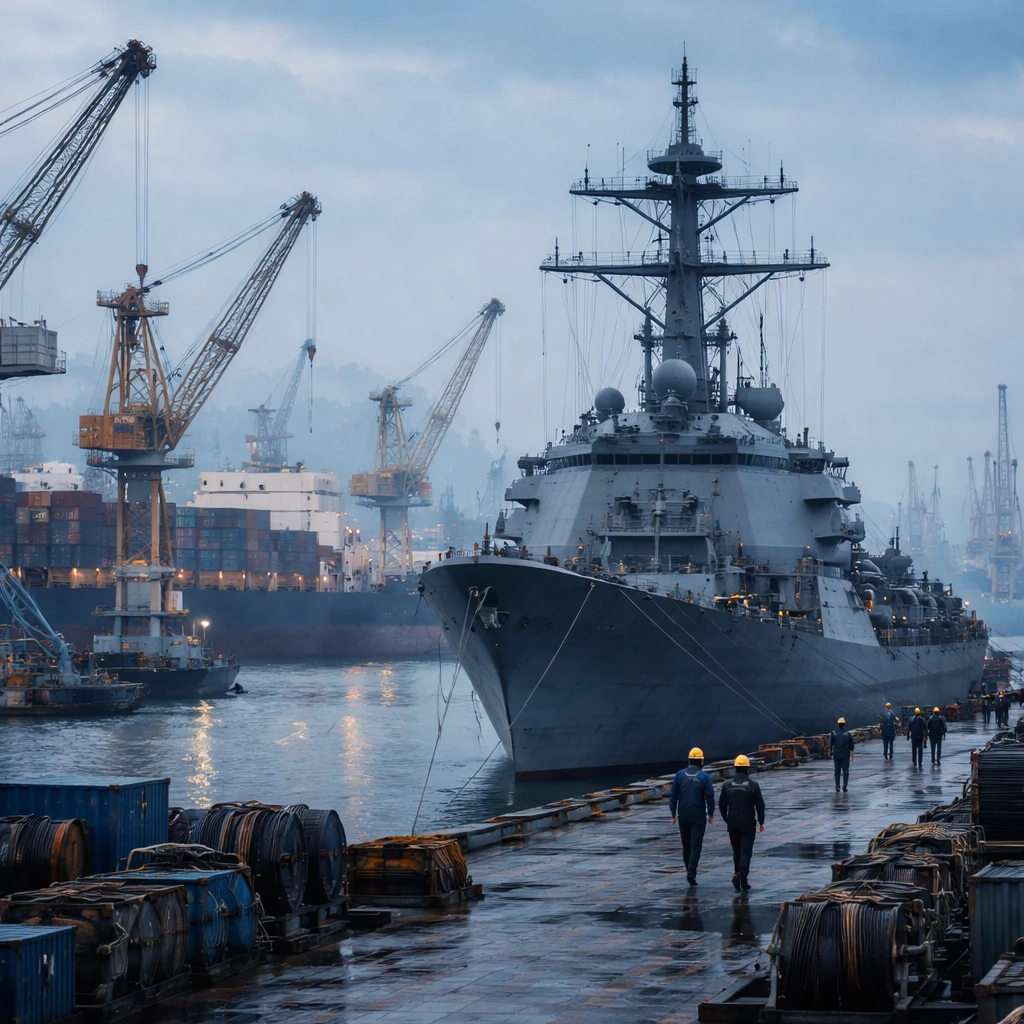
Shares of defense and heavy-equipment makers in Asia moved higher on Monday after a weekend of military action involving the U.S., Israel and Iran sparked concerns that unrest in the Middle East could persist.
In Japan, aircraft and missile manufacturers advanced, with Mitsubishi Heavy Industries, Ltd. (TYO:7011), Kawasaki Heavy Industries, Ltd. (TYO:7012) and IHI Corp. (TYO:7013) each rising in a band between 0.1% and 4%.
Chinese aerospace and shipbuilding names also climbed. CSSC Holdings Ltd (SS:600150) added 0.5%, Avic Shenyang Aircraft Co Ltd (SS:600760) increased about 4%, and AECC Aviation Power Co Ltd (SS:600893) jumped roughly 6%.
Meanwhile in Australia, shipbuilder Austal Ltd (ASX:ASB) surged 4%, as the sector broadly outperformed declines across Asian equity markets.
The market moves followed a series of weekend strikes in the region. The U.S. and Israel conducted attacks on Iran, and Iran responded with attacks on Israel and on several other U.S.-aligned countries in the Middle East. U.S. President Donald Trump said on Sunday evening that Washington will continue attacking Iran until all "objectives are achieved."
Iran’s National Security Council Chief, Ali Larijani, rejected media reports that Tehran had reached out to Washington and said the country will not enter negotiations with the U.S.
Analysts and market participants often see defense equities as beneficiaries of heightened geopolitical risk because increased military activity can imply larger or more numerous defense contracts. Japanese contractors in particular have recorded notable gains in recent months, a trend that has been reinforced by Tokyo’s statements about increasing defense spending in coming years.
For investors evaluating individual stocks, some firms offer quantitative tools. One such service states it evaluates Austal Ltd (ASB) against thousands of companies each month using more than 100 financial metrics, applying machine-driven screening to identify potential opportunities. The service cites past winners including Super Micro Computer (+185%) and AppLovin (+157%) when describing its track record and suggests it can highlight whether ASB appears in any of its strategies or if alternative opportunities exist within the same sector.
Key points
- Defense and heavy-equipment stocks across Asia rose after renewed U.S.-Iran hostilities increased geopolitical risk.
- Japanese aircraft and missile makers climbed between 0.1% and 4%; several Chinese aerospace firms and an Australian shipbuilder recorded larger gains.
- Sectors affected include aerospace, shipbuilding and broader defense manufacturing, which can benefit from expectations of higher military contracting.
Risks and uncertainties
- Further escalation in the Middle East could amplify market volatility across regional equities and defense-related sectors.
- Official statements from U.S. and Iranian leaders point to a continued standoff, creating uncertainty for supply chains and defense procurement planning.
- Despite recent gains, broader Asian markets declined, indicating sector outperformance is not uniform and macro risks persist.