
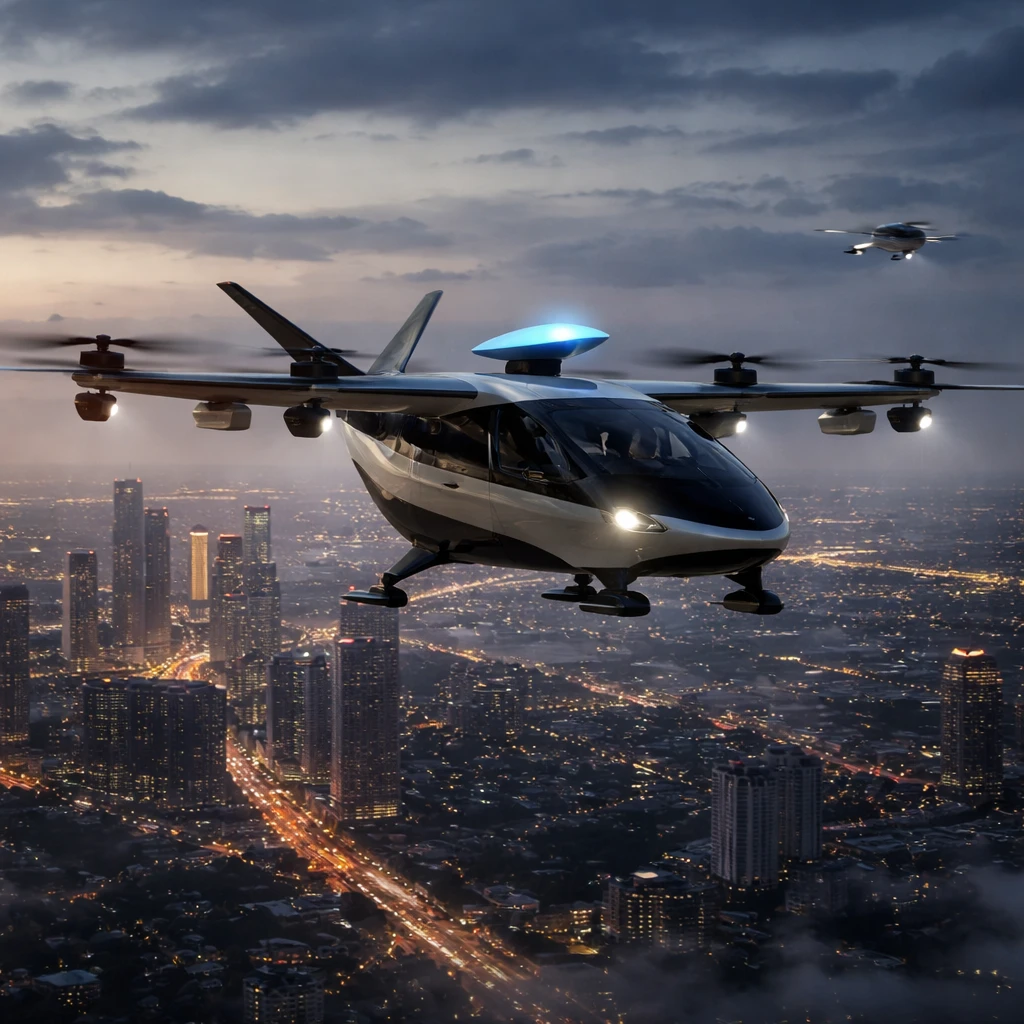
Archer Aviation Inc. (NYSE:ACHR) announced on Friday that it has entered a partnership with Elon Musk’s Starlink to bring satellite-based, high-speed internet connectivity to the company’s Midnight air taxi.
Under the agreement, Archer will install Starlink’s low-Earth-orbit satellite internet system on its Midnight aircraft and perform testing to validate connectivity during air taxi operations. The Starlink system is intended to offer high-speed, low-latency internet service while Midnight is in flight.
Midnight is a piloted electric air taxi engineered to carry up to four passengers and to operate with lower noise and emissions compared with a conventional helicopter. Archer has built redundant systems into Midnight, including a total of 12 engines and propellers distributed across the aircraft.
Beyond providing onboard internet access for passengers, Archer says it will use Starlink to facilitate communications between Midnight, pilots and engineering teams on the ground. The company views the satellite link as a component of its broader air taxi connectivity infrastructure, and Archer and Starlink have agreed to collaborate on a connectivity solution intended to support the company’s future work on autonomous aircraft.
Starlink’s low-Earth-orbit constellation differs from traditional aircraft connectivity methods that rely on ground towers or geostationary satellites. According to the companies, the system is designed to maintain consistent, high-bandwidth coverage even at lower flight altitudes and in dense urban environments, where cellular networks can be unreliable. Those characteristics are cited as relevant for air taxi operations that may take place at approximately 1,500 feet above ground.
Adam Goldstein, founder and CEO of Archer, said, "Connectivity is a must have feature for Midnight. Starlink is uniquely built to deliver it. This industry-first collaboration will enable seamless, high-speed connectivity and essential amenities for our passengers and pilots." Archer plans for Midnight to transport passengers across cities in roughly 5-15 minutes, and Starlink is expected to provide continuous high-speed connectivity during those trips.
The announcement comes while Archer awaits regulatory approval to begin commercial operations. The integration and testing program is positioned as a step toward establishing reliable in-flight connectivity and communications capabilities as the company advances toward service launch.
Summary
Archer will equip its Midnight piloted electric air taxi with Starlink’s low-Earth-orbit internet service and carry out in-flight testing. The collaboration targets passenger Wi-Fi, operational links between aircraft and ground teams, and a joint effort to build connectivity solutions that could support future autonomous aircraft development. Archer remains pending regulatory permission to start commercial flights.
Key points
- Archer will install and test Starlink’s satellite internet on Midnight to provide high-speed, low-latency connectivity during flights - affecting the aviation and telecom sectors.
- Starlink is intended to support both passenger amenities and operational communications between aircraft, pilots and engineering teams on the ground - relevant to urban mobility and aerospace operations.
- The two companies plan to collaborate on connectivity that could enable Archer’s future autonomous aircraft efforts - impacting autonomous systems development and aircraft software stacks.
Risks and uncertainties
- Archer is still awaiting regulatory approval to begin commercial operations; regulatory timing and outcomes could affect commercialization - impacting the aviation sector and investor expectations.
- The partnership requires in-flight installation and testing of Starlink on Midnight to validate performance at operational altitudes; successful testing is a prerequisite for deployment - affecting aerospace integration timelines.
- Work to develop connectivity solutions that support future autonomous aircraft is described as a planned collaboration rather than a completed capability, leaving uncertainty about timelines and technical outcomes - relevant to autonomous vehicle developers and systems suppliers.