
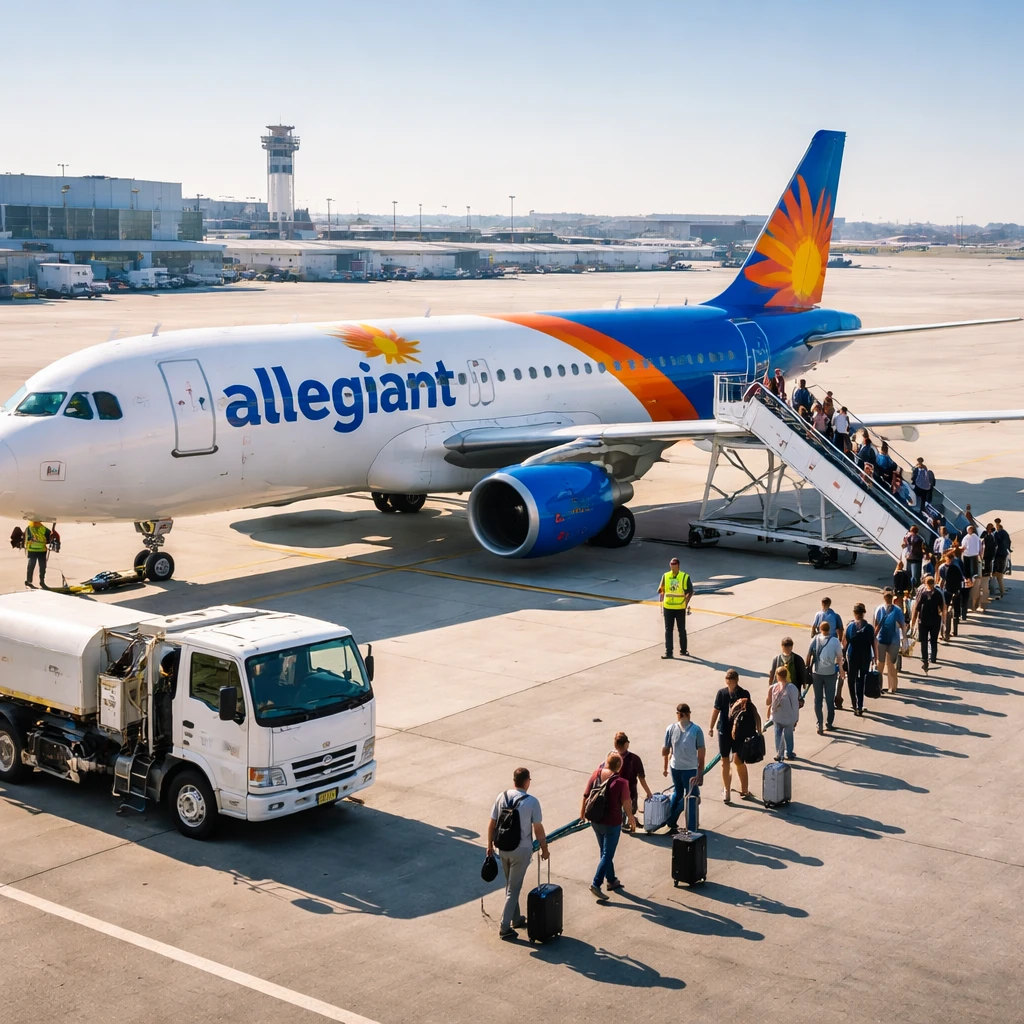
Shares of Allegiant Travel Company advanced 6% on Thursday after the carrier revised upward its guidance for adjusted earnings per share for the first quarter.
The company now projects adjusted EPS in a range of $3.25 to $3.75 for the quarter, an increase from its prior guidance of $2.50 to $3.50. Management attributed the stronger outlook to a demand environment that outperformed the company’s earlier expectations.
At the same time, Allegiant raised its fuel cost assumption for the quarter. The airline now estimates first-quarter fuel expenses at roughly $3.00 per gallon, up from the previous guidance of $2.60 per gallon.
The concurrence of a higher EPS outlook with an increase in projected fuel costs indicates that revenue performance during the period was sufficient to outweigh the additional fuel expense assumption. The company’s upward revision on profits, despite the reset in fuel assumptions, points to demand and revenue trends that were better than anticipated in the prior guidance.
This update has direct implications for stakeholders tracking the airline and travel sectors, and it also intersects with energy cost trends through the higher fuel projection. Investors reacted positively to the news, lifting the stock by 6% on the trading day the company disclosed the changes.
Summary
Allegiant raised its first-quarter adjusted EPS guidance to $3.25-$3.75 from $2.50-$3.50, citing stronger-than-expected demand. The company also increased its fuel cost estimate to approximately $3.00 per gallon from $2.60. The market responded with a roughly 6% gain in the stock on the announcement.
Key points
- Allegiant lifted first-quarter adjusted EPS guidance to $3.25-$3.75, up from $2.50-$3.50.
- First-quarter fuel cost projection was revised to about $3.00 per gallon, versus prior guidance of $2.60 per gallon.
- Shares rose 6% after the company said demand exceeded its expectations; developments affect the airline and travel sectors and relate to energy cost trends.
Risks and uncertainties
- Higher fuel cost projection - increased fuel assumptions raise cost pressure for the airline sector and can affect margins.
- Reliance on demand outperformance - the improved EPS outlook is tied to demand that outpaced expectations, making results sensitive to changes in travel demand.