
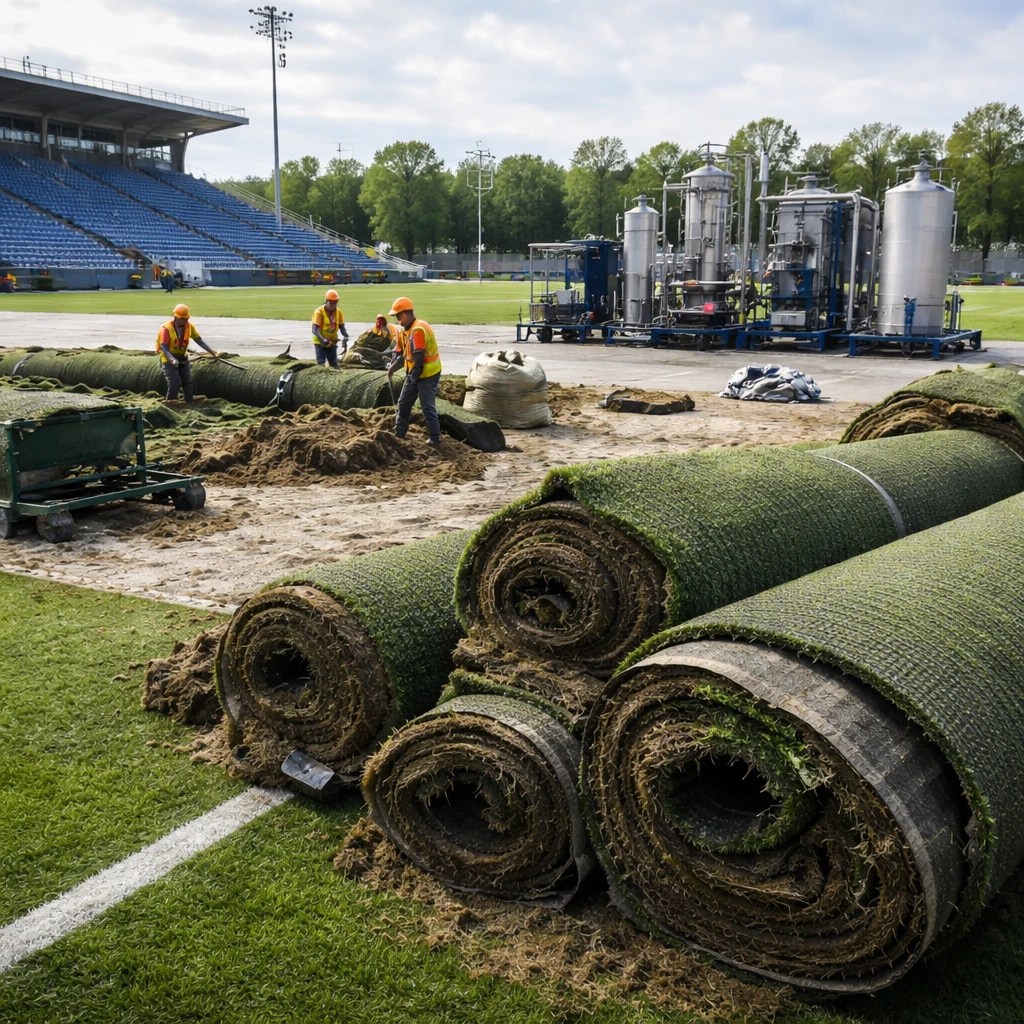
Aduro Clean Technologies Inc. stock rose 4% on Tuesday after the company disclosed a Memorandum of Understanding (MOU) with AstroTurf Corporation to jointly evaluate the application of Aduro's Hydrochemolytic Technology to recycled synthetic turf.
Under the MOU, the two companies will examine whether the combination of Aduro's chemical process and mechanical pre-treatment can extract PE and PP fractions from end-of-life synthetic turf and convert those polyolefins into liquid hydrocarbon products that could serve as circular feedstock for petrochemical infrastructure.
Synthetic turf assemblies include components made from polyethylene and polypropylene - such as the grass blades, thatch, and backing layers - that are challenging to reclaim. Those components are frequently bonded with other materials like cured polyurethane backing and are contaminated by infill, sand, rubber, and field-use debris, factors that complicate recovery.
Laboratory testing previously conducted by Aduro showed selective conversion of PE and PP components into shorter-chain hydrocarbons. Those products, according to the company, are suitable for additional upgrading or potential use as steam-cracker feedstock.
The collaborative work outlined in the MOU will focus on the full chain of steps needed to prepare the polyolefin-rich fraction for assessment by Aduro's technology. That pathway starts with field recovery and disassembly of used turf, continues through de-infill and separation of non-target materials, and includes the cleaning of the recovered PE/PP fraction.
"This collaboration with AstroTurf allows Aduro to work directly with a recognized name in synthetic turf to better understand the full end-of-life challenge," said Ofer Vicus, Chief Executive Officer of Aduro.
The MOU is an agreement to evaluate and does not set commercial deployment terms or create any definitive commercial arrangement. Any future commercial, licensing, supply, or joint development relationship would require separate definitive agreements between the parties.
Key points
- Aduro and AstroTurf signed an MOU to assess recycling of end-of-life synthetic turf using Hydrochemolytic Technology plus mechanical pre-treatment.
- Work will address recovery, de-infill, separation, and cleaning of PE/PP fractions for conversion into liquid hydrocarbon products suitable for petrochemical feedstock.
- Sectors impacted include synthetic turf/waste management and petrochemical feedstock markets.
Risks and uncertainties
- The MOU does not constitute a definitive commercial agreement; future commercial terms would require separate definitive contracts - affecting potential near-term commercialization.
- Recovery is complicated by embedded and bonded materials such as cured polyurethane backing and contamination from infill and field use, which may impede separation and cleaning processes.
- Technology assessment depends on successful preparation of a polyolefin-rich fraction from field-recovered material, a step that requires effective disassembly, de-infill, and cleaning procedures.