
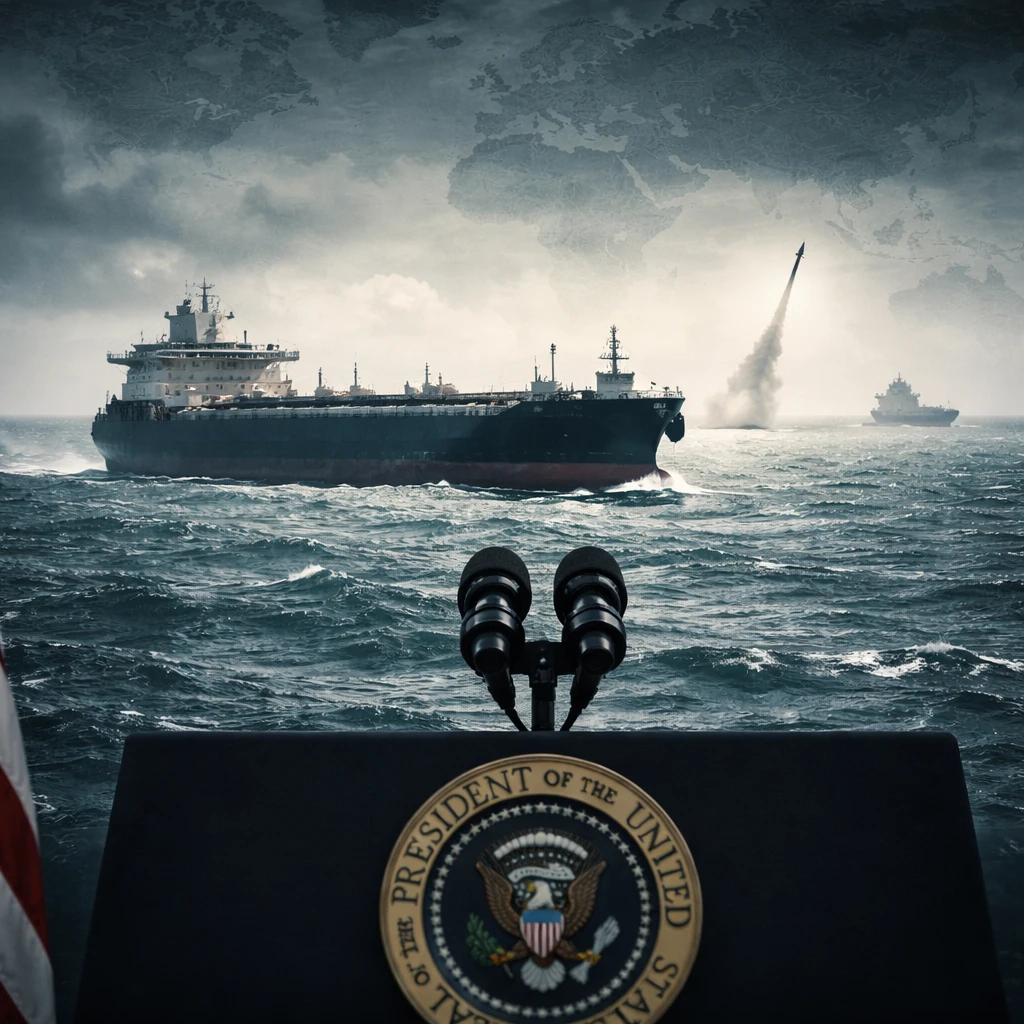
Wolfe Research analysts say recent comments from U.S. President Donald Trump point to an early effort to disengage from the Iran conflict. In a Tuesday note, Tobin Marcus interprets the president's public remarks as the first tangible step toward what the firm had long expected would become the conflict's endgame.
Marcus writes that Trump "made his first move toward what we’d argued would be the endgame… declaring victory and trying to walk away," following a market rally that followed the president's statement that "the war is very complete, pretty much."
At a press conference, Trump combined assertions about U.S. military success with caution about future action. Marcus describes the president's delivery as a "triumphal but mixed message," noting that Trump both claimed U.S. forces had degraded and destroyed Iran's missile, drone, and naval capabilities and said the war "would not end this week."
Trump also warned he would devastate Iran's civilian infrastructure if threats to the Strait of Hormuz continue.
Wolfe says President Trump may be moving toward an off-ramp faster than the firm had modeled. Marcus notes the team had "took the under on the 4- to 5-week timeline" the president had previously mentioned, but did not expect him to "start steering toward an off-ramp quite as soon as Day 9."
Whether U.S. forces will actually be able to secure an early end to hostilities hinges heavily on Tehran's calculus, according to Marcus. He cautions that "it's too soon for Iran to accept a ceasefire on Trump’s terms," pointing to Iranian leaders' vows that "not one litre of oil" will flow through the Strait if U.S. strikes continue. That threat, Marcus warns, means the conflict could persist if Iran can still threaten shipping.
Marcus adds a market-focused caveat: "If the US can't get the Strait reopened through military coercion, the other policy steps under consideration could help somewhat, especially an SPR release." He outlines one specific option under consideration, saying, "A globally coordinated SPR release in the 400MMbbl range would be material, potentially offsetting ~20 days of Strait shipments."
The Wolfe note frames the recent presidential statements as a potential pivot toward de-escalation, while stressing the substantial role Iran's response will play in determining whether an off-ramp is feasible. Markets and shipping remain sensitive to the status of the Strait of Hormuz, and policy tools such as coordinated SPR releases are being evaluated for their capacity to mitigate supply disruptions.
The situation remains fluid: Trump signaled both a belief in significant U.S. military impact on Iranian capabilities and a willingness to consider ending U.S. involvement, but Iran's stated intent to threaten shipping and the practical limits of military options mean that a firm resolution is not yet assured.