
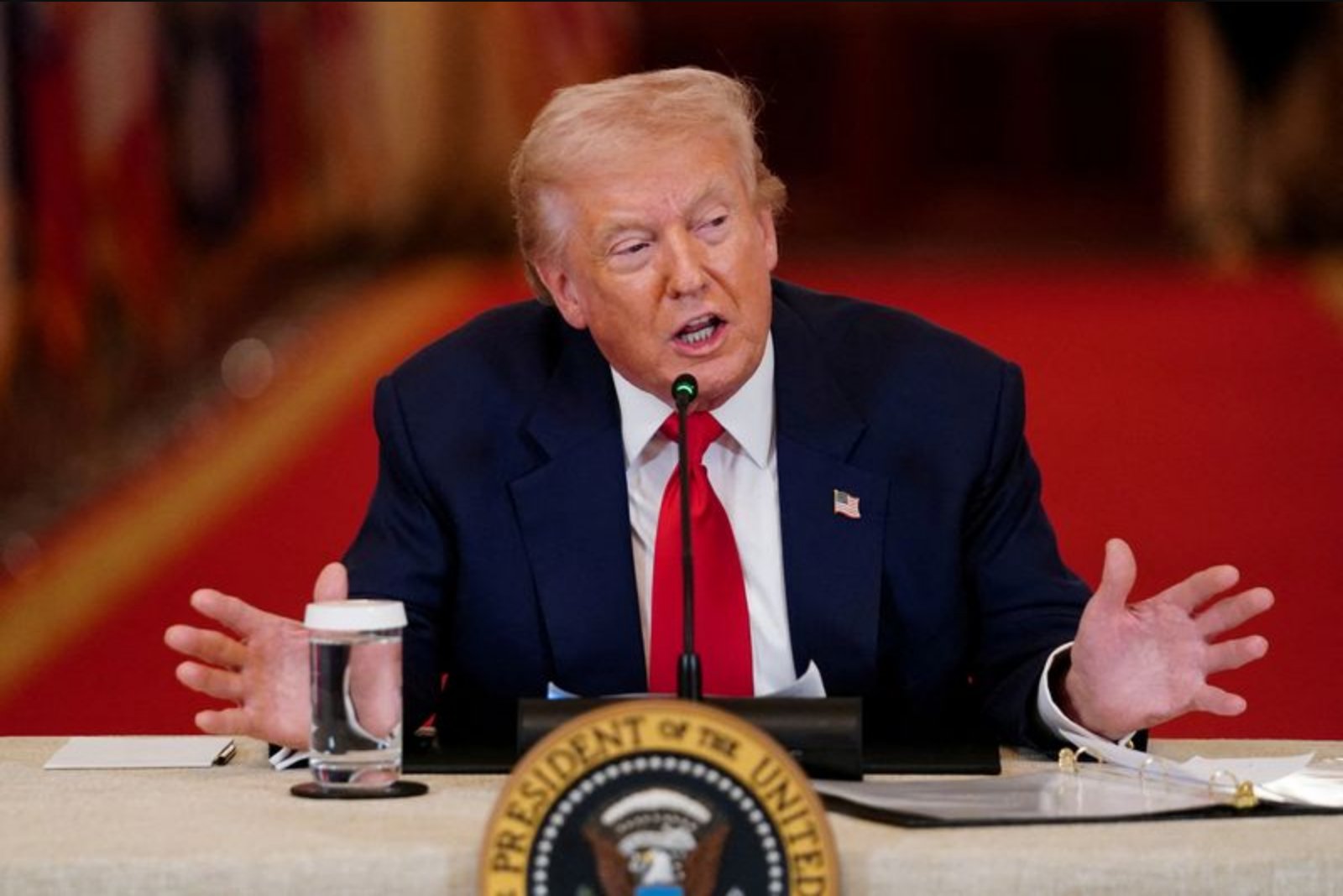
The Justice Department on Friday asked the U.S. Court of Appeals for the District of Columbia Circuit to reinstate executive orders issued by President Donald Trump that targeted four prominent U.S. law firms, saying lower-court judges exceeded their authority when they blocked the directives.
In its filing, the department criticized the trial judges and said they had "bent over backwards" to invalidate the orders against Perkins Coie, WilmerHale, Jenner & Block and Susman Godfrey without giving proper weight to the constitutional powers the president exercises, particularly in matters tied to national security and other domains the administration characterized as within executive authority.
The firms that sued to block the directives argued the president’s actions amounted to unlawful retaliation. They said the orders improperly targeted them because of their representation of clients who are political opponents of the president or who had challenged his policies in court, or because the firms employed lawyers who had participated in prior investigations involving the president.
Trump’s directives sought two main outcomes: to limit the ability of lawyers from the four firms to access federal buildings and to terminate U.S. government contracts held by clients of those firms. Federal judges issued orders permanently blocking the president’s measures after finding constitutional violations - concluding that the directives infringed on First Amendment protections against government abridgment of speech and violated Fifth Amendment due process guarantees.
The Justice Department’s appeal request was filed after a brief procedural reversal by the administration. The department moved on Monday to abandon its appeals of the judicial rulings but then changed course the next day, prompting the current filing in the D.C. Circuit. The Friday submission provides the administration’s first formal legal argument explaining why it believes the orders should be reinstated.
WilmerHale responded to the appeal by saying the firm disagreed with the government’s decision to pursue the appeal and that it would continue to defend both its clients and the firm. The administration, meanwhile, framed the dispute as a separation-of-powers issue, stressing that the litigation is "not about the sanctity of the American law firm" but about what it described as lower courts encroaching on the constitutional powers of the president in areas including national security.
Separate from the four firms subject to the challenged orders, nine other major law firms reached settlements with the administration last year to rescind or avoid similar actions. Those firms - including Paul Weiss, Skadden Arps, Latham & Watkins and Kirkland & Ellis - collectively agreed to provide nearly $1 billion in pro bono legal work to causes supported by the administration as part of their resolutions.
The administration faced a filing deadline on Friday to submit its opening appellate papers. The D.C. Circuit has not yet scheduled oral argument in the case to consider the government’s appeals.
Summary
The Justice Department has appealed to the D.C. Circuit seeking to revive executive orders from President Trump that targeted four law firms by restricting access to federal buildings and threatening clients' government contracts. Lower-court judges permanently blocked the orders on First and Fifth Amendment grounds. The administration had briefly moved to drop its appeals before reversing course and filing its legal rationale with the appeals court.
Key points
- The administration asked the D.C. Circuit to reinstate directives aimed at Perkins Coie, WilmerHale, Jenner & Block and Susman Godfrey, arguing the trial courts overstepped.
- Judges permanently enjoined the orders after finding violations of the First Amendment and Fifth Amendment due process protections.
- Nine other major firms negotiated settlements last year that led them to rescind or avoid similar actions and to pledge nearly $1 billion in pro bono work.
Sectors impacted
- Legal services - law firms directly targeted and firms that settled similar actions.
- Government contracting - clients of the targeted firms whose federal contracts might have been affected by the orders.
- Judiciary and administrative law - questions of separation of powers and judicial review.
Risks and uncertainties
- Legal uncertainty - the outcome of the appeals could reshape the extent to which courts review executive actions aimed at private entities; this could affect law firms and their clients that hold or seek government contracts.
- Contracting and compliance risk - clients of targeted firms faced the prospect of losing government contracts, which could disrupt services tied to those contracts.
- Reputational and operational risk for firms - targeted firms argued the orders were retaliatory based on their representation and staffing choices, introducing potential reputational costs and litigation exposure.
Next steps
The appeals court has yet to set a date for oral argument. The government’s Friday filing meets the administration’s deadline to submit opening appellate papers, and the D.C. Circuit will determine the schedule for further proceedings.