
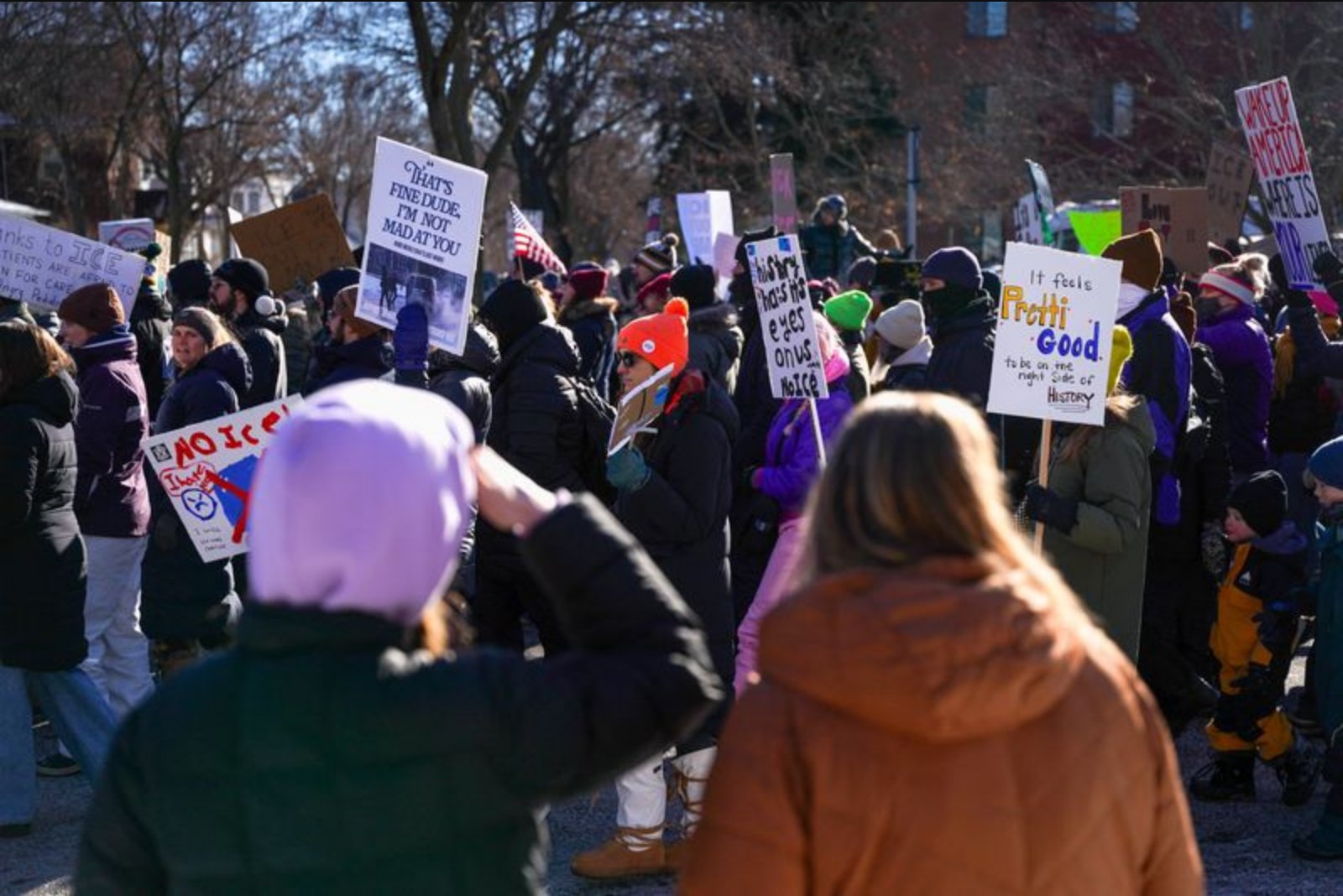
President Donald Trump said on Saturday that he has directed the Department of Homeland Security (DHS) to "under no circumstances" involve itself in protests in Democratic-led cities unless local authorities formally request federal assistance or federal property is threatened. The statement came amid renewed tensions over federal immigration enforcement operations in Minnesota and elsewhere.
The announcement follows weeks of demonstrations that intensified after the deployment of Border Patrol and U.S. Immigration and Customs Enforcement agents to Minnesota and the fatal shootings of two U.S. citizens, Renee Good and Alex Pretti, by federal agents who said they were responding to threats. Observers have highlighted bystander videos that call those self-defense claims into question. Video footage of Pretti's death, verified by Reuters, undercuts administration assertions that he had brandished a weapon before the officers shot him.
Activists and protesters opposed to the administration's immigration enforcement actions have been tracking immigration officers in Minneapolis and other communities, sometimes confronting them in public spaces. On social media, the president indicated that while DHS should avoid street-level confrontations with demonstrators and resist engaging during raids unless help is requested, ICE and Border Patrol will "act aggressively to protect federal buildings." "We will not allow our Courthouses, Federal Buildings, or anything else under our protection, to be damaged in any way, shape, or form," he wrote.
In his message the president placed responsibility for the security of state and local property on city and state officials, adding that municipal and state authorities must assist in protecting federal sites. He said the federal government will provide help if requested and that it would "take care of the situation very easily and methodically."
The moves come after thousands of demonstrators took to the streets of Minneapolis and other U.S. cities to press for the withdrawal of federal immigration agents from Minnesota, following the killings of Good and Pretti. The administration had previously deployed about 3,000 federal officers to the Minneapolis area as part of a broader crackdown on illegal immigration. Many of those officers encountered protesters and activists in the course of their assignments.
This episode is the latest instance of the administration using federal law enforcement or National Guard forces in cities largely governed by Democrats. Previous deployments have included officers or troops sent to cities such as Los Angeles, Chicago, Washington, D.C., and Portland, Oregon. The president has framed such deployments as necessary to enforce immigration laws and to control crime, a justification that municipal leaders in those cities have largely disputed.
Minnesota officials have publicly urged the administration to halt its immigration enforcement operations in the state. Separately, a federal judge on Saturday denied a request from Minnesota Attorney General Keith Ellison and other state officials for a preliminary injunction that would have paused the federal operation.
Key points
- The president ordered DHS to avoid engaging with protesters in Democratic-led cities unless federal help is requested or federal property is threatened.
- Federal immigration enforcement operations in Minnesota - including a deployment of roughly 3,000 officers - and the deaths of Renee Good and Alex Pretti have driven protests and scrutiny of federal tactics.
- The administration signals federal officers will protect courthouses and federal buildings aggressively, while placing responsibility for state and local property protection on city and state officials.
Sectors potentially affected: municipal government operations and local public safety budgets, federal law enforcement resource allocation, and sectors tied to public order and security contracting.
Risks and uncertainties
- Ongoing public protests and clashes with federal agents create uncertainty for municipal services and local governance in affected cities, with implications for municipal budgeting and operations.
- Disputes between federal and local authorities over deployments and enforcement tactics could lead to legal challenges or further judicial actions that affect the timing and scope of federal operations; such decisions may have downstream effects on federal contracting and security spending.
- The potential for continued unrest in areas with federal deployments could influence insurance and liability exposures for public events and property in affected municipalities.
Legal and political context
City and state officials remain divided with the administration over the presence and role of federal immigration agents in local communities. Minnesota's elected officials have sought to curb the federal operation in the state; a bid by Attorney General Keith Ellison and others to secure immediate judicial relief was rejected by a federal judge on Saturday.
What remains unclear
The president's instruction sets a threshold for DHS involvement tied to requests for assistance or threats to federal property, but it does not specify operational details about how that directive will be implemented across different jurisdictions or enforcement contexts.
None.