
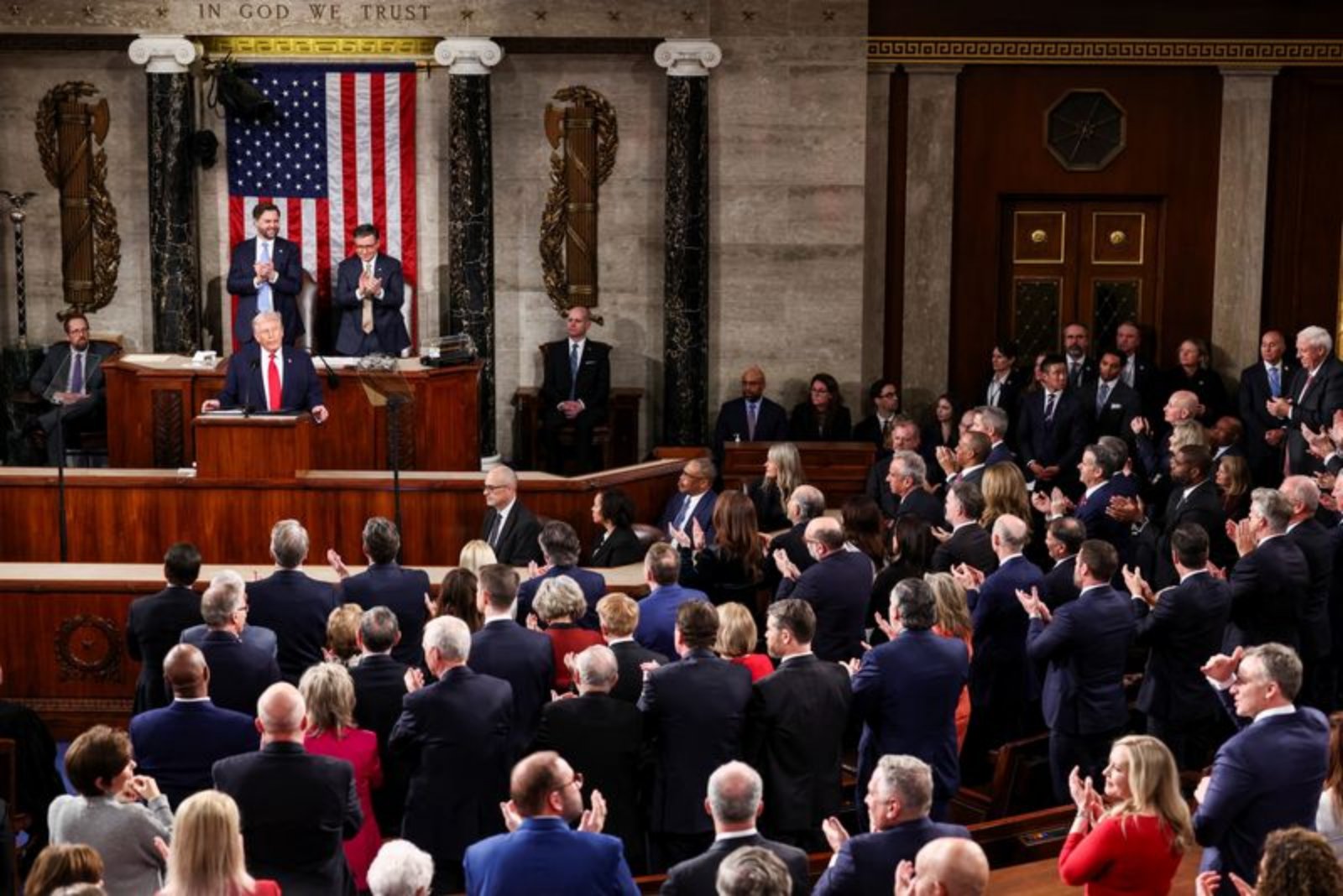
WASHINGTON - President Donald Trump used Tuesday night’s State of the Union address to cast his administration as the architect of what he called the "golden age of America," presenting a portrait of economic success even as public sentiment about his presidency has cooled.
Speaking before a joint session of Congress, Trump spent much of the first hour of the event focused on economic themes that Republicans have pressed to counter growing voter unease ahead of November’s midterm elections. He credited his administration with slowing inflation, lifting the stock market to record highs, signing sweeping tax cuts and lowering drug prices.
But the administration’s optimistic framing faces headwinds in public opinion and in recent economic releases. A Reuters/Ipsos poll cited during the week found that just 36% of Americans approve of Trump’s handling of the economy. New economic data released on Friday showed the economy slowed more than expected last quarter while inflation accelerated, and prices for groceries, housing, insurance and utilities remain substantially higher than a few years ago.
"Our nation is back - bigger, better, richer and stronger than ever before," Trump declared upon taking the chamber's podium, receiving chants of "USA, USA" from Republican members of Congress. The president’s entry also highlighted the partisan divisions in the room: dozens of empty seats on the Democratic side reflected lawmakers who skipped the address to attend anti-Trump rallies outside the Capitol.
For Republican members worried about retaining control of Congress, the televised speech was an opportunity to re-emphasize economic gains. Yet whether Trump’s account will ease voter anger over affordability is uncertain. In his remarks, he sought to shift blame for high prices onto his Democratic predecessor, Joe Biden. Polling noted in recent days suggests many voters nonetheless assign responsibility to Trump for not doing more to address the cost-of-living pressures after he had campaigned heavily on that issue.
The annual address came at a politically fraught moment. Polls indicate a majority of Americans have soured on Trump’s overall performance, anxieties about potential conflict with Iran have grown, and the president’s signature tariff policy suffered a setback when the U.S. Supreme Court struck down most of his import taxes.
Throughout much of the speech the president appeared unusually disciplined, generally adhering to his prepared remarks and avoiding his characteristic stream-of-consciousness digressions. Still, he reverted to a combative tone when addressing immigration, prompting several exchanges of shouted remarks with Democratic members of the chamber.
Spectacle and personal honors were woven into the address. Trump boasted of the administration’s "winning" before introducing several invited guests who had accomplished recent triumphs. Members of the U.S. men’s ice hockey team, who entered the chamber wearing the gold medals they won at the Winter Olympics on Sunday, drew applause. The president announced that the team’s goaltender, Connor Hellebuyck, would receive the Presidential Medal of Freedom - one of roughly half a dozen medals presented to guests during the event with notable fanfare.
The 79-year-old president’s remarks stretched to approximately an hour and 47 minutes, eclipsing the length of his address from the previous year and setting a new record for the longest presidential address to Congress.
No new clarity on Iran emerged from the address. While Trump asserted that inflation is "plummeting," he acknowledged broader foreign policy concerns in measured terms. He said his "preference is to solve this problem through diplomacy," referring to the situation with Iran, but also warned that he would not allow what he called "the world’s No. 1 sponsor of terror" to obtain a nuclear weapon. Beyond that statement, he offered no detailed plan for addressing the escalating tensions that have raised questions about the prospect of military conflict.
On trade, the president was restrained in his public remarks after the Supreme Court’s decision the previous Friday that struck down much of his tariff policy. Trump described the ruling as "unfortunate" yet told the chamber that it would have limited long-term impact on his trade agenda. He greeted the four justices present with handshakes as he entered the room and otherwise avoided personal attacks on the court during the speech.
Notably absent from the address were substantive discussions of artificial intelligence and extended foreign policy detail. Trump gave scant attention to Ukraine despite the speech taking place on the fourth anniversary of Russia’s invasion, and he did not address China or Greenland - territories and nations he has previously highlighted. He also reiterated an assertion that he had "ended" eight wars, a claim the administration has made before and that drew note during the remarks.
The speech highlighted deep partisan divisions on immigration, a topic that has animated Trump’s presidential campaign. He reiterated rhetoric that ties undocumented migrants to a wave of violent crime - language the address presented without the studies cited in public debate to the contrary. During his remarks, he chastised Democrats for refusing to provide funding for the Department of Homeland Security unless changes are made to curb what he described as overly aggressive tactics by immigration agents working under his administration.
At one point, he addressed Democrats directly: "You should be ashamed," he said, in the context of criticizing elected officials who oppose his immigration enforcement approach. The moment sparked heated exchanges, including from Democratic Representative Ilhan Omar of Minnesota, who shouted across the chamber, "You have killed Americans!" as Trump praised his enforcement record.
The immigration focus comes after incidents that have shaped public perceptions of federal enforcement. Opinion polling referenced during the week indicated a majority of Americans believe the administration’s crackdown has gone too far, a shift that followed the fatal shootings of two U.S. citizens by masked federal agents in Minneapolis.
Election integrity and voting rules were another flashpoint. Trump repeated long-standing claims about rampant election fraud and criticized Democrats for opposing a voter identification requirement. "They want to cheat," he said, arguing for stricter verification measures. Democrats counter that such legislation would create unnecessary barriers and potentially suppress turnout.
The address also included pointed protest actions from Democratic lawmakers. Representative Al Green was removed from the chamber for the second straight year after displaying a sign reading "Black people aren’t apes," referring to a social media video the White House later removed after it showed a clip depicting former President Barack Obama and former first lady Michelle Obama as apes. The White House said the video had been posted by a staffer. Green, who is Black, had also been ejected during last year’s address after shouting at the president.
Other, more understated forms of protest appeared during the speech. Representative Jill Tokuda, a Democrat from Hawaii, wore a white jacket bearing words such as "affordability" and "healthcare" to underscore the economic concerns raised by many voters. Several Democratic women wore tags urging authorities to "release the files," a reference to the scandal surrounding convicted sex offender Jeffrey Epstein. Approximately a dozen Epstein accusers attended the address as guests of Democratic lawmakers.
Outside the chamber, Democrats staged protests, and Virginia Governor Abigail Spanberger delivered the party’s official response. Spanberger, a Democrat who had recorded a decisive victory in November that party strategists cited as an early midterm warning sign for Republicans, criticized the president’s approach to economic policy and support for struggling Americans. "Is the president working to make life more affordable for you and your family?" she asked rhetorically in her remarks. "We all know the answer is no," she said.
Looking ahead to November, Democrats are aiming to take control of both houses of Congress. All 435 seats in the House of Representatives are on the ballot, and about a third of the 100 Senate seats will be contested. Republican lawmakers, mindful of the political outlook, appeared intent on using the State of the Union as a platform to underscore the administration’s economic message to voters.
As the midterm calendar advances, the State of the Union provided a window into how the president and his party plan to frame the policy debate in the months ahead - emphasizing economic accomplishments while confronting persistent concerns over inflation, affordability and foreign policy uncertainty.