
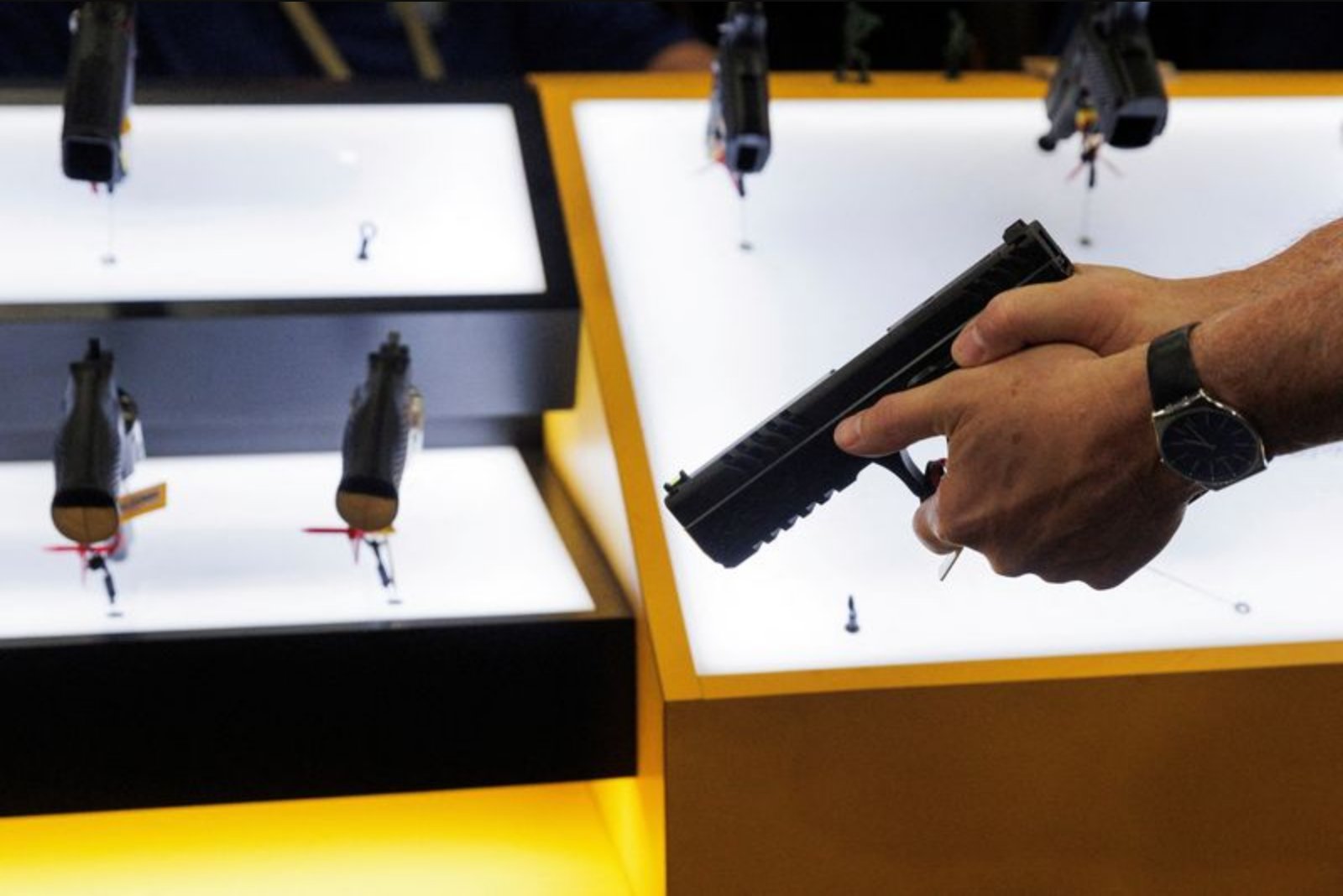
The U.S. Supreme Court on Monday will take up a challenge to a federal law that bars people who are unlawful users of controlled substances from possessing firearms, the latest high-profile test of the Second Amendment right to "keep and bear arms." The case arrives after a lower appeals court dismissed an illegal-possession charge against Ali Hemani, an American-Pakistani dual citizen and Texas resident who told authorities he was a regular marijuana user.
Hemani was charged in 2023 after an FBI raid on the Denton County home he shared with his parents uncovered a Glock 9mm pistol, marijuana and cocaine. Authorities say Hemani told them he used marijuana about every other day; prosecutors did not assert he was intoxicated at the time of the search. The indictment against him included a single count under the Gun Control Act of 1968, which makes it illegal for any person who "is an unlawful user of or addicted to any controlled substance" to possess a firearm.
In filings, the Justice Department cited other facts that it says drew FBI attention to Hemani, including travel to Iran and his brother's attendance at an Iranian university. But the criminal charge itself rested solely on the statutory prohibition in the 1968 law.
Legal challenge and lower-court ruling
Hemani moved to dismiss the indictment on Second Amendment grounds, invoking the Supreme Court's 2022 framework that requires firearm regulations to be "consistent with the nation’s historical tradition of firearm regulation" in order to survive constitutional scrutiny. In January, the New Orleans-based 5th U.S. Circuit Court of Appeals granted that motion and dismissed the illegal-possession charge, finding that "there is no historical justification for disarming a sober citizen not presently under an impairing influence."
Following that decision, the Justice Department appealed to the Supreme Court, urging the justices to permit prosecutions under the 1968 statute against what it characterizes as "habitual users" of unlawful drugs. The government argued the gun prohibition is analogous to historical laws from the 1800s that allowed authorities to temporarily disarm "habitual drunkards," and asked the high court to adopt a rule that would allow comparable firearm possession charges against repeated users of unlawful controlled substances.
Defense arguments
Hemani's lawyers, supported by the American Civil Liberties Union, countered in court papers that regular marijuana users are not equivalent to the "habitual drunkards" referenced in historical statutes and that the law's reference to an "unlawful user" is unconstitutionally vague. They warned lower courts have been left "struggling to determine how frequent, prolonged, and substantial use must be," arguing that the statute fails to provide adequate clear standards for enforcement.
Statutory and regulatory context
The dispute over the 1968 statute intersects with the Controlled Substances Act's system of scheduling illegal drugs. Under that law, substances are organized into tiers called "schedules." Marijuana is listed as a Schedule I substance alongside heroin, ecstasy and peyote, a classification that reflects a determination the drug has high potential for abuse and no currently accepted medical value. Separately, the White House under President Donald Trump signed an executive order in December instructing the attorney general to move quickly to consider reclassifying marijuana.
Wider judicial backdrop
The case arrives amid ongoing national debate over how to address persistent firearms violence, including frequent mass shootings. The Supreme Court, which has a 6-3 conservative majority, has in recent years taken broadly protective stances toward gun rights in major decisions. Earlier this year the court also heard arguments in another significant Second Amendment case concerning a Hawaii law that restricts carrying handguns on private property open to the public without the owner’s permission; during those January arguments the court's conservative justices signaled skepticism toward the restriction.
How the justices resolve the Hemani appeal could shape the scope of federal prosecutions under the 1968 law and clarify the application of the Second Amendment framework adopted in 2022. The high court's ruling may address whether historical analogues to modern prohibitions exist and whether the statutory language provides constitutionally adequate guidance for enforcement.
Case specifics retained by the record
- Hemani, an American-Pakistani dual citizen living in Texas, was charged in 2023 after an FBI search found a Glock 9mm, marijuana and cocaine.
- The single indictment count cited the Gun Control Act of 1968, which forbids firearm possession by anyone who "is an unlawful user of or addicted to any controlled substance."
- The 5th U.S. Circuit Court of Appeals dismissed the charge in January, saying there is no historical basis to disarm a sober citizen not under an impairing influence.
- The Justice Department has asked the Supreme Court to allow convictions for "habitual users" of unlawful drugs, drawing an analogy to 19th-century laws aimed at "habitual drunkards."