
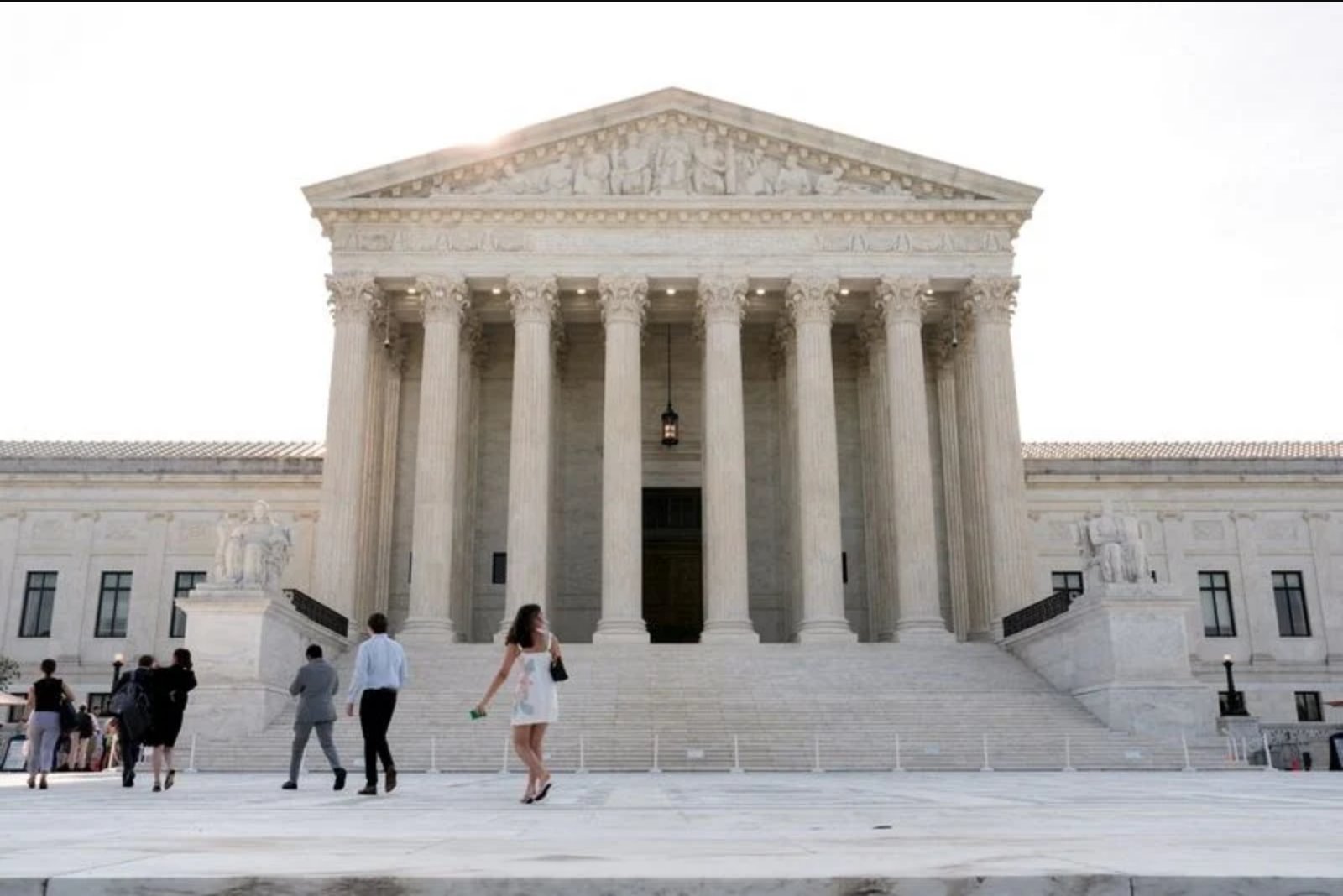
In a term marked by frequent clashes between the White House and the courts, the U.S. Supreme Court issued a series of consequential rulings this week that both rebuked and empowered President Donald Trump. On Tuesday, the court rejected the administration’s effort to narrow who qualifies as a U.S. citizen by birthright, a clear legal defeat for the president. But in a separate decision issued just one day earlier, the justices substantially strengthened presidential authority by removing a longstanding barrier to at-will dismissal of leaders of independent agencies.
The court, which sits with a 6-3 conservative majority, closed a nine-month term that featured a heavy concentration of disputes tied to the Trump administration and its policy agenda. Over the course of the term, the justices handed the president three notable defeats - on his global tariff program, on his attempt to deny birthright citizenship to some children born in the United States, and on his effort to remove a member of the Federal Reserve Board of Governors - while also approving a wide-ranging expansion of executive power in other cases.
Legal scholars and observers have characterized the term as one in which the Supreme Court has generally deferred to the executive branch on matters of immigration and national security, but has pushed back in instances where the administration’s positions lacked apparent legal grounding or raised the prospect of serious economic disruption.
"The Trump administration has pushed a robust vision of executive power, which the court has largely embraced," said Robert Luther III, a law professor at George Mason University. That deference, however, was not uniform across all disputes this term.
Emergency actions and the shadow docket
The term was notable for the volume of emergency decisions the justices issued through their so-called shadow docket - a mechanism in which the court makes rapid rulings outside its normal, full-briefing-and-argument process. In those cases the court frequently allowed the administration to put contentious policies into effect while lower-court litigation continued.
Through such expedited actions, the conservative majority permitted several aggressive policies to proceed. These included immigration enforcement actions that the court allowed to target individuals on the basis of race or language, cuts to certain National Institutes of Health grants focused on research involving racial minorities or LGBT people, and a restriction on passport applicants selecting the sex that matches their gender identity for the document.
Beyond shadow-docket interventions, the court also issued fully argued decisions favorable to administration positions, including rulings that made it easier for the federal government to restrict immigration in various contexts.
Recent wins for the administration on immigration
In decisions announced last week, the conservative justices voted, over the dissent of liberals, to make it easier to deport or deny entry to certain migrants, including people with previously recognized legal statuses. Those rulings enabled the administration to strip hundreds of thousands of Haitian and Syrian immigrants of humanitarian protections that had shielded them from deportation.
Turning point on agency independence - Humphrey's Executor overturned
On Monday, the court issued a watershed decision that many legal experts said materially enlarges presidential control over the federal bureaucracy. The majority overruled Humphrey's Executor v. United States, a precedent dating back to 1935 that had protected certain officials at independent agencies from being removed by the president without cause.
By reversing that doctrine, the court cleared the way for the president to remove leaders of independent regulators more freely, firmly vesting executive levers of power under presidential control. That change had long been a priority for conservative legal activists seeking greater presidential oversight of agencies.
Critics warned that the decision could accelerate the politicization of federal agencies Congress had intended to staff with nonpartisan experts, and could increase cyclical swings in regulatory policy tied to partisan control of the White House. The liberal justices dissented and delivered stark criticisms of the ruling.
"The court gives the president a power unknown even to the English Crown against which the Founders revolted," Justice Sonia Sotomayor wrote, joined by Justices Elena Kagan and Ketanji Brown Jackson.
Cornell Law School professor Gautam Hans described the outcome as "the triumph of decades of conservative advocacy." He added that, despite several losses, the administration likely views the shift as a major win.
Adoption of administration legal positions in other cases
Legal observers also noted the court's willingness to adopt legal reasoning advanced by the administration even in matters where the president was not an original party but participated as an amicus - a friend of the court. A notable example was the April ruling that significantly narrowed enforcement of a key provision of the Voting Rights Act. In that 6-3 decision, the conservative majority made it harder for minority voters to challenge electoral maps as racially discriminatory under the 1965 civil rights law.
The decision created a path for Republican-led Southern states to reconfigure districts that had been majority-Black or majority-Latino, changes that could affect the partisan composition of congressional delegations ahead of the November midterm elections. Plaintiffs representing minority communities, who tend to support Democratic candidates, could face greater hurdles in contesting such redistricting moves.
Major defeats and limits on economic authority
Despite the court's general deference on many executive actions, the justices handed the president two significant setbacks that curtailed his authority over economic policy. In February, Chief Justice John Roberts wrote the 6-3 opinion striking down the administration's expansive use of global tariffs that had been imposed under a statute intended for national emergencies. That ruling represented a rebuke to the president's attempt to deploy trade tools broadly on an economic front.
The tariff decision prompted a sharp reaction from the president, who singled out the six justices who ruled against him - including two he had appointed - in unusually personal language. He said, "I think it’s an embarrassment to their families, you wanna know the truth, the two of them," referring to Justices Neil Gorsuch and Amy Coney Barrett.
In a separate loss, the court on Monday declined to permit the president to remove a member of the Federal Reserve Board of Governors, preserving a measure of central bank independence that limits direct presidential influence over monetary policy through personnel changes.
Birthright citizenship ruling
On Tuesday the court ruled that the president's executive order seeking to deny birthright citizenship to children of certain immigrants was inconsistent with the 14th Amendment's language conferring citizenship to those born in the United States who are "subject to the jurisdiction thereof." That decision represented a clear judicial check on the administration's attempt to redefine a constitutional guarantee.
George Mason University law professor Luther called the birthright citizenship ruling "wrongly decided" and "a catastrophic loss," adding, "Its consequences will be felt throughout the country for decades to come." He also said the administration has largely been rewarded for pursuing an ambitious vision of executive power and encouraged continued efforts on that path, given the court's record.
Overall assessment of the term
Across the term the court's conservative majority has frequently sided with the administration, whether through rapid shadow-docket decisions or through fully litigated opinions. That pattern stands in contrast to the court's treatment of the previous Democratic administration, where scholars note the justices were more inclined to rule against presidential assertions of power.
Syracuse University College of Law professor Jenny Breen observed that exceptions to the court's deference have arisen when the administration's position appeared to be far removed from legal justification or when the court feared serious disruption to markets or the broader economy.
As the court concludes its current term, its rulings have produced a mixed but transformative outcome for executive authority: clear constraints in areas such as trade and one aspect of independent Federal Reserve governance, alongside an historic expansion of the president's supervisory powers over independent agencies. Those developments will continue to shape legal and policy disputes with potential consequences for regulatory stability, immigration enforcement, voting rights litigation and the boundaries of presidential authority.
Reporting for this analysis incorporated direct quotations and judicial outcomes announced during the court's recent term. The decisions discussed reflect the court's formal rulings and the public comments of legal scholars who evaluated them.