
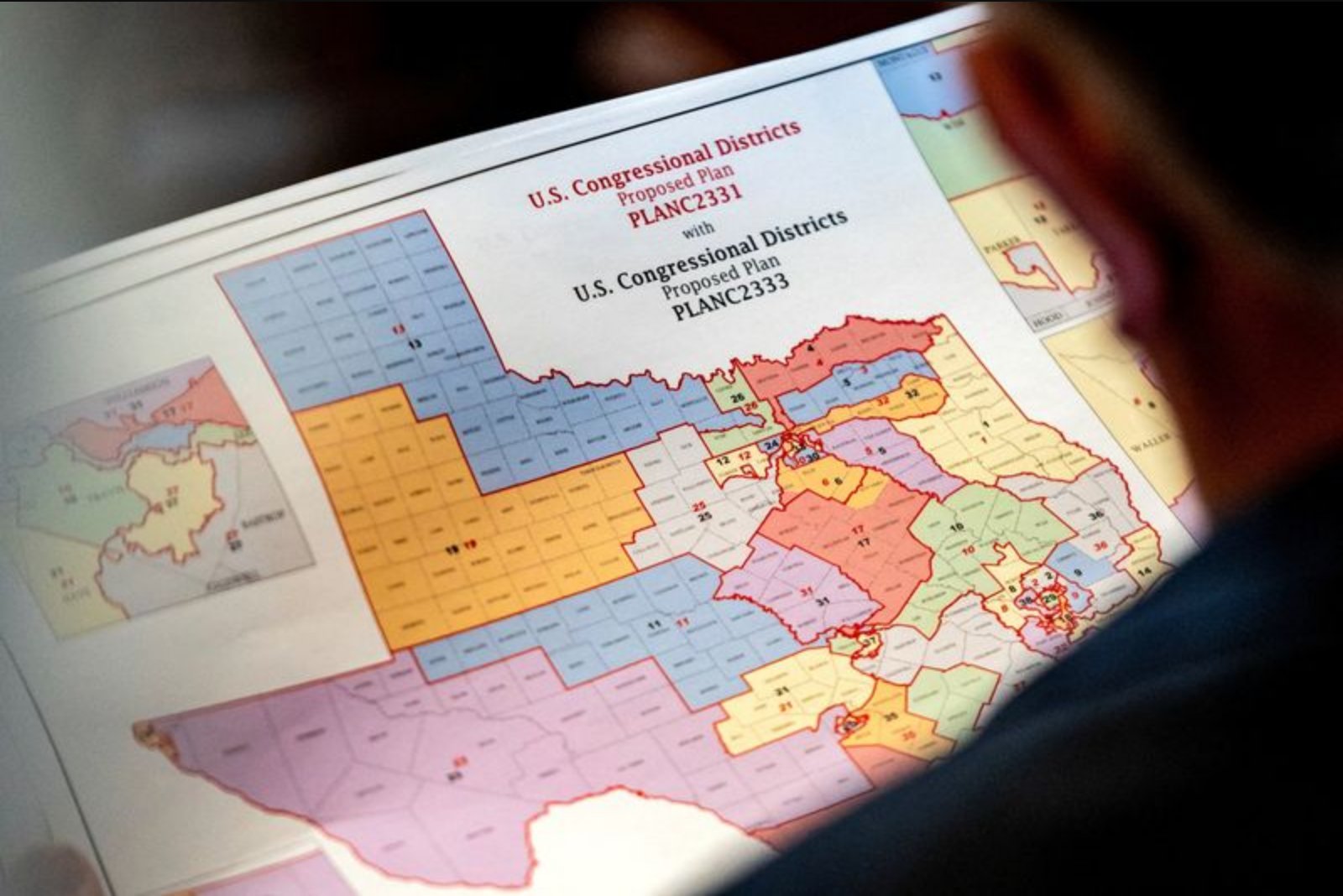
The demand by former President Donald Trump that Republican-governed states redraw congressional boundaries to help his party preserve its slim House majority has sparked a campaign of map changes and legal fights across the country. The push began in July when Texas Republicans approved an uncommon mid-decade revision to the state's congressional map intended to flip five Democratic-held seats. California, led by Democrats, responded with its own redistricting plan aimed at up to five Republican incumbents, and other states under both parties' control have moved to alter districts as well.
Republicans initially looked to have the upper hand, but Democratic-led efforts have cut into that advantage. Given the GOP won the House in 2024 by only a three-seat edge, outcomes in individual districts could determine control of the chamber in November.
How the contest is playing out state by state
TEXAS - Up to five seats
The U.S. Supreme Court in early December cleared the way for a new Republican-backed map in Texas that targets five Democratic-held districts. The court issued a 6-3 ruling that overturned an earlier lower court finding that the map likely discriminated against minority voters, with the three liberal justices dissenting. Governor Greg Abbott signed the map into law in August. Prior to the vote, more than 50 Democratic lawmakers temporarily fled the state to block the measure but later returned. Under the Republican-drawn map adopted in 2021, Republicans already controlled 25 of Texas' 38 U.S. House seats.
MISSOURI - One seat
Governor Mike Kehoe signed a new map in September that dismantled a Democratic-held seat based in Kansas City, shifting the partisan balance so Republicans would have the advantage in seven of the state's eight congressional districts. Opponents are seeking to force a voter referendum on the map, and multiple organizations have filed lawsuits contesting its legality.
OHIO - Up to two seats
A technicality in state law required a new map for 2026 because the previous plan had been approved without any Democratic votes. The state's redistricting commission, comprised of five Republicans and two Democrats, unanimously approved a compromise map in October. That agreement enhanced Republican prospects of flipping as many as two Democratic-held districts while stopping short of the most aggressive changes Democrats feared. Republicans currently control 10 of Ohio's 15 seats.
NORTH CAROLINA - One seat
The Republican-led state legislature approved a new map in October crafted to flip a Democratic-held seat. If successful in November, the change would give Republicans control of 11 out of North Carolina's 14 U.S. House districts, despite the state's status as a politically divided battleground. Under state law, the Democratic governor, Josh Stein, had no formal role in the redistricting process.
FLORIDA - Possibly two to five seats
Governor Ron DeSantis has called a special legislative session for late April to consider redrawing congressional boundaries. Analysts cited in state reporting say the effort could target three to five Democratic incumbents. It remains unclear whether there is sufficient support within the Republican-controlled legislature to enact new U.S. House districts. Legal hurdles also exist: any new map would face a state constitutional amendment that bars the legislature from drawing districts solely for partisan gain. Republicans already hold 20 of Florida's 28 seats after a 2022 map enacted by DeSantis and the legislature flipped four Democratic districts.
INDIANA - Effort failed
In a notable internal Republican rebuke, Indiana's GOP-controlled Senate declined to approve a proposed map aimed at flipping the state's only two Democratic U.S. House seats. The rejection leaves Republicans in control of seven of the state's nine congressional districts.
KANSAS - Effort failed
Kansas Republicans abandoned a Trump-supported push to redraw the state's congressional map after the state House speaker, Republican Dan Hawkins, said in January there was not sufficient backing in his chamber to overcome a likely veto from Democratic Governor Laura Kelly. Republicans currently hold three of Kansas' four U.S. House seats.
Democratic-led responses and legal turns
CALIFORNIA - Up to five seats
Voters in California overwhelmingly approved a map backed by Governor Gavin Newsom and Democratic lawmakers that is aimed at flipping as many as five Republican-held U.S. House seats. The change was adopted explicitly as a response to the Texas map. Democrats now hold 43 of the state's 52 congressional districts.
VIRGINIA - Possibly four seats
In January, the Democratic-controlled Virginia legislature approved a constitutional amendment that would authorize lawmakers to redraw the state's congressional map. The amendment must be approved by voters at a special election scheduled for April 21. A Virginia judge blocked the amendment process in late January after finding procedural defects raised by Republicans, prompting an appeal by Democrats to the state Supreme Court. That court ruled the April referendum could proceed while the legal challenge moves through the courts. A later separate order by Judge Jack Hurley in February again tried to block the referendum, but the state Supreme Court on March 4 ruled the vote may go forward while the underlying challenge is considered. Democrats hold six of Virginia's 11 U.S. House seats, and they have proposed a map intended to produce a 10-1 advantage in November.
UTAH - One seat
A state judge struck down a Republican-drawn map as unlawfully partisan and put in place an alternative that is likely to flip one of Utah's four Republican-held seats to Democratic control.
MARYLAND - Effort stalled
Democrats in the Maryland state House advanced a new map in February that targeted the state's lone Republican member of Congress, a plan backed by Governor Wes Moore and national Democratic leaders. Democrats already occupy the state's other seven House districts. However, the move faced internal opposition: state Senate President Bill Ferguson, a Democrat, opposed the bill, making its prospects for enactment unlikely.
NEW YORK - Possibly one seat
In January, a New York judge ordered the state's independent redistricting commission to redraw a Republican-held congressional district centered on Staten Island, potentially giving Democrats an opening to flip the seat in November. The U.S. Supreme Court's conservative majority placed that ruling on hold on March 2 after the Republican incumbent, Nicole Malliotakis, sought relief. Democrats currently hold 19 of New York's 26 congressional seats. While Governor Kathy Hochul has pledged a response to Texas' new map, New York law prevents any statewide redistricting initiative until 2027.
Where things stand and what remains uncertain
Across Republican and Democratic states alike, redistricting debates have produced a mixture of enacted maps, court interventions, internal party pushback and stalled efforts. Some states have seen maps signed into law by governors or approved by voters. Others face ongoing litigation, judicial reversals, or internal legislative resistance that could keep proposed changes from taking effect.
With the national House majority held by a margin of three seats, each successful map change that flips even a single district could shift the balance of power. The outcome in individual states therefore takes on heightened importance for national politics ahead of the November midterms.