
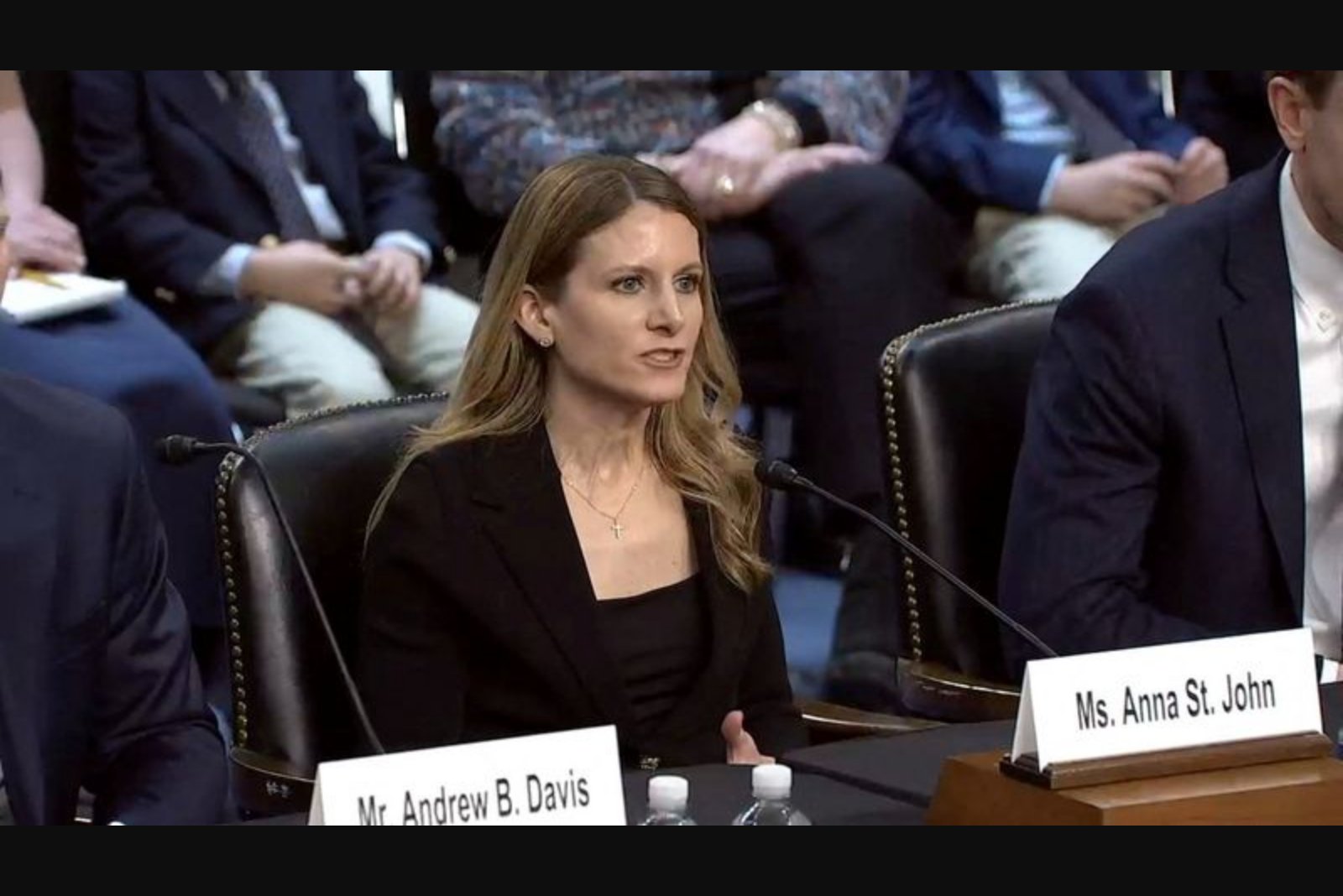
The U.S. Senate on Tuesday approved a conservative legal activist to a federal judgeship in Louisiana, voting 51-45 to confirm Anna St. John to the U.S. District Court for the Eastern District of Louisiana. The confirmation came despite objections from Senate Democrats and criticism from a former Fox News anchor focused on testimony St. John gave opposing a ban on mandatory arbitration for workplace sexual assault and harassment claims.
St. John is currently the president and general counsel of the Hamilton Lincoln Law Institute. Her nomination was announced by Republican President Donald Trump in a January social media post that highlighted her record "of tirelessly fighting to protect Free Speech, champion Religious Liberty, and keep men out of women’s sports." The New Orleans-based attorney has been associated since 2015 with legal activist Ted Frank’s Center for Class Action Fairness, which is now part of the Hamilton Lincoln Law Institute, and she has worked on efforts contesting class action settlements the group says favor lawyers while delivering little relief to consumers.
Supporters in the Senate emphasized her legal qualifications. In a statement Tuesday, Republican Senator John Kennedy of Louisiana, a member of the Senate Judiciary Committee, said,
"She knows our Constitution like the back of her hand and has the smarts and experience to be a great, fair judge."
Opposition to St. John’s nomination came from Democrats including Senator Dick Durbin, the top Democrat on the Senate Judiciary Committee. Durbin, during a hearing earlier this month, criticized her record as reflecting a partisan ideology and said it raised serious questions about her capacity to administer justice impartially.
Durbin highlighted the public objection from former Fox News anchor Gretchen Carlson, who brought a high-profile lawsuit a decade ago accusing Roger Ailes, Fox News’ former chief executive, of sexual harassment - allegations Ailes denied prior to his death in 2017. Carlson authored an opinion piece published online January 29 by the Alliance for Justice Action in which she argued that St. John, when testifying before Congress, had sought to "gaslight" women pursuing the elimination of forced arbitration in the aftermath of the #MeToo movement.
The legislative measure at the center of that testimony was the bipartisan Ending Forced Arbitration of Sexual Assault and Sexual Harassment Act, which Congress passed in 2022. The law prevents employers from requiring employees who allege sexual assault or sexual harassment to resolve those claims only through arbitration, ensuring they retain the option to bring a court lawsuit.
St. John testified in November 2021 before the U.S. House Judiciary Committee opposing that bill. In a written submission to the committee she argued that arbitration can provide a faster and less expensive forum for resolving disputes, "even when serious harms such as sexual harassment and assault are at issue." When questioned about that testimony during a February 4 hearing, St. John reiterated her defense of arbitration, stating it can be beneficial and that it "can result, and often does result, in much higher recoveries for plaintiffs and sexual assault survivors."
The confirmation concludes a contentious floor fight where Senate Republicans voted largely along party lines to install a nominee with a background in litigation reform and class action advocacy. Her record on arbitration and class action reform was central to both the criticism from Democrats and the support voiced by Republican backers.
Context for markets and legal services
St. John’s confirmation places a jurist with a longstanding position favoring arbitration and challenging class action practices onto the federal bench in a region where labor, energy, and commercial litigation can have material implications for businesses. Her prior work contesting class action settlements and defending arbitration as a dispute-resolution mechanism is likely to be watched by corporate legal departments, litigation funders, and insurers who track judicial attitudes toward class certification and settlement fairness.
At the same time, the dispute over her testimony underscores enduring tensions in Washington over workplace dispute resolution policy and the role of Congress in shaping litigation pathways for sexual assault and harassment claims.