
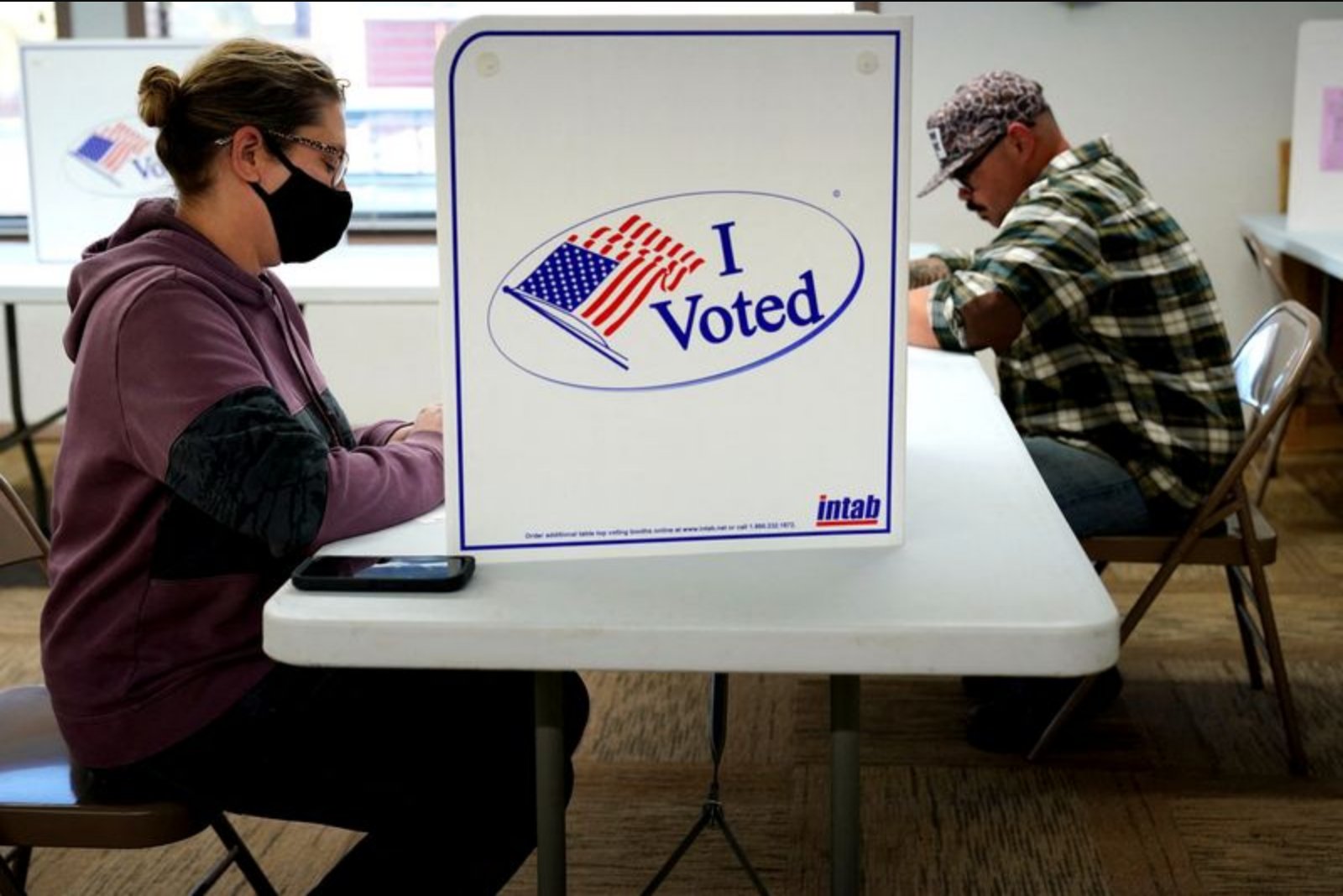
Senate Republicans have opened a sustained fight on the chamber floor over a voter identification measure endorsed by former President Donald Trump, seeking to portray Democratic opposition as tolerance for illegal voting and open borders. The effort centers on the SAVE America Act, a bill that would require proof of U.S. citizenship to register and a photo identification to cast a ballot.
Republicans acknowledge the legislation is unlikely to clear the Senate before the midterm elections, because it lacks the 60 votes needed for passage in the 100-member body. Still, GOP senators have embarked on an extended debate designed to record Democrats' opposition publicly and to underline an argument that resonates with many voters - that photo ID at the polls should be required.
"We’re going to put every one of them on the record so that everyone in America knows that Republicans support voter ID and Democrats are the party of open borders and illegal voters," said Senator John Barrasso, the chamber’s No. 2 Republican, as he described the strategy to reporters.
Supporters of the bill have repeated assertions pushed by Trump and his allies that significant numbers of people in the country illegally cast ballots in U.S. elections. Federal law already makes voting in federal contests by non-citizens illegal. State audits of voter rolls and studies from organizations across the political spectrum indicate that votes cast by non-citizens in federal elections are extremely rare.
Democrats counter that the SAVE America Act is aimed at a problem that does not exist and that its requirements could prevent eligible citizens from voting. They warn the bill could disenfranchise millions of Americans - specifically citing women, minorities and low-income citizens who may lack easy access to passports, birth certificates or other documentation needed to prove citizenship.
Senate Democratic leader Chuck Schumer labeled the measure "a pernicious, radical bill" on the floor and pledged that Democrats would not allow it to pass. The legislation had narrowly cleared the House last month, but faces a hostile Senate where it confronts a Democratic filibuster and insufficient Republican support to meet the 60-vote threshold.
Beyond the immediate legislative prospects, analysts and political operatives warn the bill could be repurposed as a narrative device if Republicans lose narrowly in November. By spotlighting Democratic opposition to voter ID, Trump and his allies could claim that contested or close outcomes were the result of fraud by non-citizen or otherwise ineligible voters.
"It seamlessly introduces an excuse for losing the midterms. It is also a possible rationalization for intervening in some way," said Walter Olson, a senior fellow at the libertarian Cato Institute, describing how the legislation could be used post-election.
Political strategists on the Republican side are already framing Democratic resistance to the bill as proof that Democrats would welcome non-citizen votes. That argument is being advanced even as the law makes non-citizen voting illegal and audits show it is a rare occurrence.
The larger political context heightens the stakes for both parties. The midterm season typically presents a disadvantage for the party controlling the presidency, and Republicans face the challenge of holding their narrow House majority as Democrats focus on public dissatisfaction with the economy and rising concerns over foreign entanglements. The article referenced an escalating conflict involving Iran that has pushed oil prices above $100 per barrel, a development Democratic campaigns are using alongside economic messaging.
Analysts cited in the debate assess that Democrats have solid prospects to recapture the House, while Republican divisions in states such as Texas could imperil the GOP’s Senate margin; nonetheless, few observers expect Democrats to win an outright Senate majority at this stage.
Observers of voting behavior say the SAVE America Act appears tailored to energize so-called anti-system voters - those who are receptive to claims that institutions have been corrupted by fraud. Chris Williams, an expert on voting at the University of Arkansas at Little Rock, said that appeals to institutional fraud helped deliver votes for Trump in 2016 and 2024, and that this constituency remains a sizable portion of the electorate.
Polling data cited in the discussion show concern among a substantial share of the public about non-citizen voting: Reuters/Ipsos polling found that 44% of U.S. adults worried about "large numbers of non-citizens voting," with concern highest among Republicans (82%), followed by independents (44%) and Democrats (15%). The numbers underscore why the issue holds cross-partisan salience, even as factual evidence of widespread non-citizen voting is lacking.
In scenarios where Republicans lose close contests, Olson suggested that a narrative built around the failed bill could be used to justify attempts to intervene in the post-election process - for example, by contesting the chain of custody for ballots before state officials certify results. He warned the bill’s failure could provide a rationale for intervention under the claim that authorities had not addressed alleged fraud.
Parallel to the Senate debate, the Justice Department under the Trump administration has filed lawsuits against 29 states over their refusal to hand over voter registration lists. The suits include actions against Republican-led states such as Utah and Oklahoma. Attorney General Pam Bondi said the federal government needed those rolls to ensure election integrity.
Separately, the former president has indicated he would pursue voter ID requirements by executive order if Congress would not act. That approach, along with litigation and public campaigning, shows a multipronged effort to press the voter-ID issue even as the SAVE America Act stalls in the Senate.
Democrats and election overseers warn of broader consequences if the administration or its allies seek to constrain or interrupt the work of local election officials. Representative Joe Morelle, the top Democrat on the House Administration Committee, argued that elections belong to the American people and not to any president or party. "When the American people recognize the president is trying to shut down or stop the work of election officials, I think there’s going to be an enormous outcry," he said.
Summary - Senate Republicans have mounted a prolonged floor campaign centered on the SAVE America Act, aiming to brand Democrats as opponents of voter-ID rules and to strengthen claims of illegal voting despite legal prohibitions and evidence that non-citizen voting is rare. Democrats argue the bill addresses a nonexistent problem and risks disenfranchising millions. The dispute unfolds amid a contentious midterm environment and related Justice Department litigation seeking state voter-registration lists.