
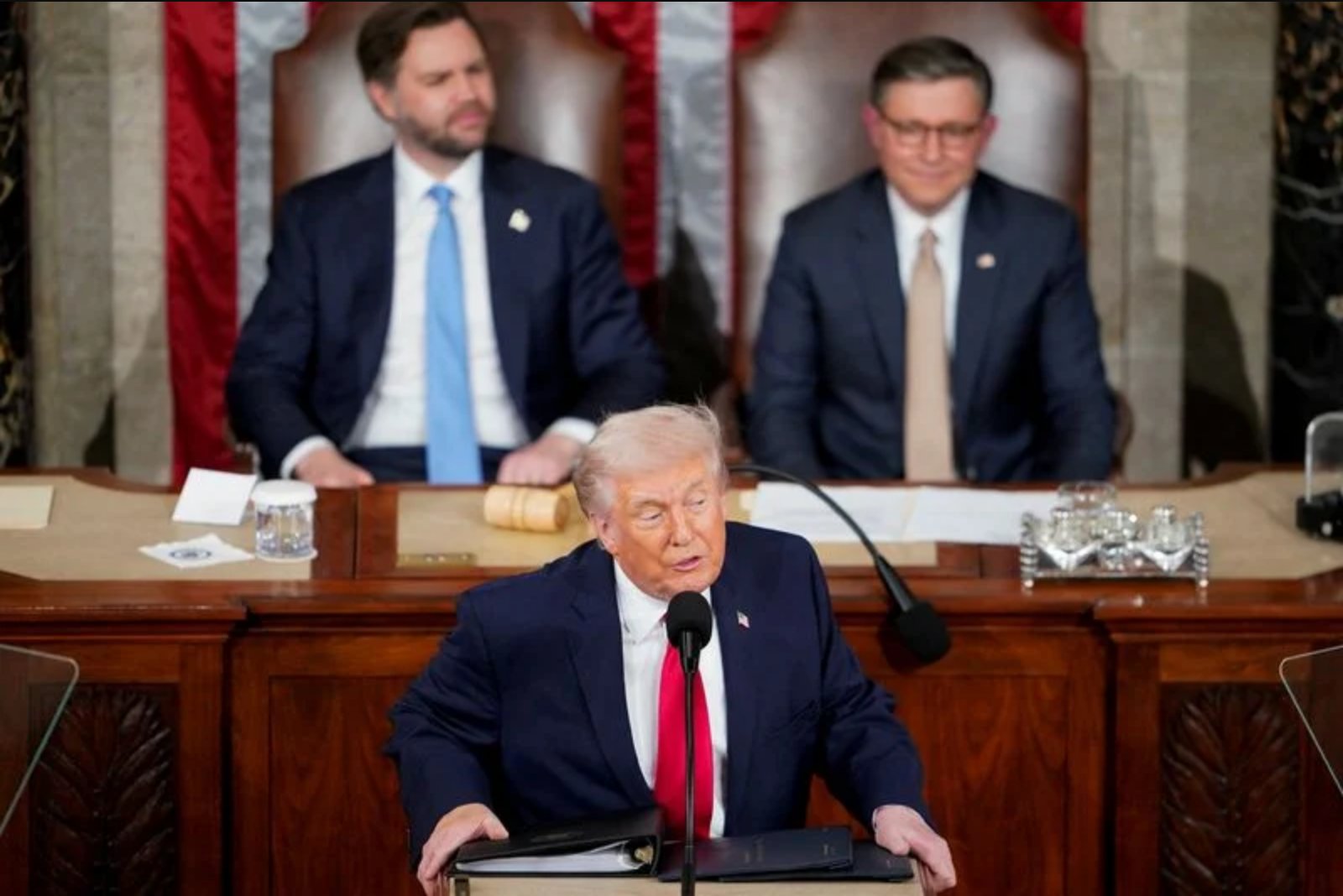
Republican lawmakers in Congress are showing an increased readiness to part ways with President Donald Trump on several contentious measures, signaling a shift from long-standing public deference to a more assertive posture ahead of the midterm elections.
Over roughly the past week, multiple factions of Republicans in both chambers have taken steps that amount to public rebukes of the president's priorities. Actions include rejecting a plan tied to $1 billion in funding for White House ballroom projects, resisting Mr. Trump's confrontational approach toward Iran, extracting a retreat on an $1.8 billion "anti-weaponization" fund and blocking domestic spying legislation backed by the White House. In the House, Republicans voted to advance a bill providing assistance to Ukraine and imposing new sanctions on Russia - legislation that appears likely to face a presidential veto.
Those moves have prompted observers to question whether the party is undergoing a meaningful revolt. Leaders in both parties have largely played down the notion of a full-scale rebellion. Still, a widening coalition of GOP lawmakers - including some whom Mr. Trump helped oust from office - is showing a willingness to buck the president, raising the prospect that his most ambitious initiatives could face obstacles between now and Election Day.
"I think what you’re seeing as you get closer to the election is that people are going to vote the way they think their constituents want them to," said Republican Senator Thom Tillis, who made the decision to retire from the Senate last year after opposing the president’s One Big Beautiful Bill.
Democrats have sought to minimize the significance of the defections, arguing the breaks largely involve those already alienated by the president. Senator John Fetterman, a Democrat who sometimes aligns with Trump-backed efforts, said the pattern reinforces the president's control rather than indicating broad-based dissent, noting that many who are breaking with Mr. Trump were previously marginalized by him.
One White House official, speaking on condition of anonymity, attributed the Republican dissent to election-year calculations, saying not every member will accept the political cost of standing with the administration on every issue. White House spokeswoman Abigail Jackson expressed a contrasting view, stating that despite media reports and Democratic commentary about divisions, the administration looks forward to continuing its close relationship with GOP lawmakers to advance the president's agenda.
For much of Mr. Trump's tenure, congressional Republicans displayed public loyalty by supporting contested cabinet nominees, acceding to executive orders, and backing signature legislative priorities even as some voiced private reservations about deficits and cuts to programs such as Medicaid.
But lawmakers and aides report rising frustration with the president after he opposed the reelection bids of Republican Senators Bill Cassidy and John Cornyn and periodically undercut the party's agenda with poorly timed announcements. The situation came to a head just before the Memorial Day recess, when Mr. Trump's opposition to Senator Cornyn’s reelection and his announcement of the "anti-weaponization" fund contributed to Senate Republicans abandoning a $70 billion immigration enforcement funding bill and departing Washington in a mood described by aides as angry and frustrated.
"That was kind of like a perfect storm of events," said a Senate Republican aide.
Despite the earlier collapse, the Senate subsequently passed the immigration enforcement funding bill on Friday. Republicans also opposed a Democratic amendment that sought to block the controversial fund, even as some members expressed concern that the money could be diverted to support January 6 rioters and other political allies of the president.
Mr. Trump appears intent on advancing nominations of loyalists despite reservations from influential Republicans. He has pushed to nominate Bill Pulte to replace Tulsi Gabbard as a temporary Director of National Intelligence, though key Senate Republicans have expressed doubts. Senate Republican leader Mitch McConnell publicly said he would not support any permanent DNI nominee who did not meet the statutory experience requirement, stating, "No nominee who falls short of this requirement will earn my vote." McConnell asserted the law requires nominees to possess extensive relevant experience.
On the floor, Republican opposition has so far been largely symbolic. Three described as electorally vulnerable Senate Republicans - Susan Collins, Jon Husted and Dan Sullivan - joined a Democratic effort to ban the president's "anti-weaponization" fund in a vote that ultimately failed, along with two other GOP attempts to terminate the program.
"This whole exercise is to pass President Trump’s top agenda item to secure the border, fund ICE. What’s happening on the floor right now shows the solidarity that we have with the president," said Republican Senator Jim Banks, a Trump ally, as lawmakers voted.
Looking ahead, the administration's next major personnel test is expected to be the nomination of the president's former attorney, identified in some references as Todd Blance and elsewhere as Blanche, as permanent U.S. attorney general. That nomination is likely to encounter scrutiny in the Senate Judiciary Committee, where figures such as Senator Cornyn - described in reports as a casualty of Mr. Trump's retribution - have signaled their support will hinge on how the nominee answers committee questions.
"The attorney general is not the president’s private lawyer," Cornyn told reporters, adding he wants assurance the nominee understands the distinction and will commit to enforcing the law impartially.
Context and implications
Republican lawmakers are navigating competing pressures as the election approaches - balancing responsiveness to their constituents with ties to a president who remains a central figure in the party. The recent votes and public statements reflect a narrowing of unanimous support and a growing inclination among some GOP members to distance themselves from specific presidential initiatives.
How far that willingness to resist will extend - whether to sustained legislative opposition, coordinated blockades of nominations, or other institutional checks - remains uncertain. For now, the episodes represent test cases in which Republican unity has frayed but not collapsed entirely.