
Introduction
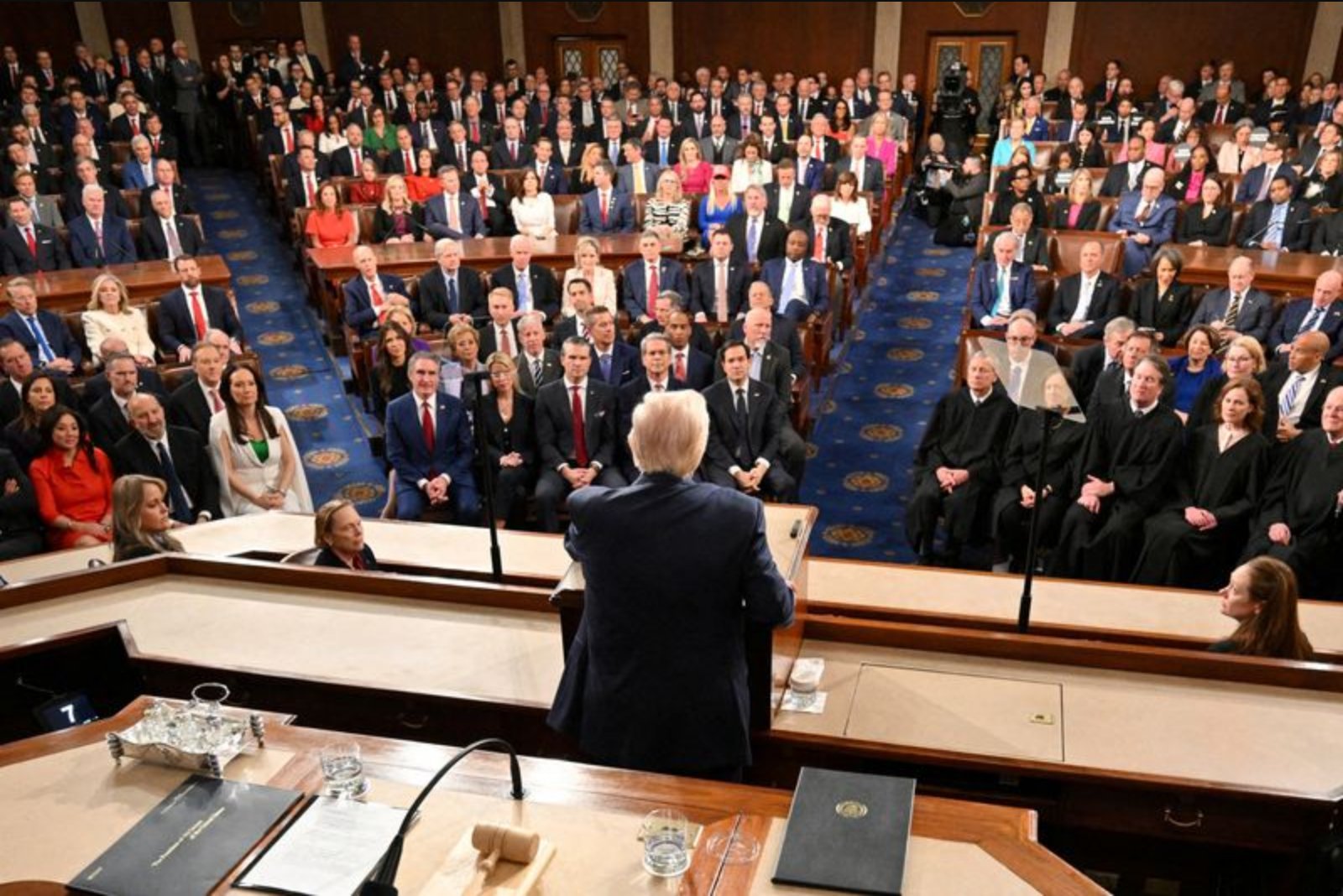
What began as a succinct written communication to lawmakers has, over more than two centuries, grown into a televised showcase of political theater and confrontation. The State of the Union address - once a short, formal report to Congress - is now a prime-time event crafted to deliver powerful images, generate headlines and, at times, provoke public clashes.
Where it stands this year
President Donald Trump is set to address Congress at 9 p.m. ET on Tuesday (0200 GMT on Wednesday). The occasion this year is punctuated by visible partisan tension: a group of Democrats has announced plans to skip the speech and instead hold an outdoor rally opposing the president’s policies. After the address, the customary televised response from the opposition party will come not from a sitting member of Congress but from newly elected Virginia Governor Abigail Spanberger, a Democrat.
Adding to the charged atmosphere, the speech comes just days after a Supreme Court decision that directly affected a central element of the president’s economic policy. Four days earlier, a 6-3 majority - including two justices appointed by the president - found that his signature tariffs exceeded presidential authority, striking them down as an overreach.
From a short report to a prime-time spectacle
The State of the Union’s form and delivery have shifted repeatedly since the republic’s founding. President George Washington’s first address in 1790 was a brisk 1,089-word report, brief enough to be read in only a few minutes. In 1801, President Thomas Jefferson chose to send his message in writing rather than deliver it aloud, setting a precedent that persisted for more than a century.
It was not until 1913 that President Woodrow Wilson returned to the practice of delivering the message in person. The transition to electronic mass communication accelerated the address’s prominence: President Harry Truman delivered the first televised State of the Union in 1947, while President Lyndon Johnson moved the speech to prime time in 1965 to capture the largest possible television audience. Since then, the shift to evening scheduling has coincided with greater partisan display in the chamber, with members of the president’s party frequently rising in applause while the opposition at times remains seated.
Length and ritual changes
Over the past several decades, presidents have taken advantage of the spotlight by giving longer addresses. President Bill Clinton set a record in 2000 with a speech that lasted 1 hour, 28 minutes and 49 seconds. President Donald Trump’s 2025 address ran even longer, clocking in at 1 hour, 39 minutes and 32 seconds, according to the American Presidency Project. By contrast, when a president is newly inaugurated or returning to office shortly before the annual address, the event may be labeled differently; Trump’s speech last year happened too soon after his return to the presidency to be formally considered a State of the Union address and was instead presented as a joint address to Congress.
Customs surrounding guest recognition and ceremonial honors have also been adapted for dramatic effect. President Ronald Reagan, in 1982, began the modern practice of inviting attention-grabbing guests when he introduced Lenny Skutnik, a Congressional Budget Office employee who had rescued a plane crash survivor from the Potomac River. Such recognitions have sometimes been controversial: in 2020, President Trump presented the Presidential Medal of Freedom to Rush Limbaugh, a radio host whose polarizing public profile drew sharp reactions.
Moments that went viral
Several confrontational moments tied to speeches to Congress have reverberated beyond the chamber and become widely shared images of partisan rupture.
- 2009 - 'You lie.' During a healthcare speech to Congress, Republican Representative Joe Wilson interrupted then-President Barack Obama, shouting, "You lie!" Wilson’s outburst came as Obama asserted that proposed healthcare plans would not insure immigrants who entered the country illegally. The breach of protocol drew swift bipartisan criticism and led Wilson to apologize.
- 2010 - A Supreme Court scowl. When President Obama criticized the Supreme Court’s Citizens United decision for opening the way to unlimited corporate and potentially foreign money in elections, Justice Samuel Alito reacted by shaking his head and appearing to mouth "not true" - an atypical visible response from a member of the bench.
- 2020 - Trump and Speaker Pelosi. In an exchange watched by millions, President Trump handed a printed copy of his speech to House Speaker Nancy Pelosi but declined to shake her hand. The customary introduction used by the speaker - which typically includes the phrase "high privilege and distinct honor" - was not recited. At the close of the roughly 80-minute speech, Pelosi stood and tore the copy of the remarks that had been handed to her, later explaining the gesture as "the courteous thing to do, considering the alternative."
- 2023 - Biden’s sharp responses. President Joe Biden drew pointed interruptions and boos during his State of the Union address. Representative Marjorie Taylor Greene shouted "liar" after Biden criticized Republicans for resisting proposals to make the wealthy pay more. Representative Andy Ogles of Tennessee yelled "it’s your fault" at Biden in relation to the fentanyl crisis.
- 2024 - Biden confronts Trump and Republicans. In his 2024 address, Biden deployed pointed contrasts with former President Trump and the Republican Party, accusing them of undermining democratic norms, accommodating Russia and blocking immigration reform, even while largely refraining from naming Trump directly. When some Republicans booed his claim that they sought tax cuts for the wealthy, Biden ad-libbed a line that rhetorically questioned their opposition to another $2 trillion tax cut for the wealthy.
When the address reshaped policy
Beyond theatrical moments, State of the Union and related presidential addresses have sometimes launched or framed consequential policy shifts.
- 1941 - Four Freedoms. President Franklin Roosevelt used a major address in 1941, less than a year before the United States entered World War Two, to articulate what he called the "Four Freedoms" people worldwide should enjoy: freedom of speech, freedom of worship, freedom from want and freedom from fear.
- 1964 - War on Poverty. President Lyndon Johnson declared an "unconditional War on Poverty" in 1964, initiating a broad set of social programs that reoriented federal spending and government engagement in economic opportunity.
- 1996 - A turn on government scope. President Bill Clinton declared that "the era of big government is over," signaling a political and policy recalibration that sought to draw Republicans into a more bipartisan approach in governance.
- 2002 - 'Axis of evil.' In 2002, President George W. Bush labeled Iraq, Iran and North Korea an "axis of evil" in remarks shaped by the post-September 11 environment and that marked a shift toward a more assertive foreign policy posture.
Conclusion
What began as a concise report has become a central ritual of American political life - a televised evening in which presidents aim to seize narrative control and opponents stage responses ranging from formal rebuttals to symbolic acts and protests. This year’s address - timed amid judicial pushback on a major trade policy and accompanied by vocal demonstrations and an off-site Democratic rally - underscores how the State of the Union now operates as a high-stakes forum for both policy presentation and partisan confrontation.