
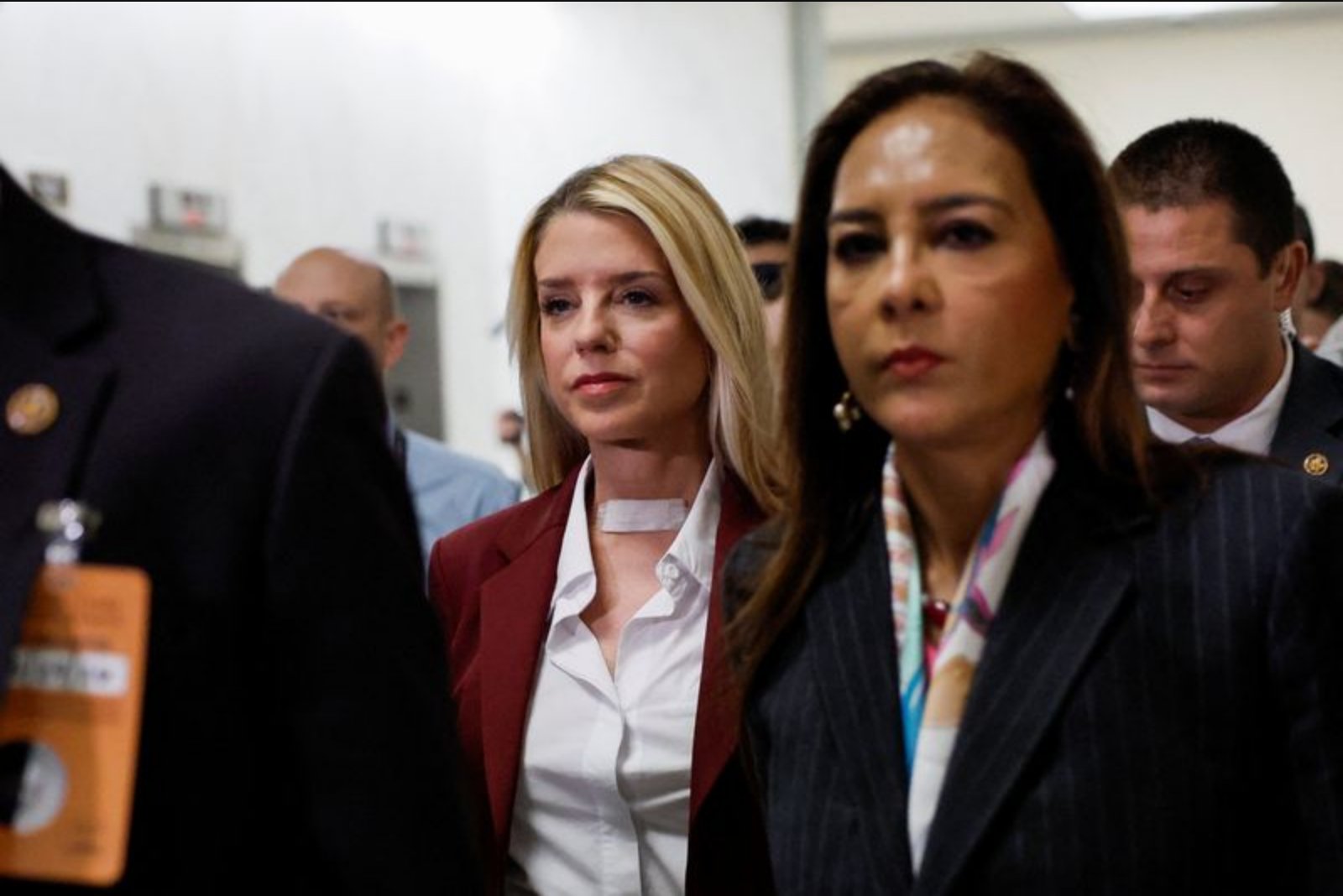
Former U.S. Attorney General Pam Bondi appeared on Friday for a closed-door session with a Republican-led congressional committee to answer questions about the Justice Department’s release of records tied to its probe of late sex offender Jeffrey Epstein.
House Oversight Committee Chairman James Comer told reporters ahead of the session that committee members would press Bondi on outstanding document issues. "We will be asking today about why documents still are not released....what documents remain and why they haven’t been turned over," he said, adding that no documents should be withheld from the committee.
During Bondi’s tenure, the Justice Department made available more than 3 million pages of records connected to the Epstein investigation. The release, however, drew criticism because portions of that material were not made public. Justice Department officials have defended their choices by saying they would not disclose information that would expose victims or compromise active investigations.
Still, Democrats and some Republicans faulted Bondi for decisions they say amounted to shielding then-President Donald Trump from scrutiny. Trump had opposed the release of the information until shortly before Congress approved a law, by an overwhelming margin, that mandated their disclosure. According to officials cited in congressional statements, Trump dismissed Bondi on April 2, citing in part her handling of the Epstein files.
The relationship between Trump and Epstein is referenced in the released files. The two socialized during the 1990s and early 2000s, though Trump has repeatedly said he ended their association before Epstein pleaded guilty in 2008 to soliciting prostitution from a minor. Epstein was arrested again in 2019 on charges of sex trafficking of minors, accused of recruiting and abusing underage girls in New York and Florida. His death that year in a New York jail cell was ruled a suicide.
The documents made public revealed Epstein’s connections to prominent figures, including Trump, former President Bill Clinton and Andrew Mountbatten-Windsor, the former Duke of York. Each of those individuals has stated they had no knowledge of Epstein’s alleged sex trafficking.
Democratic Representative Robert Garcia of Texas criticized the decision by the Republican chairman not to videotape Bondi’s interview, saying a recording would have allowed the public to evaluate her demeanor. Garcia also reiterated Democratic concerns about the incomplete nature of the document release and questioned why some files containing private information about Epstein survivors ended up in the public domain, which he said placed those survivors at risk.
At least one survivor attended the proceedings and sharply criticized Bondi’s stewardship of the records. "It boggles my mind that the Department of Justice released nude photos...the Department of Justice released pornography. That is unacceptable," survivor Charlene Richard told reporters outside the committee hearing room.
Context and next steps
The closed session is part of the committee’s effort to map what remains unreleased and to press for full cooperation from the Justice Department. Committee leaders have signaled they expect complete access to materials they deem necessary for oversight, while others on the panel and outside critics contend the earlier public disclosures harmed survivors and may have been influenced by political calculation.