
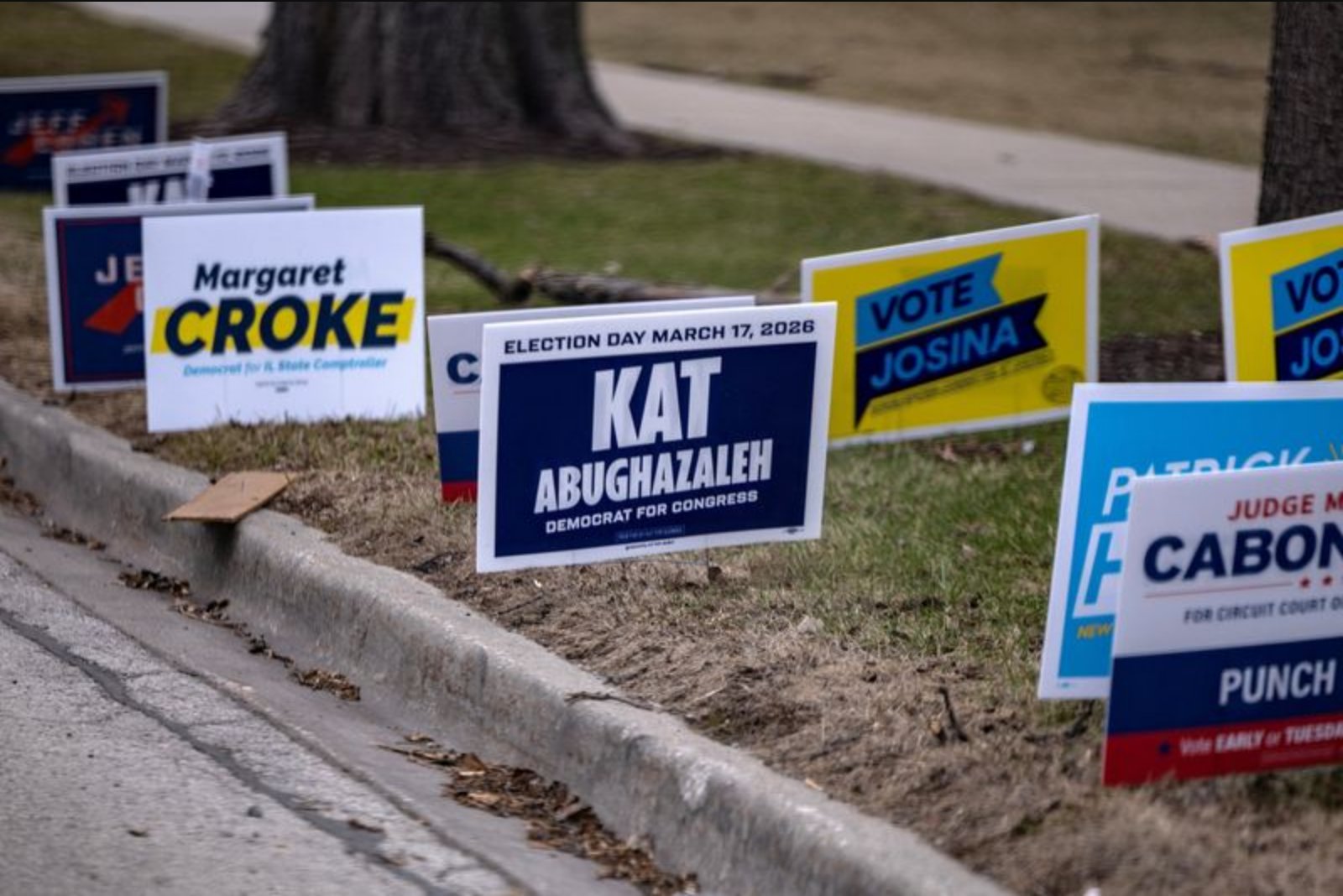
WASHINGTON, March 17 - Illinois voters head to the polls on Tuesday to pick nominees for a slate of U.S. House races that will shape party control of Congress for the next two years. Several long-serving members of Congress are not seeking reelection, prompting a wave of contested primaries in districts that are broadly considered safe for Democrats.
What follows is a closer look at five congressional primaries in Illinois that have drawn national attention because of candidate comebacks, substantial fundraising totals, significant outside advertising and the influence of political groups with reported ties to pro-Israel organizations.
Jesse Jackson Jr. seeks return to the seat he once held - Illinois 2nd District
Former U.S. Representative Jesse Jackson Jr. has mounted a bid to reclaim the Chicago-area 2nd congressional district, which he represented from 1995 until his resignation in 2012. Jackson pleaded guilty in 2013 to federal charges connected to the misuse of $750,000 in campaign funds. His brother, Jonathan Jackson, currently serves in Congress.
The contest for the open 2nd District seat has attracted at least nine Democrats. Among the better-funded contenders are Cook County Commissioner Donna Miller, who raised nearly $2 million, and state Senator Robert Peters, a progressive who raised more than $1.1 million.
Outside advertising has played a substantial role in the race. Roughly $6 million in ad spending has been used to support Miller, including more than $3 million from Affordable Chicago Now, a super PAC reported to have ties to the American Israel Public Affairs Committee, a group that supports pro-Israel candidates irrespective of party affiliation. Miller has also drawn donations from individuals who have donated to Republican President Donald Trump, a point of criticism from Peters and other Democrats.
The seat became open after Representative Robin Kelly, a Democrat, launched a campaign for the U.S. Senate. Because the 2nd District is considered safely Democratic, the eventual primary winner is likely to win the general election in November.
Majority-Hispanic district sees chief of staff run unopposed on Democratic ballot - Illinois 4th District
The 4th District, a majority-Hispanic Chicago-area seat, will also select a new representative after U.S. Representative Chuy Garcia announced he would not seek reelection. Patty Garcia, who serves as Chuy Garcia's chief of staff and is not related to him, is expected to take the Democratic nomination easily because she was the only Democrat to file before the state deadline. Chuy Garcia's decision to delay his announcement until after the filing deadline left Patty Garcia as the sole Democratic name on the primary ballot.
Last year, the U.S. House formally expressed disapproval of Chuy Garcia's action to clear a path for his chief of staff, with 23 Democrats joining Republicans in the rebuke.
Though the district is safely Democratic, Patty Garcia's path to Congress in November is not guaranteed. She will face Republican nominee Lupe Castillo and Mayra Macias, a Democrat who launched an independent campaign in December after missing the Democratic ballot. Macias narrowly outraised Patty Garcia last year despite entering the race roughly a month later.
Top fundraiser faces heavy outside spending - Illinois 7th District
In the 7th District, River North developer Jason Friedman leads field fundraising with $2.5 million, more than triple the receipts of his closest rival in the Democratic primary. Despite Friedman's fundraising advantage, his campaign has been outspent on advertising that favors Chicago Treasurer Melissa Conyears-Ervin by over $4 million.
United Democracy Project, a pro-Israel super PAC, has expended more than $3 million supporting Conyears-Ervin. The district, which has been represented by a Black member of Congress since 1973, has a population that is more than 40 percent Black and features top candidates who are Black, with the exception of Friedman.
Other leading contenders include Dr. Thomas Fisher, an emergency medicine physician who advocates for universal health care; state Representative La Shawn Ford, who has criticized the scale of outside spending and has been targeted by a crypto-focused super PAC; and former Cook County Commissioner Richard Boykin, who emphasizes lower costs, job creation and public safety in his campaign messaging. The seat opened with the retirement of Representative Danny Davis, 84, who has endorsed Ford. Because the district is safely Democratic, the primary winner is likely to prevail in November.
Another former representative joins crowded primary - Illinois 8th District
Democratic former U.S. Representative Melissa Bean is seeking her old seat in the 8th District, which she held from 2005 to 2011. In her prior tenure in Congress, Bean was a conservative-leaning Democrat often categorized as a Blue Dog, having supported the Iraq War, voted with her party on the Affordable Care Act and sided with Republicans on extensions of tax cuts. She narrowly lost her 2010 reelection by fewer than 300 votes to then-Republican Joe Walsh.
The 8th District was redrawn after the 2010 census and has been in Democratic hands since 2013. This open-seat primary has become a crowded field, but three candidates stand out after each raised more than $1 million: Bean; Neil Khot, a technology CEO; and tech entrepreneur Junaid Ahmed.
Khot is the top fundraiser in the 8th, collecting $2 million. Bean has been boosted by approximately $4 million in advertising from Elect Chicago Women, a super PAC with ties to the American Israel Public Affairs Committee. The three leading candidates share many policy positions, although Ahmed is described as the most progressive of the trio. Ahmed supports Medicare for All and has called for ending U.S. military aid to Israel.
Additional candidates include Dan Tully, a former U.S. Army Reserve judge advocate who resigned a civil service post in protest of former President Donald Trump, and Kevin Morrison, a Cook County commissioner. The incumbent, Representative Raja Krishnamoorthi, a Democrat, vacated the seat to launch a campaign for the U.S. Senate. As the 8th District is safely Democratic, the primary victor is likely to secure the seat in the general election.
High fundraising totals and large ad buys define a crowded field - Illinois 9th District
The 9th District Democratic primary has become a high-profile and resource-heavy contest. Six candidates have raised more than $1 million, led by 26-year-old influencer Kat Abughazaleh, who reported $3.4 million in fundraising. Abughazaleh's campaign website includes critical material targeting figures such as Elon Musk, "Libs of TikTok" and former Fox News host Tucker Carlson.
State Senator Laura Fine and Evanston Mayor Daniel Biss each raised $2.5 million. However, Fine has benefited from more than $6 million in outside advertising, far outpacing other candidates. Elect Chicago Women, a super PAC with ties to the American Israel Public Affairs Committee, has spent more than $5 million on ads backing Fine.
Biss has led in every public poll and has addressed the influx of outside funding in campaign messaging, saying, "MAGA money can buy a lot of noise, but it can’t buy a record like mine." Abughazaleh has framed the race as a contest primarily between her and Biss, citing a recent poll to support that claim, and has criticized career politicians as insufficient to solve current problems.
Other significant fundraisers in the 9th include former FBI special agent Phil Andrew, a former hostage negotiator and gun-violence survivor supported by the gun safety group Brady PAC; Bushra Amiwala, a school board member; and state Representative Hoan Huynh.
The seat is held by outgoing Representative Jan Schakowsky, 81, who announced her retirement after Abughazaleh launched a primary challenge. With the 9th District reliably Democratic, the primary winner is expected to be chosen in the November general election.
What to watch on Tuesday
- Multiple open seats in safely Democratic districts have produced large and competitive Democratic primaries.
- Outside groups with reported ties to the American Israel Public Affairs Committee have invested millions of dollars in advertising across several contests.
- Several candidates with prior congressional experience are attempting returns to the House, while younger, well-funded newcomers and local officials have mounted strong challenges.
These Illinois primaries are notable for the combination of crowded fields, large personal fundraising hauls and extensive outside advertising. In several districts, the primary results are expected to effectively determine who will hold the seat in Congress after November, given the partisan leanings of those districts.