
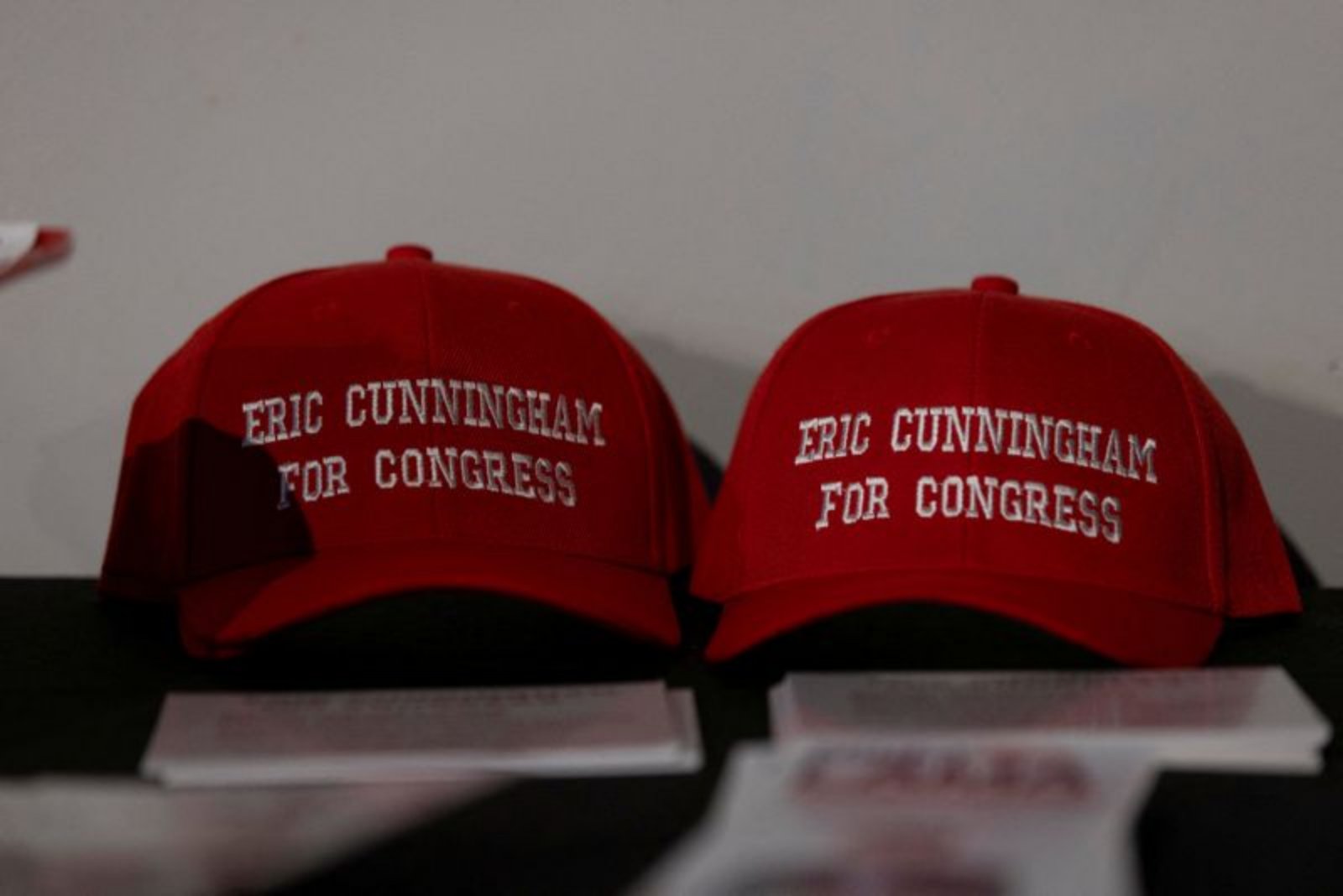
President Donald Trump’s public backing of Clay Fuller on February 4 was intended to narrow the field in the special election to replace Marjorie Taylor Greene, yet it has not produced the consolidation his supporters might have expected. Fuller, the former district attorney for four counties in northwest Georgia, emerged as the candidate Trump called a torchbearer of the MAGA movement. Still, 14 other Republicans have stayed in the race ahead of the March 10 special election, for which early voting is scheduled to begin on Monday. Three Democrats and one independent are also competing.
The crowded Republican primary in Georgia’s 14th Congressional District has turned a reliably conservative region into a test of how cohesive Trump’s Make America Great Again coalition remains. The district, a largely blue-collar corridor stretching from Atlanta’s exurbs up to the Tennessee border, became a focal point of the movement when Greene won in 2020 and rose to national prominence as one of its most vocal figures. Greene resigned her seat in January after a bitter split with Trump, leaving a vacuum that multiple candidates are trying to fill.
Interviews with 22 local voters indicate the contest is still unsettled. A majority of the Republicans interviewed said they had not settled on a candidate and that the former president’s endorsement alone would not determine their choice at the ballot box. "I’m a Trump supporter, and I respect his opinion, but he doesn’t live in this district," said John Burdette, who attended a candidate forum in Kennesaw. "I think we have a better perspective on who is best to represent us."
That sentiment underlines a broader point: while loyalty to Trump remains the main shared attribute among the contenders, there is limited agreement about what being "MAGA" means in practice. The label now spans a wider and more varied coalition and includes distinct approaches to political style and policy priorities. Some candidates emphasize confrontational tactics and performative loyalty to Trump, while others promise a return to more traditional conservative governance and a less combative tone.
Clay Fuller, who served as a district attorney covering four counties in northwest Georgia, is campaigning on economic development for the district’s poorer rural communities across the foothills of Appalachia. He has also made a point of distinguishing his approach from Greene’s combative style, which was characterized by conspiracy-driven rhetoric and online attacks. "I’ve got the gear for fire and brimstone when the situation calls for it," Fuller said after a campaign event. "But I’m my own man. I don’t think the voters want that style again."
Despite signaling a more measured tone at times, Fuller has also used sharp rhetoric in support of Trump’s agenda. On January 24, the same day federal immigration officers shot and killed nurse Alex Pretti in Minneapolis, Fuller posted that if elected he would nominate all Immigration and Customs Enforcement agents for the Presidential Medal of Freedom and push to triple the agency’s budget.
Other candidates embrace a far more aggressive posture. Colton Moore, a former state senator, brands himself as "Trump’s #1 Defender" and is campaigning under the slogan "GOD. GUNS. TRUMP." Moore has been among the most ardent promoters of the claim that the 2020 election was stolen and has a history of clashes with Georgia’s Republican establishment. For some grassroots conservatives, that confrontational approach is precisely what they want.
Charles Stoker, an 81-year-old Republican voter, voiced frustration with Trump’s pick of Fuller, saying that the president has been getting poor advice and that leadership should come from the base up. "President Trump has been getting bad advice," he said. "Directions need to come from the people upward."
Moore did not receive Trump’s endorsement, but he has secured endorsement from several prominent and partisan figures and groups on the right, including former national security adviser Michael Flynn, former Florida Congressman Matt Gaetz, and the Georgia Republican Assembly, which represents the party’s far-right wing. Nathaniel Darnell, president of that group, argued that Moore, not Fuller, is best situated to serve the district’s interests and observed that, in his view, "President Trump’s going to be gone in a few years."
For many voters and candidates, the dispute is less about discrete policy differences and more about style. Meg Strickland, a 39-year-old travel consultant and mother of three who voted for Trump in the past, positions herself as a self-described moderate in the Republican field. She argues the party should return to small-government principles and away from personality-driven politics. "I don’t think that Trump is a true conservative and I hope that we can get back there," she said.
Shawn Harris, the leading Democratic contender, is focusing on winning over disaffected Republicans by addressing economic issues that resonate with working voters. A 59-year-old cattle farmer and retired brigadier general, Harris has centered his campaign on lowering living costs and expanding access to affordable healthcare. He also pointed to overlap between his positions and the posture Greene adopted after her break with Trump - specifically, a focus on helping working Americans and reducing toxic political rhetoric. Harris has $1.2 million in campaign resources on hand.
Harris’s performance is likely to be closely observed. After losing to Greene by 64.4% to 35.6% in 2024, his ability to reach into parts of the GOP electorate will be a test of whether Democrats can carry momentum in special elections. While an outright victory in this deeply conservative district is considered unlikely by observers, political analysts note that an open Republican field could create an opportunity for Democrats to advance to a runoff if no single candidate achieves a majority on March 10. A runoff would be scheduled for April 7.
Polling data underscores the competitive uncertainty. A Quantus Insights survey of 729 registered Republicans conducted in the final week of January, before Trump’s endorsement, showed a broadly open contest. Moore and Fuller led the field with 13.4% and 12.6% support respectively, while more than a third of respondents remained undecided.
Nathan Price, a political science professor at the University of North Georgia, described the fluidity as symptomatic of a Republican Party and a MAGA movement in transition. "I think you’re starting to see perhaps the party looking beyond him a little bit as he gets into the sixth year and maybe starting to think about the future of the party," he said, pointing to an emerging search among voters and activists for what comes next.
Observers warn that the intra-GOP competition and the public airing of divisions could have implications beyond the district. These emerging splits among Republican contenders raise questions about party cohesion heading into November’s midterm elections. If Republican infighting produces vote-splitting in other competitive districts, Democrats could find openings to challenge seats they otherwise might not contest successfully.
Still, the local dynamics are specific. Candidates in the 14th District are navigating a mix of issues that matter to voters here - economic stagnation in rural areas, reactions to federal immigration enforcement tactics, and the balance between combative political theater and practical constituency service. Voters interviewed cited both national and local concerns, indicating that decisions at the ballot box will be shaped by a range of influences, not solely by external endorsements.
As the race progresses toward the March 10 vote, the outcome will offer a window into how the MAGA movement is evolving at the grassroots level and whether a national endorsement is sufficient to shape results on the ground in a district with a deeply partisan history. The result will also gauge the durability of Greene’s brand of politics and whether a new standard-bearer will emerge from among those competing to claim her mantle.
Summary
Donald Trump’s endorsement of Clay Fuller did not deter 14 other Republicans from competing in the special election to replace Marjorie Taylor Greene in Georgia’s 14th District. Voters say many remain undecided and the race reflects broader divisions within the MAGA coalition between confrontational and more traditional conservative approaches. The crowded field raises the possibility of a Democratic candidate advancing to a runoff and highlights uncertainties for Republican cohesion ahead of the midterms.
Key points
- Trump’s endorsement elevated Clay Fuller but did not consolidate the Republican field; over a dozen GOP candidates remain in the race, with early voting set to begin before the March 10 special election.
- Divisions within the MAGA movement are evident in competing styles - from combative, confrontational candidates to those advocating calmer, consensus-driven politics - a dynamic that could influence voter turnout and preferences in this and other districts.
- Policy debates highlighted in the campaign include immigration enforcement funding and economic development for rural Appalachian communities; these discussions may shape priorities for federal spending and local economic initiatives.
Risks and uncertainties
- Vote-splitting among the many Republican contenders could enable the Democratic candidate, Shawn Harris, to advance to a runoff - a scenario that would signal vulnerabilities for the GOP in heavily red districts. This uncertainty could have political implications for party strategies heading into the November midterms.
- The lack of consensus on what "MAGA" represents creates unpredictability in Republican voter behavior, making it harder for national endorsements to predict local outcomes; this could affect campaign resource allocation and electoral forecasts in other competitive districts.
- Local voter concerns about economic pressures and federal enforcement actions are shaping the contest; shifts in public sentiment on these issues could produce outcomes that diverge from expectations based solely on past partisanship.