
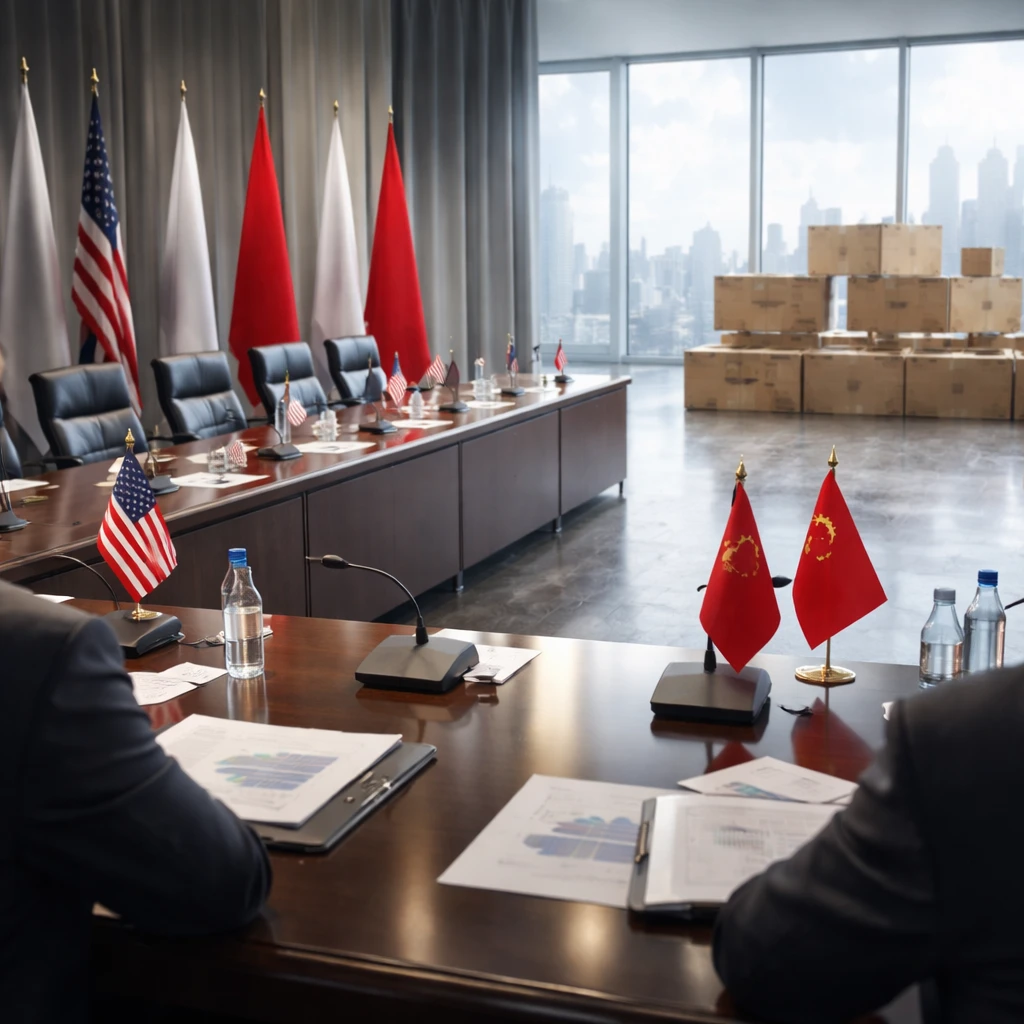
The balance of bargaining power in the U.S.-China trade relationship has moved in Beijing's favor in the run-up to a high-profile meeting between President Donald Trump and Chinese officials on March 31. A U.S. Supreme Court ruling that stripped the White House of broad emergency tariff powers has removed a key instrument of immediate economic pressure, altering the posture of the forthcoming negotiations.
The decision eliminated second-term levies that in some cases had been pushed as high as 145% on specified goods. In their place, China now confronts a 15% global baseline tariff - the same rate applied to U.S. allies - that carries a built-in sunset after 150 days. That narrower, time-limited levy reduces Washington's ability to wield steep, ongoing tariff increases as leverage to secure large, rapid purchase commitments from Beijing, including for U.S. soybeans and Boeing aircraft.
Officials in Beijing are expected to capitalize on the altered landscape. With unilateral reciprocal duties no longer in force, Chinese negotiators are likely to press for concessions that were previously difficult to obtain. Foremost among those is expanded access to advanced semiconductors. The dynamics around chip access have already shifted: U.S. authorities recently authorized sales of NVIDIA's H200 chips to Chinese firms, signaling a relaxation of some prior export restrictions.
Beyond silicon, China may rely on its dominant position in rare earth metals as a strategic counterbalance. The ruling makes trade talks more of a two-way negotiation, market analysts say, opening the door for Beijing to threaten limits on materials that are critical inputs for U.S. high-tech manufacturing if Washington responds with controls on chip-design software or jet engines.
At the same time, the 150-day baseline creates urgency and uncertainty. U.S. officials are pursuing alternative legal and administrative routes to reimpose higher trade barriers. Under Section 122 and with a forthcoming Section 301 investigation in view, the administration has been developing contingency measures that could recreate stronger tariff protection. That prospect has encouraged Chinese exporters to accelerate shipments to the U.S. - a practice known as front-loading - to make the most of the lower effective rates while the current window remains open.
Despite the Supreme Court setback, the White House retains other significant levers to influence Beijing. Tighter export controls and national security restrictions remain available tools, according to official statements. Nevertheless, the removal of the broad reciprocal duties eliminates a key diplomatic impediment and reshapes the negotiation agenda.
With Treasury Secretary Scott Bessent scheduled to meet Chinese officials ahead of the summit, the focus has shifted. Rather than concentrating solely on averting a renewed trade war, discussions are now framed around defining the contours of a new investment and economic framework that could be historically consequential if agreements are reached.
What this means for markets and sectors
- Agriculture and aerospace stand to be directly affected by any change in purchase commitments for soybeans and Boeing aircraft.
- Semiconductor companies and suppliers could face altered export regimes or demand shifts depending on concessions around advanced chips.
- Producers of rare earths and manufacturers reliant on those materials for high-tech production could see policy-driven supply disruptions if Beijing uses resource access as leverage.
The legal and administrative maneuvers now underway in Washington, together with Beijing's strategic priorities, set the stage for complex, reciprocal negotiations. The near-term 150-day tariff window adds pressure to both governments and markets, and front-loading by exporters may produce short-term trade and inventory distortions as officials and firms adjust to the new framework.