
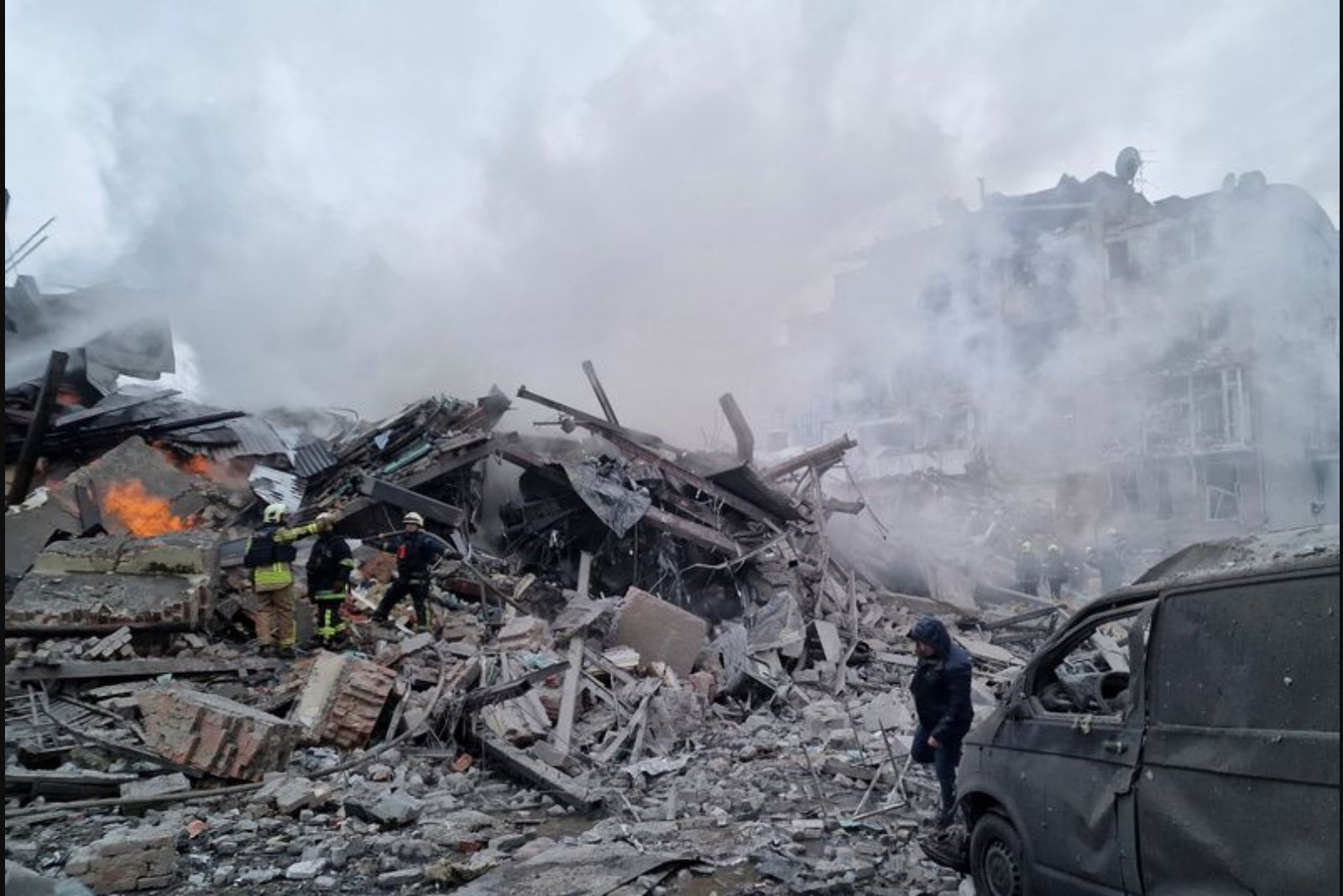
A coalition of international institutions has raised its estimate of the funds required to restore Ukraine’s economy and infrastructure to $588 billion over the coming decade, according to a joint assessment released on Monday, timed a day before the fourth anniversary of Russia’s full-scale invasion.
The calculation - prepared by the World Bank, United Nations, European Commission and the Ukrainian government - draws on data spanning Feb. 24, 2022 through Dec. 31, 2025. It represents a 12% increase compared with last year’s estimate. The update attributes part of that rise to a 21% increase in damaged or destroyed energy infrastructure versus the prior assessment.
The analysis does not incorporate additional damage from Russia’s intensified strikes on energy facilities during January and February, which left tens of thousands across Ukraine without heat, power and water amid an exceptionally cold winter.
Direct damage and sectoral impact
The fifth assessment since the conflict began reports cumulative direct physical damage in Ukraine of $195 billion, almost 11% higher than the previous estimate. Housing, transport and energy are listed as the most affected sectors. The report says total direct damage reported is now more than double the amount documented in the first assessment conducted in 2022.
"The damage is immense and increasing continuously," the report states, and notes that destruction is concentrated in frontline districts as well as in metropolitan areas including the capital, Kyiv.
Housing accounts for the largest share of recorded physical losses. The report estimates that 14% of the country’s housing stock has been damaged or destroyed, representing roughly $61 billion in losses. Railways and additional transport infrastructure account for about $40.3 billion in damage. The energy sector, which sustained heavy targeting during the past year, incurred nearly $25 billion in damage; the report also cites periods where some citizens endured electricity outages lasting up to 18 hours per day.
Economic toll and outlook
The broader measure of socioeconomic losses - covering the disruption to economic activity, public services and employment - is put at $667 billion, a 13% increase from last year’s figure. The war has also led to substantial demographic and labor-force changes: as of December 2025, more than 6 million Ukrainians were living as refugees outside the country and 4.6 million people were internally displaced. United Nations data cited in the report indicate Ukraine now has 2.4 million fewer children than before the war.
Ukraine’s gross domestic product is estimated to be 21% smaller in real terms than in 2021, prior to the invasion. The report includes conditional forecasts for growth: if the war continues through the current year, GDP growth is expected to be roughly 2%. If a ceasefire were in place by the end of the year, growth could rise to about 4% in 2027 and 4.5% in 2028.
Political and diplomatic context
The assessment notes diplomatic developments have so far failed to ease the conflict. Ukrainian officials have engaged in talks with Russian representatives, most recently in Geneva, but those discussions last week did not produce a breakthrough. The report also describes political pressure on Ukraine’s leadership related to ceasefire negotiations; it says Ukrainian President Volodymyr Zelenskiy has faced sustained pressure from U.S. President Donald Trump to agree to a ceasefire that could involve significant territorial concessions.
Financing and reform imperatives
The government of Ukraine is already allocating resources toward reconstruction this year, earmarking $15.25 billion for various programs. Since February 2022, Ukraine and its international partners have spent $20.3 billion on urgent repairs across multiple sectors, including housing.
The report contends that private capital could meet about 40% of Ukraine’s rising reconstruction costs, but only if targeted reforms are implemented to draw investment into productive sectors such as agriculture, industry and tourism. It warns that "Ukraine’s old economic model, with its weak competition, large informal economy, and heavy state footprint, will not generate the business dynamism needed for recovery."
U.N. humanitarian coordinator Matthias Schmale is quoted emphasizing the human dimension of recovery, arguing that steps to facilitate the return of refugees, reintegrate veterans and expand women’s participation in the workforce are essential to the country’s economic future. "Ukraine’s most critical asset is its people," Schmale said. "Recovery must be human-centered and community-based."
Ukrainian Prime Minister Yulia Svyrydenko highlighted the scale of the task in a statement accompanying the assessment, saying that after four years of full-scale invasion the reconstruction and recovery price tag is nearly $588 billion over the next decade - almost three times the country’s projected nominal GDP for 2025. She noted ongoing Russian assaults on energy infrastructure and homes this winter but underscored resilience among citizens and entrepreneurs in maintaining activity and pursuing recovery.