
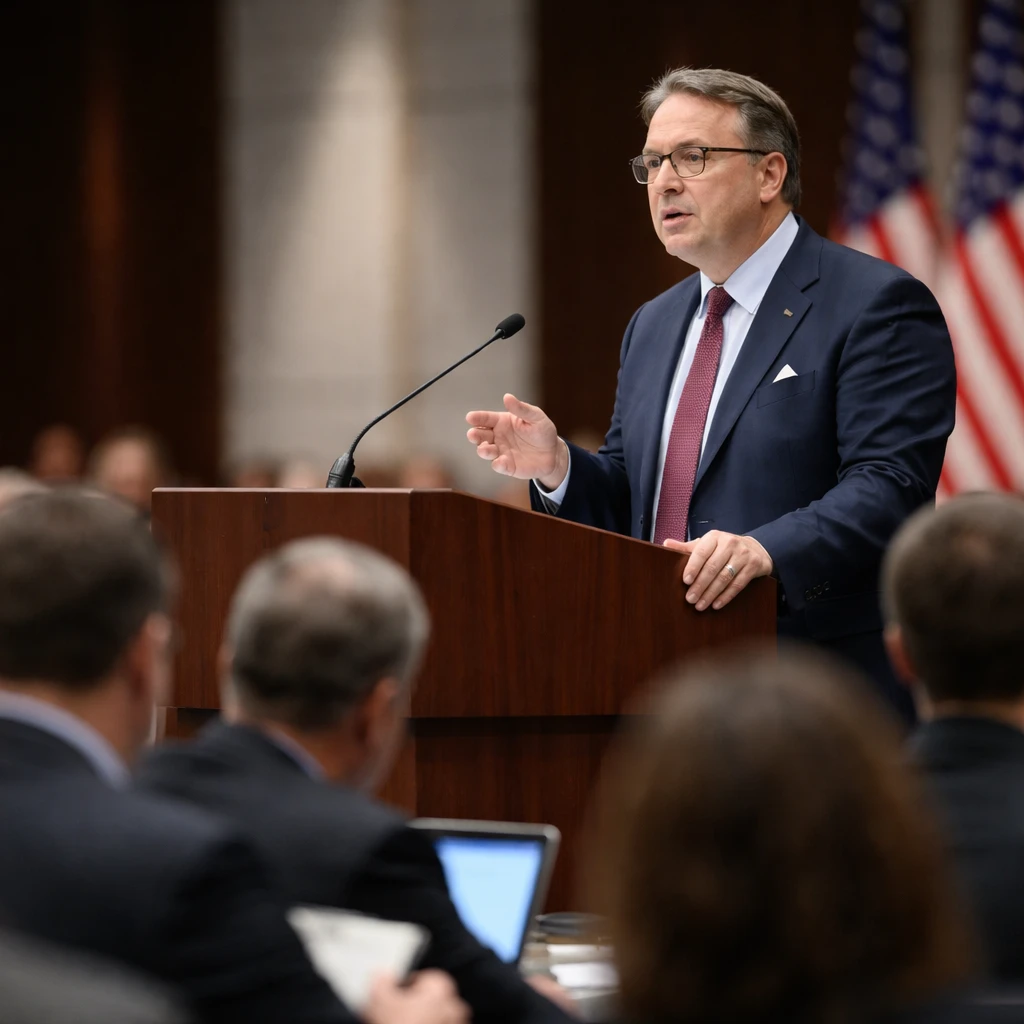
New York Federal Reserve President John Williams said on Tuesday that it remains too early to assess how the war with Iran will ultimately affect U.S. inflation and output. Speaking to reporters after an appearance at a conference hosted by America's Credit Unions in Washington, Williams stressed caution in drawing conclusions at this stage.
Channels of transmission
Williams told reporters that the economic consequences of the conflict are likely to ripple through asset prices and financial market dynamics. To date, he said, those market moves have been relatively muted. He cautioned that the duration and broader implications of the situation are unknown, and that officials will need to watch how developments unfold.
"Nobody can be sure how long this will last or the broader implications," Williams said. "Past experience has shown that movements in oil prices that we've seen so far don't fundamentally shift the economy, but we'll wait and see."
He reiterated that the principal avenues by which the Iran conflict would affect the U.S. economic outlook are changes in oil prices, shifts in financial market conditions, and broader asset-price adjustments. Williams also noted that heightened uncertainty stemming from the geopolitical situation could itself exert economic influence.
Oil dependence and inflation
Williams emphasized that the U.S. economy is substantially less dependent on imported oil than it was 50 years ago, and that movements in oil prices have not historically produced fundamental shifts in economic activity. Nevertheless, he acknowledged that oil-price movements do feed into inflation and that any such change would alter the near-term inflation outlook. The Federal Reserve, he said, will need to assess whether price changes are persistent and therefore warrant a policy response.
He warned that it is premature to make a wider judgment about the conflict's implications for the global economy. The Fed will have to consider potential spillovers across foreign markets and through trading partners, he said, but the shape and scale of those spillovers are not yet clear.
Mandate considerations and inflation expectations
Williams described the Iran conflict as a development that could influence both elements of the Fed's dual mandate - price stability and maximum employment - depending on the magnitude and persistence of the shock. He pointed to the danger that inflation remaining persistently away from target could alter inflation expectations, though he noted that such an effect has not been observed so far.
Asked to compare the current situation with prior shocks, Williams said it is difficult to equate the Iran conflict with the Russian invasion of Ukraine because the persistence of any resulting oil shock is unclear at this juncture.
Other policy and financial stability comments
Turning to other issues, Williams said recent moves in private credit do not appear to him to represent a fundamental threat at this time. He said the Fed is paying attention to shifts in lending that occur outside the regulated banking sector - what he described as a drift of lending activity - but that these developments have not yet risen to the level of a stability risk.
Williams also defended the Federal Reserve's independent research into topics such as tariffs, saying that findings have been consistent across studies and that such work is important for the Fed's policymaking. He rejected the notion that Fed research is driven by political or partisan considerations, characterizing it instead as a necessary input for setting monetary policy independently.
On the outlook for interest rates, Williams observed that long-term inflation expectations have remained notably stable. He said the primary reason to cut policy rates would be to preserve a constant real policy rate if inflation declines, and a secondary consideration would be whether the policy stance should move closer to neutral. Williams added that he continues to view the Fed's policy rate as modestly above the neutral rate.
Bottom line: Williams urged patience, noting that early market reactions to the Iran conflict have been muted, that the U.S. is less dependent on imported oil than in the past, and that the Fed will focus on whether oil-driven price changes prove persistent enough to warrant policy adjustments.