
Economy March 6, 2026

White House Secures Deal to Quadruple Output of 'Exquisite Class' Arms

Major U.S. defense contractors commit to sharply increasing advanced weapons production after White House talks

By Ajmal Hussain
White House Secures Deal to Quadruple Output of 'Exquisite Class' Arms

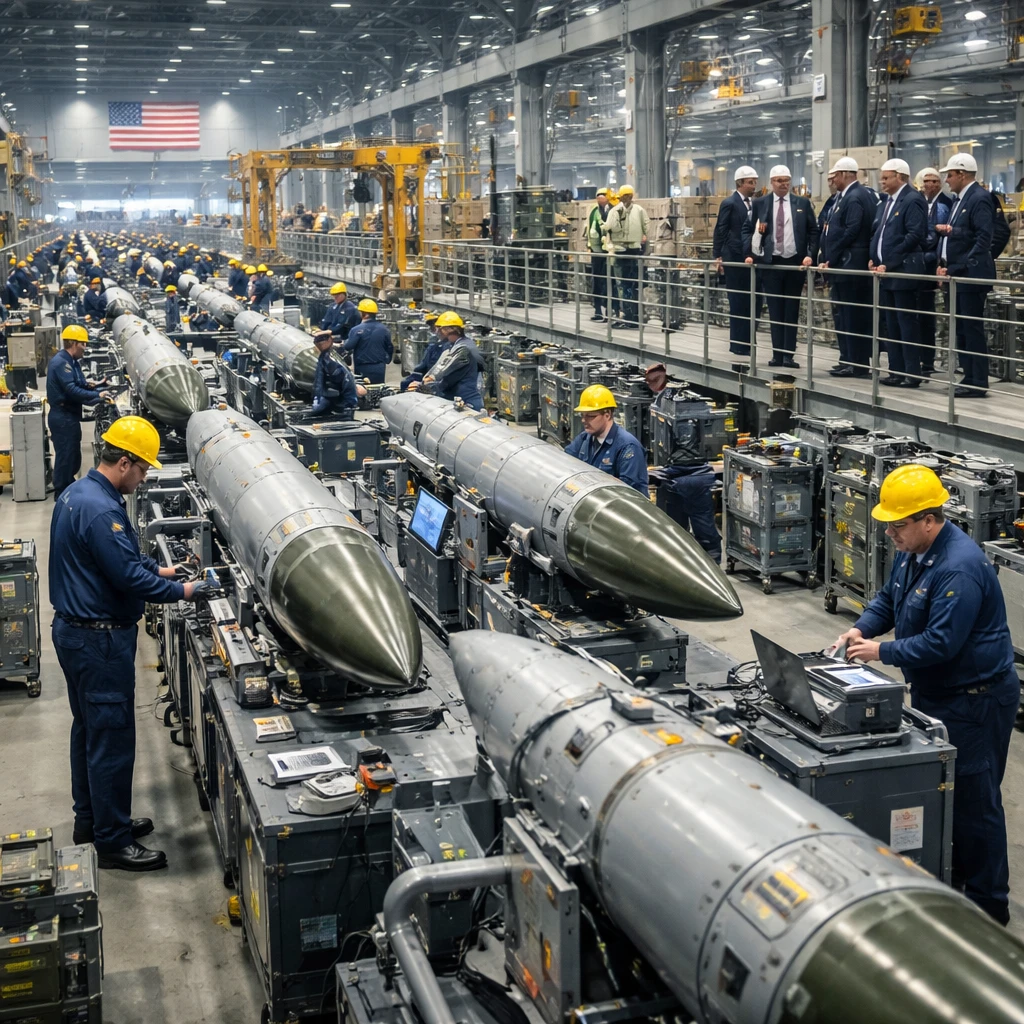
President Trump said senior executives from the country's largest defense manufacturers agreed to ramp up production of advanced weaponry to four times current output. Company expansions reportedly began months earlier, and work on new plants and weapons is already in progress. A follow-up meeting is scheduled in two months as states bid to host new facilities.

Key Points

  • Top U.S. defense contractors committed to quadrupling production of advanced "Exquisite Class" weaponry following a White House meeting - impacts the defense and aerospace manufacturing sectors.
  • Facility expansions reportedly began three months before the meeting and production lines for many weapons are already underway, signaling near-term increases in manufacturing activity - affects industrial and supply-chain logistics sectors.
  • A follow-up meeting is planned in two months and states are competing to host new production plants, indicating further coordination between government, industry, and regional economic development - relevant to manufacturing investment and regional economies.

Summary: President Donald Trump announced that leading U.S. defense contractors have agreed to increase production of advanced weapons - described by him as "Exquisite Class" systems - to four times current levels following a White House meeting. Expansion of production facilities, he said, began three months before the meeting and several plants and weapons production lines are already under way. The president added that the U.S. has a virtually unlimited supply of medium and upper medium grade munitions, which have been used in Iran and were recently used in Venezuela, and that orders at these levels have been increased.


In a post on Truth Social, the president summarized the session as focused on production capacity and delivery schedules. He wrote that the companies in attendance committed to rapidly boosting output of advanced weaponry to reach the highest possible quantities.

Trump said that physical expansions at manufacturing sites started three months prior to the meeting, and that plants and production lines for many weapons are already under construction or operation. He emphasized an abundance of medium and upper medium grade munitions, noting their deployment in Iran and Venezuela and reporting increased orders at those levels.

The executives present at the White House included the chief executives from the following firms:

  • BAE Systems
  • Boeing
  • Honeywell Aerospace
  • L3Harris Missile Solutions
  • Lockheed Martin
  • Northrop Grumman
  • Raytheon

According to the president, another meeting with these industry leaders has been scheduled in two months. He added that multiple U.S. states are competing to host new production plants tied to the expanded manufacturing effort.

This announcement frames an accelerated push by major defense contractors to enlarge capacity for advanced weapons systems. The commitments outlined at the White House, along with prior facility expansions, signal coordinated action between the administration and private sector manufacturers to scale output quickly.


Contextual notes - The public account of the meeting centers on production increases and facility expansion efforts. Specific production timelines, exact output targets beyond the described fourfold increase, and further operational details were not provided in the public statement.

The president also characterized the availability of medium and upper medium grade munitions as effectively unlimited and indicated those munitions have been deployed in Iran and Venezuela; in addition, he said orders at those levels have been increased.

Risks

  • Timing and execution uncertainty - while expansions began three months earlier, the ability to meet the rapid quadrupling commitment depends on delivery schedules and plant build-out, which could affect manufacturing and supply-chain sectors.
  • Location and capacity decisions remain pending - states are bidding to host new plants and final siting choices could influence regional economic impacts and logistics costs for the defense and aerospace industries.
  • Operational detail limits - public statements did not provide granular timelines or production milestones, leaving uncertainty about when increased quantities will be realized and how orders will be allocated across manufacturers.

More from Economy

Tokyo Seeks Assurance It Won't Be Penalized by U.S. Blanket Tariff Move Mar 6, 2026 Cleveland Fed’s Hammack: Inflation Must Fall to 2% or Policy May Tighten Mar 6, 2026 FDA Vaccines and Biologics Chief Vinay Prasad to Exit Agency at Month-End Mar 6, 2026 Where Fed Officials Stand: A Snapshot of Policy Views Ahead of the March Meeting Mar 6, 2026 Cleveland Fed President Calls February Jobs Report a Disappointment, Urges Caution on Policy Mar 6, 2026