
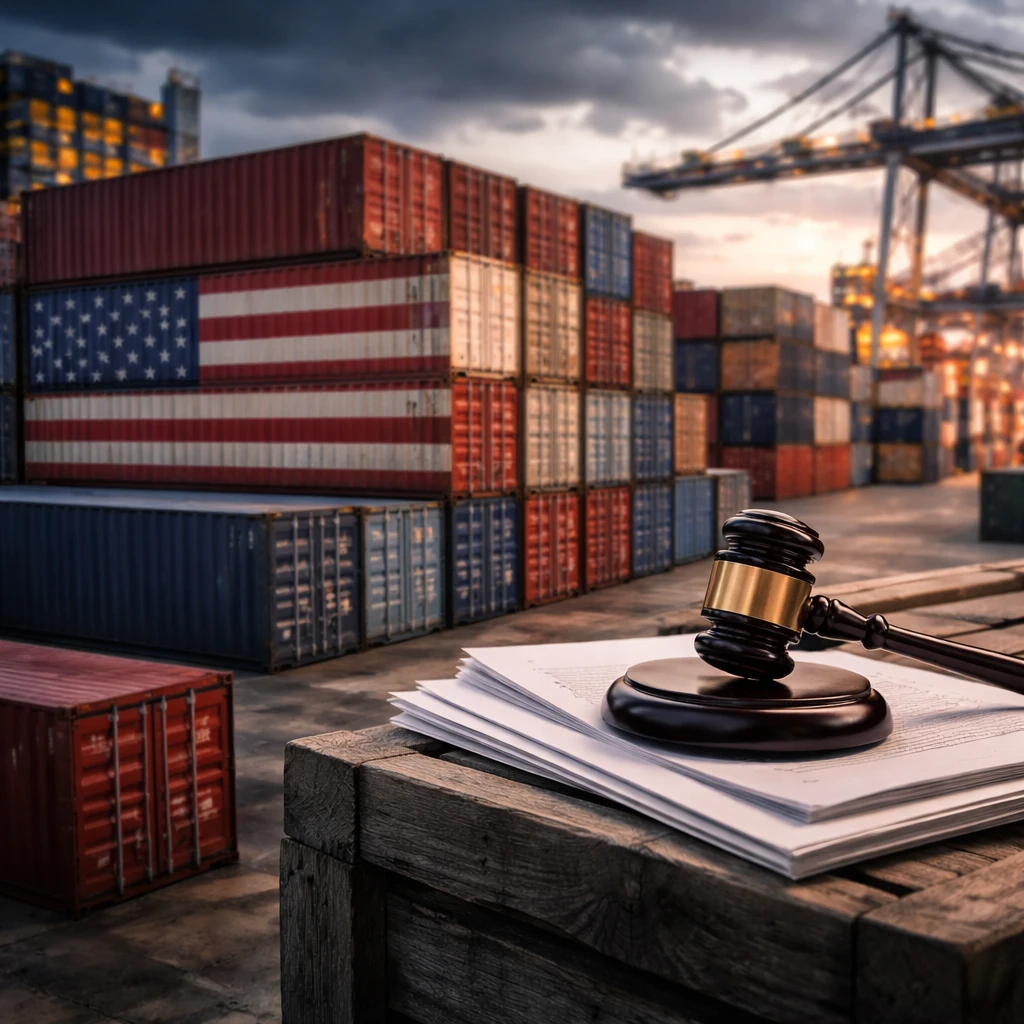
President Donald Trump said on Saturday that he will raise a temporary global tariff rate from 10% to 15%, effective immediately, after the Supreme Court limited the scope of his emergency tariff program. The decision by the high court, handed down in a 6-3 vote, determined that the International Emergency Economic Powers Act (IEEPA) does not give the president broad authority to impose sweeping tariffs, reinforcing Congress' role in tax and trade policy.
In a post on Truth Social, the president said: "I, as President of the United States of America, will be, effective immediately, raising the 10% Worldwide Tariff... to the fully allowed, and legally tested, 15% level," and added that many countries had been "ripping" the U.S. off for decades.
Under existing trade statutes, the newly announced higher tariff can remain in place for up to 150 days, though the move may prompt legal challenges. The administration's declaration follows a court ruling that curtailed one avenue for imposing tariffs, but the White House has signaled it is exploring alternative legal tools, including tariffs under Section 122 and Section 301. Those parallel paths suggest policy uncertainty could persist even after the Supreme Court's restriction.
Markets reacted strongly to the Supreme Court ruling on Friday before the president's announcement, with apparel and retail stocks rising as investors anticipated easing tariff pressures. Analysts said the decision could briefly temper inflation concerns and cut some trade-related uncertainty, outcomes that may support risk assets in the short term.
Despite that initial market relief, experts cautioned that the uplift might be temporary. Some strategists have raised unresolved questions about potential tariff refunds tied to the court's decision. Those refunds could exceed $175 billion, according to analysis cited by market watchers, and carry implications for fiscal policy and market liquidity should they materialize.
The administration's pivot to alternative legal authorities and the potential for large-scale refunds underscore how trade policy remains a principal macroeconomic risk for investors. Financial markets are likely to monitor subsequent legal filings and policy moves closely in the coming days and weeks, seeking clarity on the operational and liquidity impacts of these developments.
The combination of a legally constrained emergency tariff mechanism, an immediate presidential adjustment to the tariff level, and ongoing exploration of other tariff authorities has placed trade policy back at the center of market attention. For sectors sensitive to import costs - notably apparel and retail, which already showed price-sensitive stock moves - the prospect of renewed or redirected tariff measures will be a near-term focus for investors and supply chain managers alike.
At the same time, outstanding legal and fiscal questions - including the scope and timing of any refunds and the likelihood of court challenges to the 15% adjustment - create an environment of continued uncertainty for markets and policymakers.