
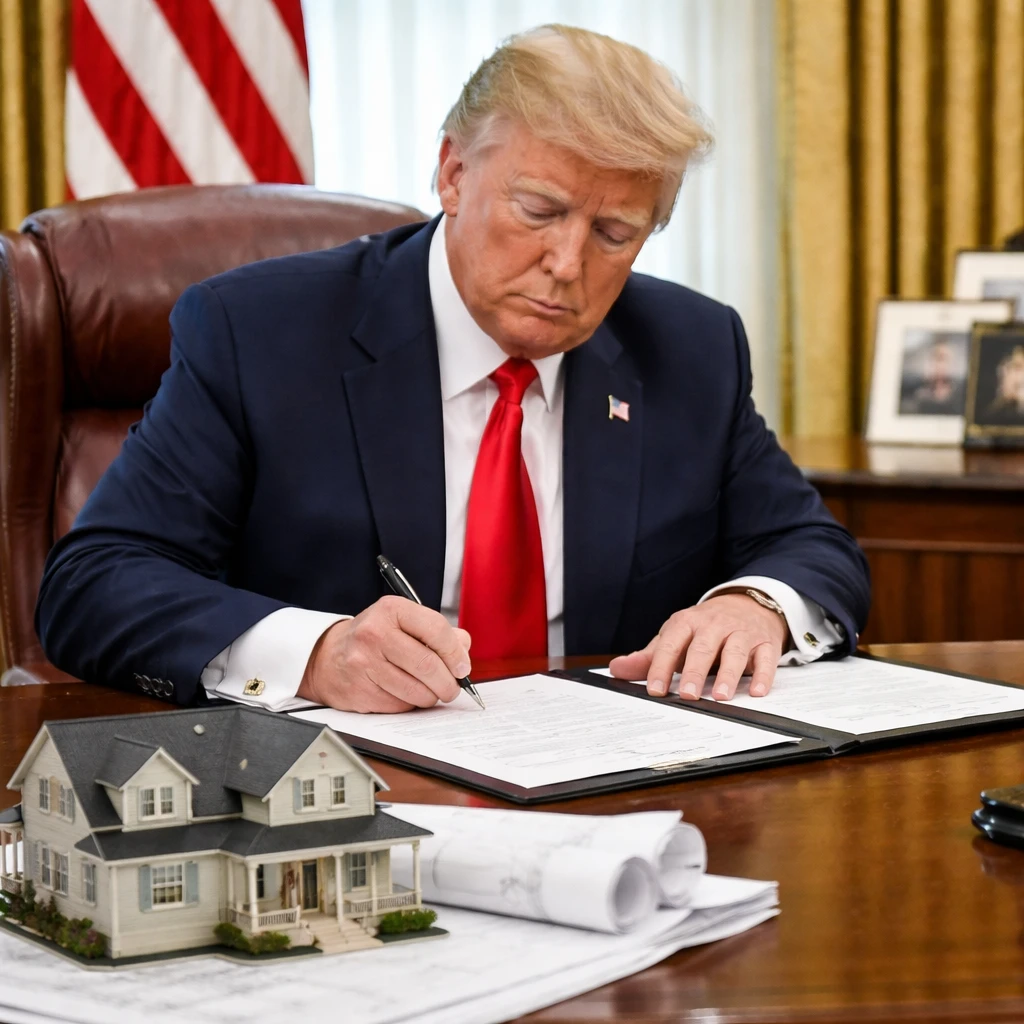
President Donald Trump on Friday signed two executive orders designed to address housing affordability as lawmakers and administrations position themselves ahead of the November election for control of the House and Senate.
The first order calls for federal efforts to pare back housing-related regulatory burdens and to establish incentives that reward state and local governments that adopt practices meant to streamline development. The stated aim is to remove obstacles that make it harder for builders to put up new homes.
The second order focuses on easing regulations connected to mortgages, with a particular eye toward allowing smaller community banks greater latitude to provide home loans. Together, the two directives seek to change elements of the regulatory environment that officials say have contributed to higher housing costs.
In a draft of one of the orders, officials wrote: "Layers of unnecessary regulatory barriers, slow permitting processes, and onerous mandates at all levels of government have delayed construction, restricted development, and driven up the costs of new housing." The draft added that these constraints have made housing less affordable for many Americans.
Documents released by the administration indicate that the measures are intended to place renewed emphasis on home ownership as a public policy priority. Housing affordability has surfaced as a central political issue for both major parties, and the administration's actions make housing a visible part of its policy agenda in the run-up to the November elections.
How the orders will be implemented - including the specific incentives for state and local governments and the particular mortgage regulatory changes for community banks - remains to be worked out in the administrative process. The directives signal an intention to reshape aspects of permitting, development approvals, and mortgage regulation without detailing every procedural step in the orders themselves.
Key points
- The first order targets reductions in housing regulatory burdens and seeks to incentivize state and local governments to adopt practices that facilitate homebuilding.
- The second order aims to trim mortgage-related regulatory burdens to make it easier for community banks to offer home loans.
- Both orders are framed as efforts to improve affordability and are being advanced ahead of the November election for control of the House and Senate.
Risks and uncertainties
- Details on implementation are not specified in the orders, leaving uncertainty about how and when regulatory changes will take effect.
- Outcomes depend on state and local government responses to incentives, creating variability in results across jurisdictions.
- Changes to mortgage regulation and the role of community banks may face administrative and procedural hurdles before producing measurable effects.