
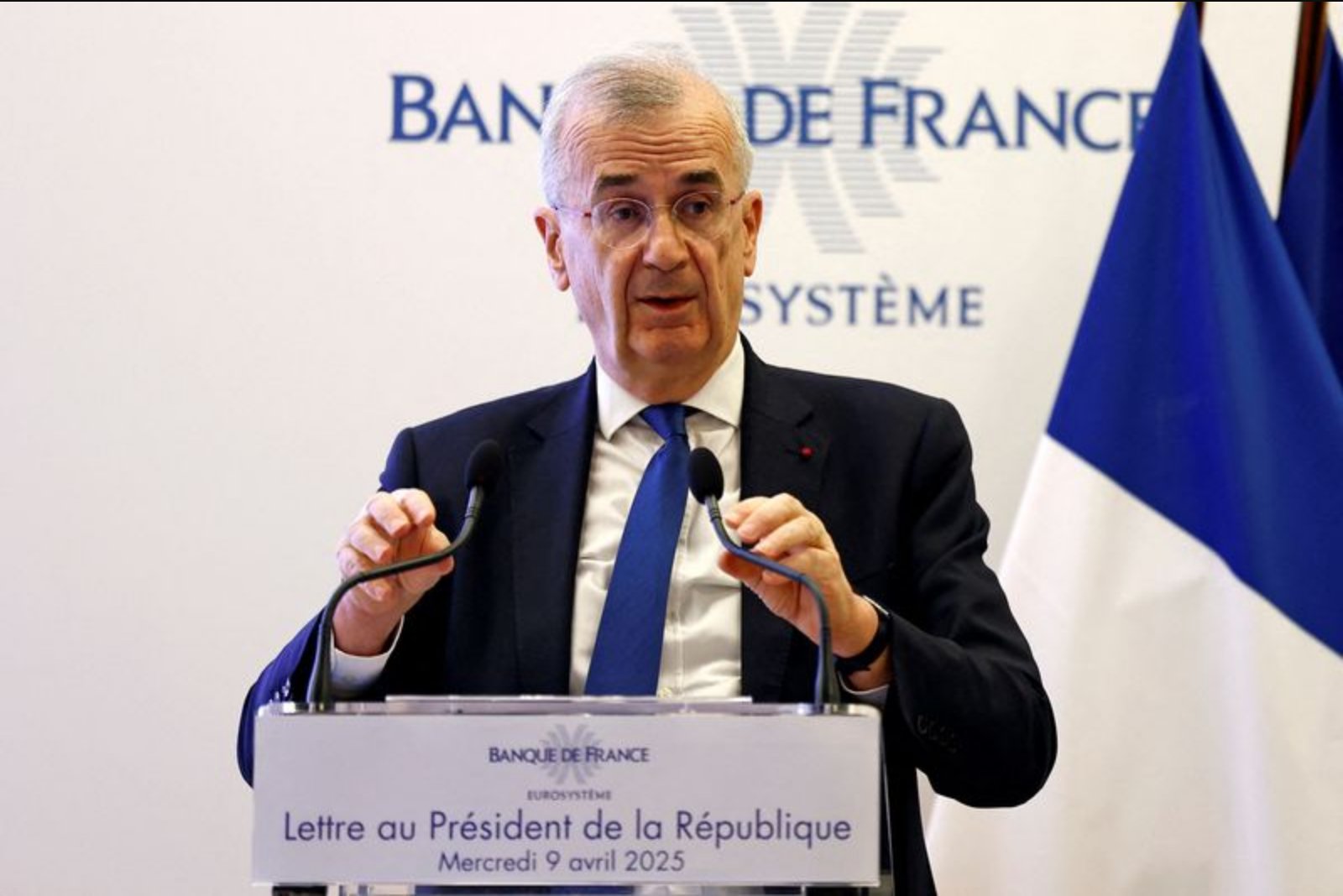
Francois Villeroy de Galhau’s decision to step down from the Banque de France in June - more than a year before his term would have expired - is unlikely to alter the European Central Bank’s policy outlook in the near term, analysts and officials say.
Announced on Monday, the resignation means French President Emmanuel Macron will name a new governor before the 2027 presidential election - a contest that polls suggest could be won by the eurosceptic far-right. Despite the domestic political implications, observers stressed that the ECB’s stance is unlikely to shift merely because one national central bank governor departs.
Villeroy has been among the most vocal doves on the ECB’s Governing Council, frequently highlighting risks that could push inflation lower, including pressures stemming from a stronger euro. His repeated cautions on downside inflation risks made him a prominent voice for lower-for-longer interest-rate expectations within the council.
Still, his resignation was widely viewed as unlikely to produce an immediate market or policy reaction. "The resignation won’t have any immediate implications for the market," said Marco Brancolini, head of euro rates strategy at Nomura, who also commended Villeroy’s investor communications.
The ECB itself moved unanimously last week to keep interest rates unchanged and, according to analysts, is expected to maintain that pause through the remainder of the year unless major geopolitical or trade shocks force a reassessment. That prevailing expectation underlines why a single personnel change at a national central bank may not translate into a change in the bloc-wide policy course.
Two sources indicated several potential candidates for the French central bank post. Names mentioned included current Banque de France director Bertrand Dumont and former head Emmanuel Moulin; deputy governor Agnes Benassy-Quere and former ECB policymaker Benoit Coeure, both of whom have held Treasury positions; and former OECD chief economist Laurence Boone, who currently works at Spanish bank Santander.
Observers note that France’s significant public debt burden tends to shape the preferences of any incoming governor. Eric Dor, director of economic studies at the IESEG School of Management, said a replacement was likely to be a centrist with dovish leanings - a tilt toward lower interest rates - because of the fiscal implications for an indebted country.
"Governors at the end of the day are hawkish or dovish depending on the state of their national economy," Dor said. "If you are the governor of the central bank of a very indebted country - so if you are French, if you are Italian - necessarily, you have to take account that too high an interest rate is a very big problem for the public finance of your country."
Yet the broader balance within the ECB appears to have moved toward rare harmony in recent months, reducing the influence any single governor can exert on the overall policy direction. Analysts attribute this cohesive dynamic to several recent personnel changes across euro zone central banks and to ECB President Christine Lagarde’s more collegiate style of management compared with her predecessor, Mario Draghi.
Examples of personnel shifts cited by analysts include Austria’s central bank, where Robert Holzmann - an often outspoken hawk who dissented when the ECB cut rates in 2024-25 - was succeeded by the more moderate Martin Kocher. In Portugal, Mario Centeno, considered dovish, was replaced by a centrist, Álvaro Santos Pereira. The Netherlands also has a new central bank chief, Olaf Sleijpen, who has generally aligned with the official line in ways his predecessor Klaas Knot sometimes did not during periods of very loose policy.
These appointments have, according to some observers, narrowed the variance of opinions on the Governing Council and made consensus easier to reach. "The variance of opinions has decreased, it is easier to reach a consensus," Dor said. "So, I don’t think that the change of another governor is a big challenge now."
Given that context, the departure of a single national governor - even one as prominent as Villeroy - is widely seen as insufficient on its own to tilt the ECB’s policy trajectory, at least in the absence of significant external shocks to the geopolitical or trade environment.
Key points
- Francois Villeroy de Galhau will step down as Banque de France governor in June, allowing President Macron to appoint a successor before the 2027 presidential election.
- Villeroy was a leading dove on the ECB Governing Council, warning of downside inflation risks including those from a stronger euro.
- Recent personnel changes across euro zone central banks and a more collegial ECB leadership have reduced variance in views, making a single replacement unlikely to shift ECB policy.
Risks and uncertainties
- Political risk in France - the new appointment will occur ahead of a presidential election that polls suggest could be won by the eurosceptic far-right; this raises uncertainty for domestic fiscal and monetary priorities, affecting sovereign debt and banking sectors.
- Potential external shocks - major geopolitical or trade disruptions could force the ECB to abandon its current hold on interest rates, with consequences for bond markets and currencies.
- Public debt sensitivity - countries with high public debt, such as France and Italy, are particularly vulnerable to higher rates, which could impact government financing costs and the broader sovereign bond market.