
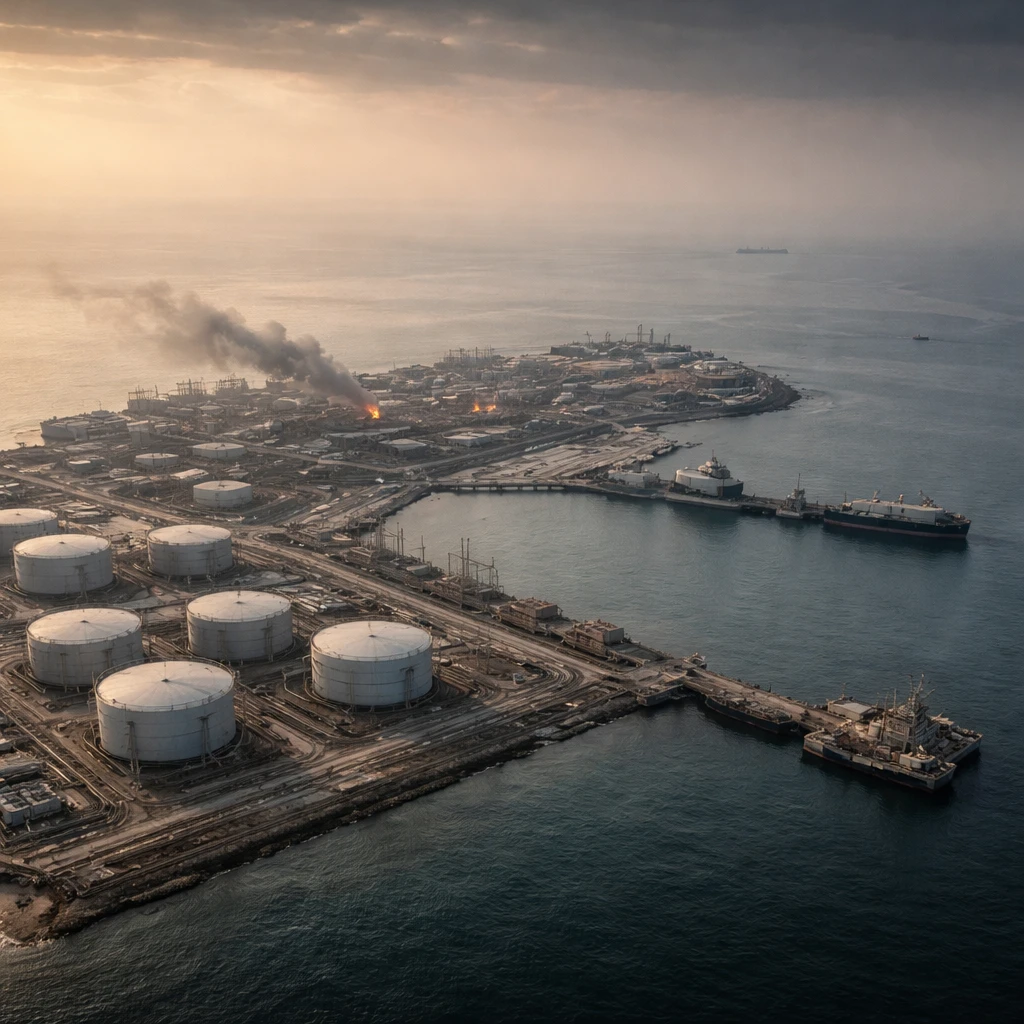
U.S. President Donald Trump stated on Friday that U.S. forces have "obliterated" every military target on Iran's Kharg Island, a facility that serves as the Islamic Republic's principal crude export hub. The operation, carried out by U.S. Central Command (CENTCOM), focused on military installations and defensive capabilities on the island.
In a public statement posted on Truth Social, the president emphasized that the strikes intentionally left the oil infrastructure intact. "For reasons of decency, I have chosen NOT to wipe out the Oil Infrastructure on the Island," he wrote, tying that restraint to Iran allowing "Free and Safe Passage" for commercial vessels. At the same time, Trump warned he remains prepared to target Iran's critical oil infrastructure should Tehran persist in obstructing traffic through the Strait of Hormuz.
Kharg Island handles roughly 90% of Iran's crude exports, making it central to the country's oil trade. Analysts at SEB had previously cautioned that damage to the island's export terminals would pose a "big, big risk" to global supply and could trigger sustained price shocks beyond the immediate conflict window.
The strike arrives against a backdrop of sharply reduced shipping through the Strait of Hormuz. Data from ACLED cited in reports show that daily transits have fallen to fewer than 10 vessels, down from a 2026 average of 84. That dramatic drop has tightened physical flows and contributed to Brent crude trading near the $100-per-barrel level.
Policy responses to the supply squeeze have included coordination by the International Energy Agency (IEA) of a large release from strategic stockpiles. The IEA has organized a 400-million-barrel distribution intended to counter what it described as "energy-fueled inflation." ING analysts have argued that the resulting rise in certain commodity-linked cost pressures - including fertilizer and plastic feedstocks affected by the Gulf crisis - may keep the Federal Reserve inclined toward a more restrictive monetary stance if the core personal consumption expenditures gauge continues to move away from its 2% target.
Naval posture in the region is being adjusted as well. The U.S. Navy is preparing to provide armed escorts for commercial vessels transiting the Strait of Hormuz, while investors and market participants are watching for any retaliatory actions from Iran's Revolutionary Guard.
Key dynamics to monitor include the durability of the restraint shown toward oil terminals, the pace at which tanker transits can be restored, and how central banks respond to commodity-driven inflationary pressure. Each of those variables bears directly on energy markets, shipping insurance, and broader macroeconomic policy settings.