
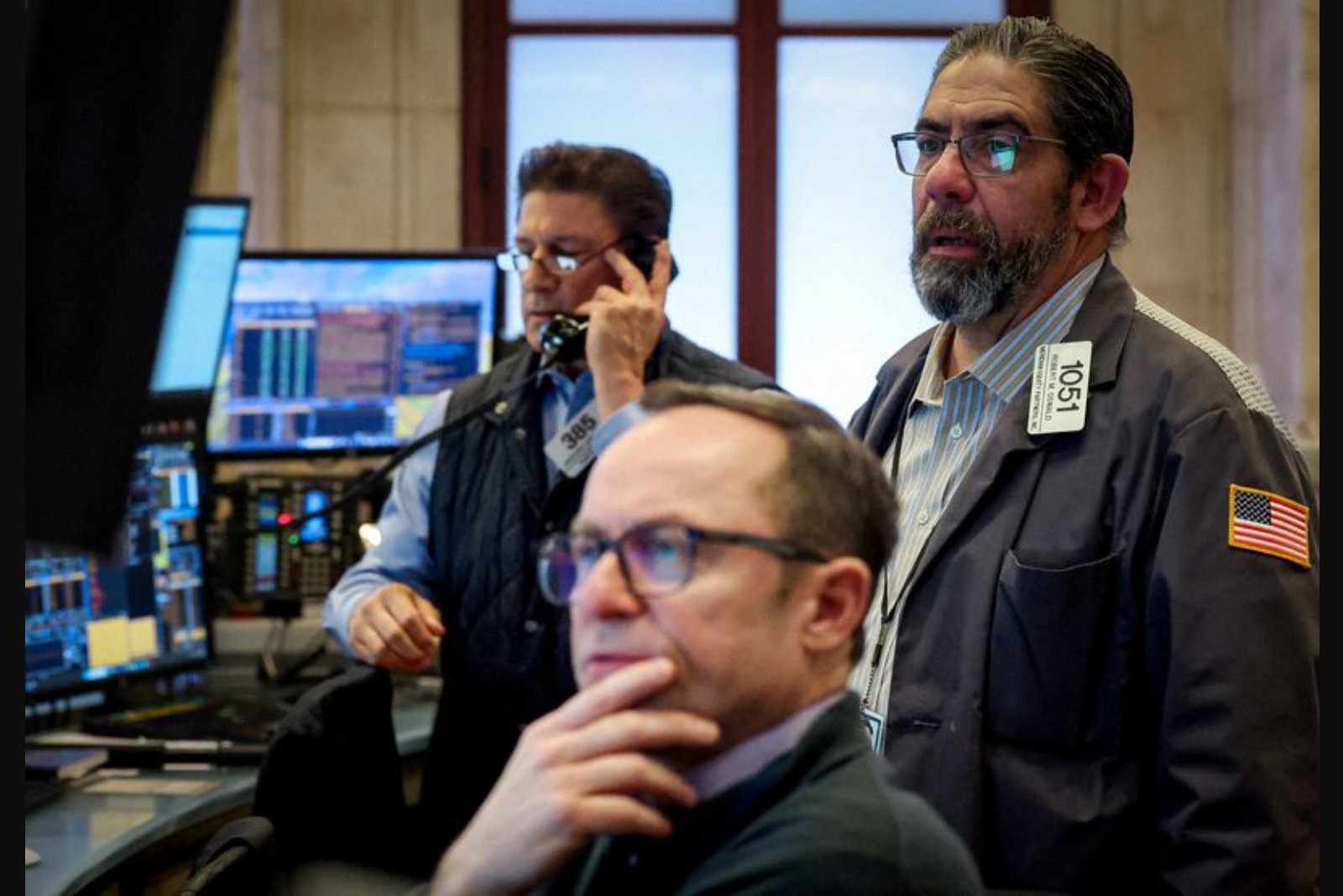
U.S. stock futures opened lower as mounting unease about artificial intelligence rattled technology shares, sending the Nasdaq toward its steepest monthly decline since March 2025. Market participants were also parsing new tariff developments and awaiting a January producer prices report due before the bell that could shed light on the Federal Reserve’s potential interest-rate path.
Tech-related volatility has been pronounced this month as investors debated whether heavy spending on AI will generate the expected returns. That skepticism contributed to broad swings across software and other growth areas even where earnings remained strong.
Tariff uncertainty added to market jitters after the U.S. Supreme Court recently voided most of the duties imposed last year by U.S. President Donald Trump. In response, the president announced a temporary global tariff of 10% that took effect on Tuesday, creating an additional layer of policy risk for markets.
Nvidia, a bellwether for AI sentiment, was marginally lower in premarket trading, slipping 0.1% after dropping more than 5% in the previous session despite reporting strong earnings. The stock’s recent moves underscored that risk appetite for AI-exposed names remained fragile.
"It’s easy to feel anxious when the tech darlings that carried the market stumble," said Brian Jacobsen, chief economic strategist at Annex Wealth Management. "We are witnessing a true market rotation, where opportunities are broadening out beyond a handful of megacap tech stocks and flowing into value stocks, small-caps and industrial sectors."
Individual stock reactions were uneven. Cloud security firm Zscaler fell 10.5% after reporting a wider net loss for the second quarter. Intuit retreated 3.1% after forecasting third-quarter profit below Wall Street estimates. Earlier in the year, software shares had already been pressured by concerns about AI-driven disruption across the industry.
Beyond pure software players, several service-oriented and industrial segments were feeling the effects of AI anxiety, with financial brokerages, data analytics and legal services, real estate services and trucking among those cited as being hit hard by brewing concerns.
In the prior session, both the S&P 500 and the Nasdaq finished lower. The Nasdaq closed beneath its 50-day moving average for the 17th consecutive session - a commonly watched gauge of the intermediate-term trend - while the Dow Jones Industrial Average was poised to log a 10th straight month of gains.
Investors were also focused on the January producer price index, a data release scheduled before the market open that could provide clues on underlying inflation and by extension influence expectations for the Fed’s interest-rate trajectory.
At 07:31 a.m. ET, futures trading showed Dow E-minis down 294 points, or 0.59%, S&P 500 E-minis down 27.75 points, or 0.4%, and Nasdaq 100 E-minis lower by 98.25 points, or 0.39%.
Most megacap and growth-oriented stocks edged lower in the session, and chip names including AMD and Broadcom also weakened. Yet pockets of the market posted notable moves in both directions:
- Netflix jumped 8.1% after investors cheered the company’s decision to exit the contest for Warner Bros Discovery, which slid 1.4%.
- Paramount Skydance climbed 7.5% after securing a coveted collection of TV and film assets.
- Block surged 20% following an announcement that it would cut over 4,000 jobs - nearly half its workforce - as part of a restructuring aimed at embedding AI across its operations.
- Dell rose 12.1% after projecting that revenue from its AI-optimized servers business will double by fiscal year 2027 and pledging to return more cash to shareholders.
- Duolingo plunged 24.2% after forecasting first-quarter and 2026 bookings below expectations.
The split in performance highlighted the rotation Jacobsen described, with investors reallocating capital away from names once viewed as market leaders and toward other areas seen as offering different risk-reward profiles. For now, that reallocation, combined with policy and inflation uncertainty, has produced a choppy market environment.
Key data to watch for the session included the producer prices report for January, released before the opening bell, which market participants expected could influence sentiment on interest-rate prospects and therefore valuations across sectors, particularly in rate-sensitive technology and growth stocks.