
Economy February 9, 2026

U.S. Container Imports Fall 6.8% in January as China Shipments Drop Sharply

Descartes data shows volumes remain above historic norms despite year-over-year declines tied to last year’s frontloading ahead of tariffs

By Maya Rios
U.S. Container Imports Fall 6.8% in January as China Shipments Drop Sharply

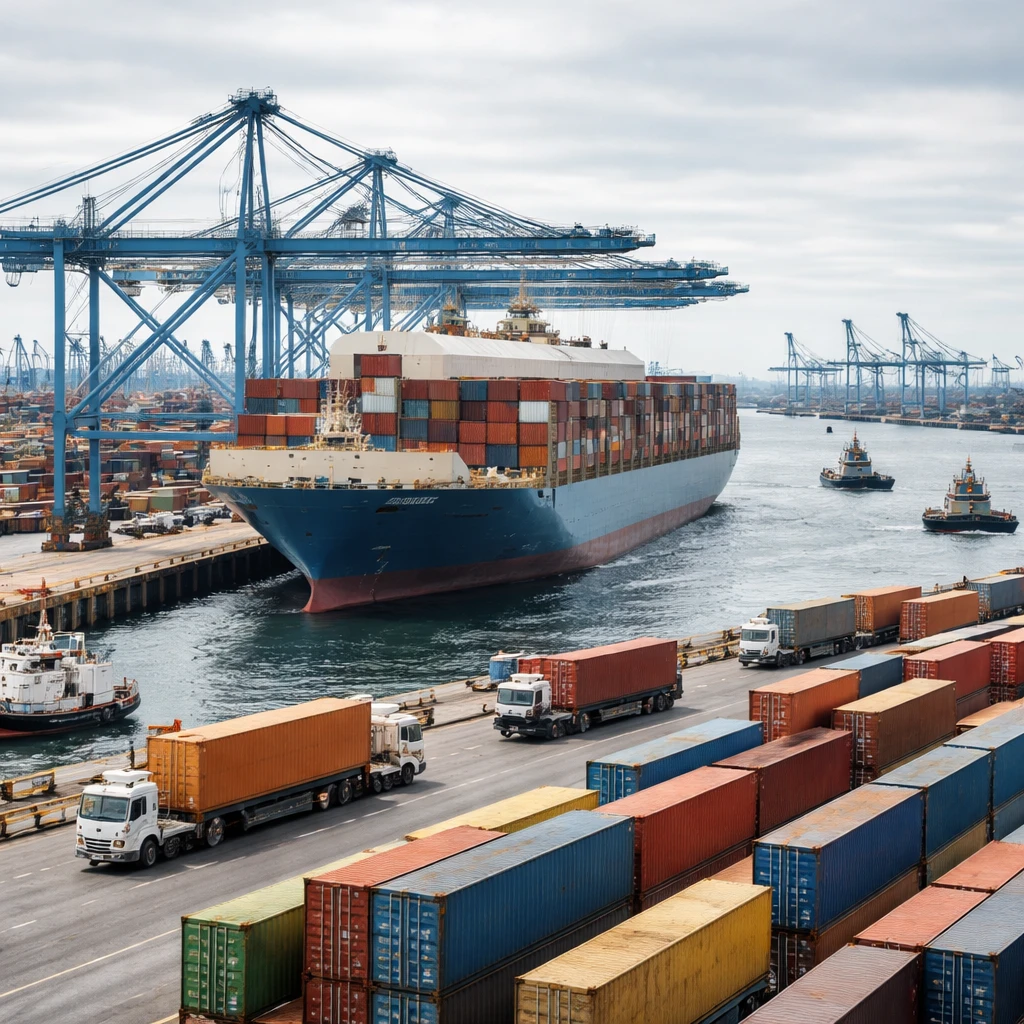
U.S. seaports handled 6.8% fewer container imports in January versus the prior year, according to Descartes Systems Group. The month saw 2,318,722 TEUs overall, a figure above the historical average that Descartes attributes to steadier demand rather than the frontloading that drove January 2025’s record. Imports from China fell 22.7% to 771,093 TEUs, but still represented about one-third of total U.S. container volumes.

Key Points

  • U.S. seaports handled 6.8% fewer container imports in January year-over-year, according to Descartes Systems Group.
  • Total January volume was 2,318,722 TEUs, above the historical average and viewed by Descartes as reflecting steadier demand rather than last year’s frontloading.
  • Imports from China fell 22.7% to 771,093 TEUs but still comprised about one-third of U.S. container imports in January.

U.S. ports recorded a 6.8% decline in container import volumes in January compared with the same month a year earlier, data released Monday by supply chain technology provider Descartes Systems Group showed.

The report noted that January 2025 had been unusually strong as companies accelerated shipments to avoid impending tariffs announced by President Donald Trump, producing a record-high month for imports. By contrast, this January’s levels, while down year-over-year, remained above the historical average for the month.

Descartes said the elevated-than-average total of 2,318,722 20-foot equivalent units - TEUs - likely reflects a return to a more normalized trade pattern driven by steady demand rather than the frontloading activity observed a year earlier.

Imports originating from China fell more sharply than the overall figure, dropping 22.7% to 771,093 TEUs compared with January 2025. Despite that sizable decrease, shipments from China still made up roughly one-third of all container imports into the United States for the month.

Container import volumes are closely monitored by market participants because they provide a real-time gauge of economic activity, particularly consumer demand, which is a major driver of the U.S. economy. Descartes' figures also underscore how the tariff-focused trade policies announced by President Trump have affected trade flows and market perceptions, influencing activity on both Main Street and Wall Street.


The data offer a snapshot of port activity that market observers and supply chain managers can use to assess current demand conditions and the lingering effects of policy-driven shipment timing. While year-over-year comparisons show declines, the persistence of above-average volumes for the month suggests demand has not weakened to the point of dropping below typical seasonal levels.

Risks

  • Policy-driven shifts in shipment timing, such as frontloading ahead of tariffs, can distort year-over-year comparisons and complicate demand assessments - this affects retail, logistics, and shipping sectors.
  • A pronounced decline in imports from a major supplier like China introduces uncertainty for supply chains and market participants that rely on stable inbound volumes - this impacts consumer goods, logistics, and financial market sentiment.
  • Interpreting whether lower year-over-year volumes reflect normalization versus weakening demand is uncertain, making short-term planning for inventory and transportation more challenging for companies and investors.

More from Economy

USMCA Goods Largely Exempted From New 10% Global Tariff, But Review Threat Looms Feb 20, 2026 U.S. Trade Office to Open Broad Section 301 Reviews Covering Major Partners Feb 20, 2026 Supreme Court Term Spotlight: High-Stakes Cases Shaping Law and Policy Feb 20, 2026 Trump Vows Fresh 10% Global Tariff After Supreme Court Limits His Trade Authority Feb 20, 2026 Supreme Court Ruling Narrows Presidential Tariff Options, Treasury Secretary Says Feb 20, 2026