
Overview
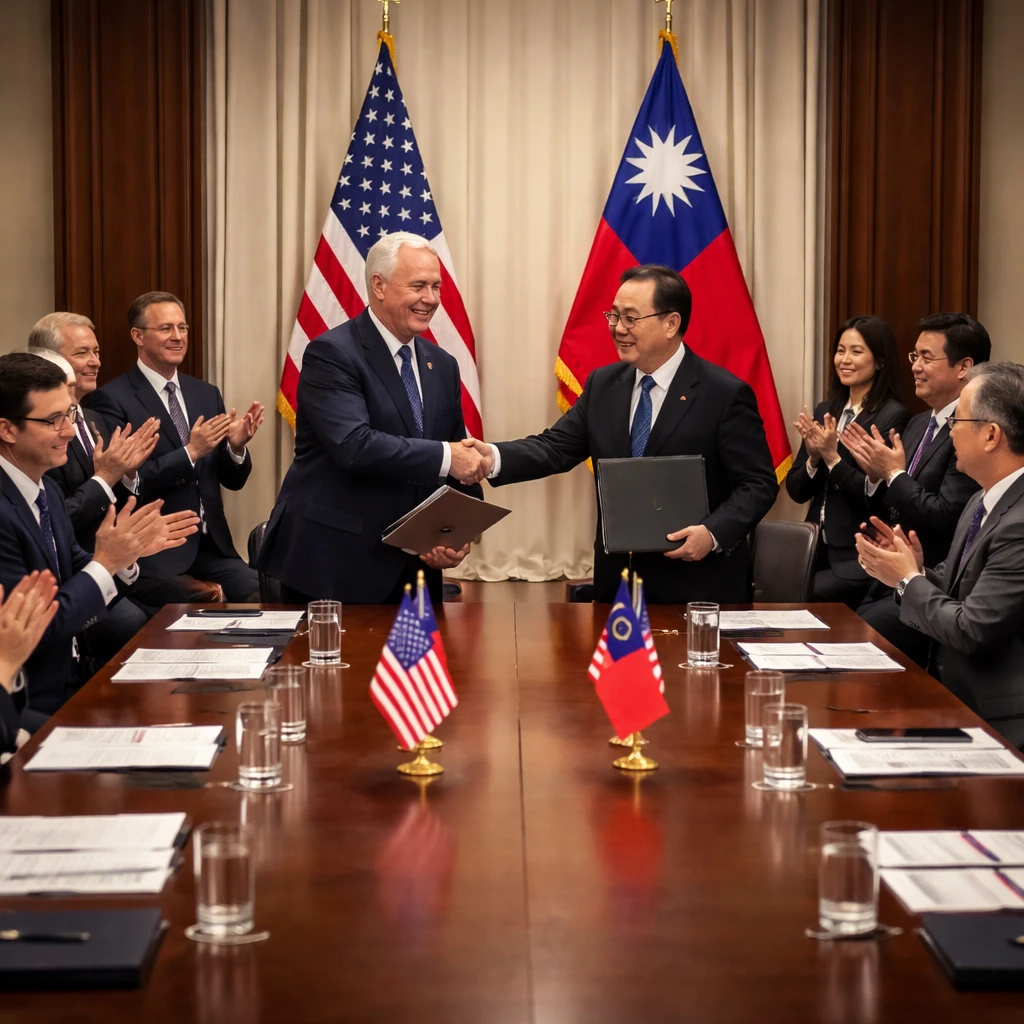
The United States and Taiwan concluded a bilateral reciprocal trade agreement in Washington that formalizes tariff reductions and a set of large-scale purchase commitments. The accord, signed under the auspices of the American Institute in Taiwan (AIT) and the Taipei Economic and Cultural Representative Office (TECRO), creates a framework intended to expand commercial ties and reduce longstanding impediments to market access.
Tariff changes and purchase commitments
A central economic element of the agreement is a reduction in Taiwanese tariffs on U.S. goods from 20% to 15%. In return, Taiwan has agreed to an expansive procurement program of U.S. commodities and manufactured products. The commitments include $44 billion in American liquefied natural gas and crude oil purchases and $15 billion in civil aircraft and parts to be acquired by 2029.
In addition to those commodity purchases, Taiwan pledged to invest approximately $25 billion in U.S.-made power-generation equipment over the coming years. The deal frames that capital as a reinforcement of U.S. domestic manufacturing while also supplying Taiwan with essential infrastructure for its industrial and energy requirements.
Non-tariff barriers and sector access
The agreement also targets non-tariff barriers that have limited U.S. exporters, with specific measures affecting automotive and agricultural trade. Taipei will remove quantitative limits on U.S. motor vehicle imports and expand market access for American beef, dairy, pork, and medical products. The deal explicitly aims to eliminate both tariff and non-tariff obstacles facing U.S. exports, according to the U.S. Trade Representative.
"The Agreement on Reciprocal Trade with Taiwan will eliminate tariff and non-tariff barriers facing U.S. exports to Taiwan, furthering opportunities for American farmers, ranchers, fishermen, workers, small businesses, and manufacturers," said USTR Jamieson Greer.
Strategic framing
USTR Jamieson Greer framed the pact as part of a wider trade strategy in the Asia-Pacific. Ambassador Greer said the agreement supports both economic and national security interests and noted the role of presidential leadership in developing trade ties in the region.
Implications for industries and markets
The agreement is structured around a mix of tariff concessions, guaranteed purchases of energy and aircraft, investments in power-generation equipment, and reduced barriers for agricultural, automotive, and medical exports. Those elements together are intended to bolster U.S. manufacturing output linked to energy infrastructure, civil aviation supply chains, and high-technology components while providing Taiwanese industry with materials and equipment critical to its energy security and industrial growth.
Key points
- The pact cuts Taiwanese tariffs on U.S. goods from 20% to 15% and addresses non-tariff barriers that have impeded exports.
- Taiwan committed to purchasing $44 billion in U.S. liquefied natural gas and crude oil and $15 billion in civil aircraft and parts by 2029; it also plans about $25 billion in U.S. power-generation equipment investments.
- The agreement emphasizes high-technology supply-chain cooperation and expands access for U.S. agricultural, automotive, and medical products.
Risks and uncertainties
- The timeline and execution of the purchase commitments and equipment investments are subject to implementation - affecting energy, aerospace, and manufacturing sectors.
- Removal of non-tariff barriers will require regulatory and administrative changes in Taiwan to benefit U.S. agribusiness, automotive, and medical exporters.
- The scale of capital flows and procurement depends on adherence to the framework by both parties over the coming years - introducing execution risk for sectors reliant on those purchases.
Conclusion
The reciprocal trade agreement signed in Washington formalizes lower tariffs and a structured set of purchases and investments designed to strengthen commercial ties between the United States and Taiwan. It couples immediate tariff relief with long-term procurement and infrastructure commitments, and it specifically targets barriers that have limited U.S. access to Taiwanese markets in several sectors.