
Key developments
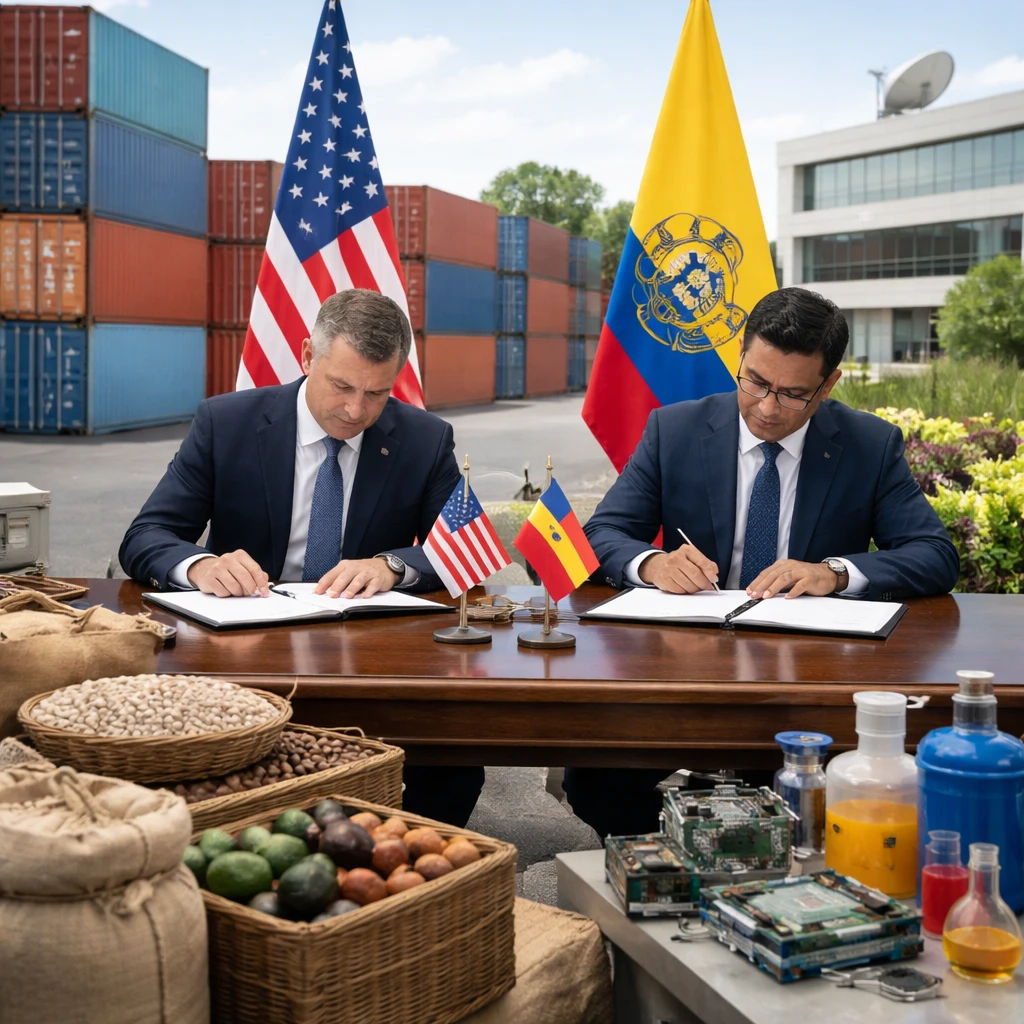
U.S. Trade Representative Jamieson Greer signed a finalized trade agreement with Ecuador on Friday, formalizing tariff reductions across several industrial and agricultural categories as the administration reshapes trade policy in the Western Hemisphere. The agreement was signed in the presence of Ecuadorian Minister Luis Alberto Jaramillo and grants U.S. exporters access to a market of roughly 18 million consumers for goods including machinery, information technology products and chemicals.
The accord follows a November framework that narrowed import levies on food items, an action taken in part to help rein in domestic grocery inflation that remains a politically sensitive issue ahead of the midterm elections.
Provisions on tariffs and critical minerals
Under terms labeled the "Agreement on Reciprocal Trade," Ecuador has agreed to remove or scale back barriers affecting specific food and beverage categories - notably tree nuts, wheat, wine and distilled spirits - and to eliminate the variable tariff mechanism applied under the Andean Price Band System. The deal also establishes a pathway for investment in critical mineral projects, which the U.S. administration treats as a central element of efforts to diversify supply chains and reduce dependence on non-market economies.
Security, migration and institutional changes
Beyond tariff adjustments, the pact contains provisions touching on national security and migration. Quito will institute transit visa requirements for what the agreement describes as "high-risk" nationalities, citing Haitians and Cubans, with the aim of reducing undocumented migration toward the U.S. border. The agreement also includes Ecuador's commitment to shift its space agency from military to civilian control to enable closer technical cooperation with Washington.
Enforcement and wider policy context
The agreement provides Ecuador relief from the 10% global import surcharge applied under Section 122. At the same time, USTR Greer signaled that enforcement will remain a priority; the office has recently launched Section 301 investigations into dozens of trading partners focused on issues such as forced labor and excess capacity. U.S. officials view the Ecuador deal as a potential template for negotiations with other regional partners, including Argentina and Guatemala.
Investors and market participants will be watching whether this and similar bilateral agreements can help offset market volatility linked to the broader 10% global tariff regime and recent Supreme Court constraints on executive tariff authority.
Summary
The finalized U.S.-Ecuador trade agreement reduces tariffs on selected industrial and agricultural products, opens Ecuador's market to U.S. machinery, IT and chemical exporters, creates an investment roadmap for critical minerals, imposes migration controls including transit visas for specified nationalities, moves Ecuador's space agency to civilian oversight, and grants relief from the 10% Section 122 surcharge while underscoring continued enforcement via Section 301 investigations.