
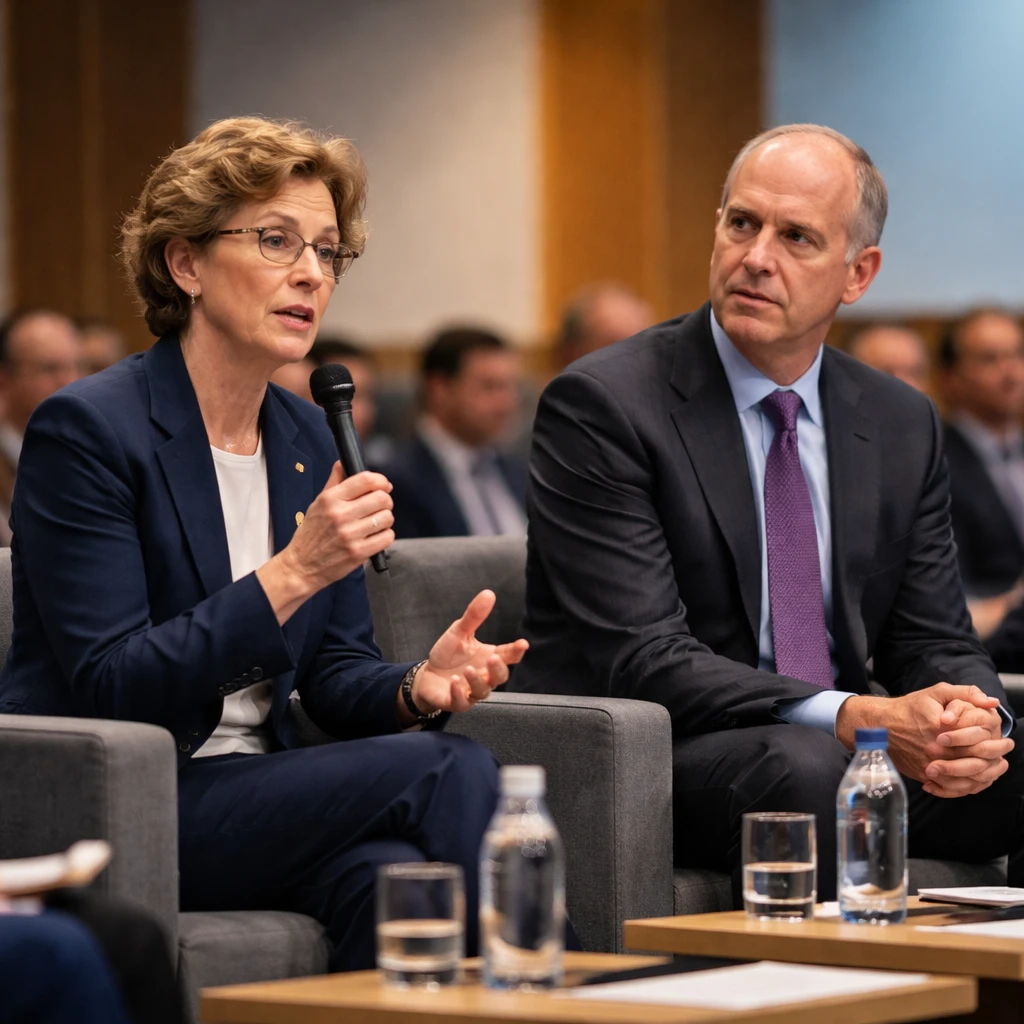
Two members of the Federal Reserve's leadership panel indicated on Tuesday that they are not inclined to change the central bank's interest rate stance in the immediate future, emphasizing caution as the outlook for inflation remains uncertain.
Markets have priced in expectations for additional rate reductions later this year, but officials have not provided firm guidance on the timing or scale of further cuts as they weigh evidence on both labor market stability and the persistence of inflation above the central bank's 2% objective.
Federal Reserve Bank of Boston President Susan Collins, speaking on a panel at a technology conference organized by her bank, said, "I think that it’s quite likely that it’ll be appropriate to hold in the current range for some time." She tempered that assessment by noting that "there are different scenarios that are possible, and so it’ll be important to continue to really take that patient, deliberate approach to making policy decisions."
Richmond Fed President Thomas Barkin, who participated on the same panel, described monetary policy as "well positioned" to address the risks surrounding the economic outlook.
Both officials pointed to signs that the job market has stabilized, characterizing it as operating in a low-hire, low-fire mode, but they stressed that further confirmation is needed that inflationary pressures are easing.
They highlighted that inflation has remained steadily above the central bank's 2% target, and said that this persistence is a central consideration in weighing any move to lower short-term borrowing costs.
Collins described the current stance of policy as either mildly restrictive or close to neutral. She recalled that the Fed trimmed its policy rate by three-quarters of a percentage point last year, bringing the target range to between 3.5% and 3.75%, and left that rate unchanged at its late January Federal Open Market Committee meeting.
On the conditions that would justify further cuts, Collins said she needs "more confidence" that inflation pressures will resume their easing. She added that her default expectation "would be that later this year that we might expect to see" inflation pressures moderate.
Both officials also referenced the recent Supreme Court decision that invalidated much of President Donald Trump’s trade tariffs, and noted the administration's response of imposing additional tariffs. They judged those tariff developments as unlikely to have a large effect on the economy.
In sum, the two Fed officials urged continued patience and deliberation in policymaking, signaling no near-term appetite to change the interest rate setting until clearer signs emerge that inflation is moving back toward the 2% objective.
Key takeaways:
- Fed officials signaled a preference to hold policy steady in the near term as they seek clearer evidence of easing inflation.
- Labor market shows signs of stability in a low-hire, low-fire environment, but officials are not yet convinced inflation will moderate sufficiently.
- Recent Supreme Court and tariff developments are viewed as unlikely to significantly impact the broader economy.
Implications for markets and sectors:
- Bond and interest-rate sensitive markets may remain focused on data for guidance on the timing of rate cuts.
- Banking and financial sectors will monitor policy path expectations given the Fed's emphasis on patience.
- Labor-dependent sectors and consumer-reliant industries will watch employment trends alongside inflation signals.