
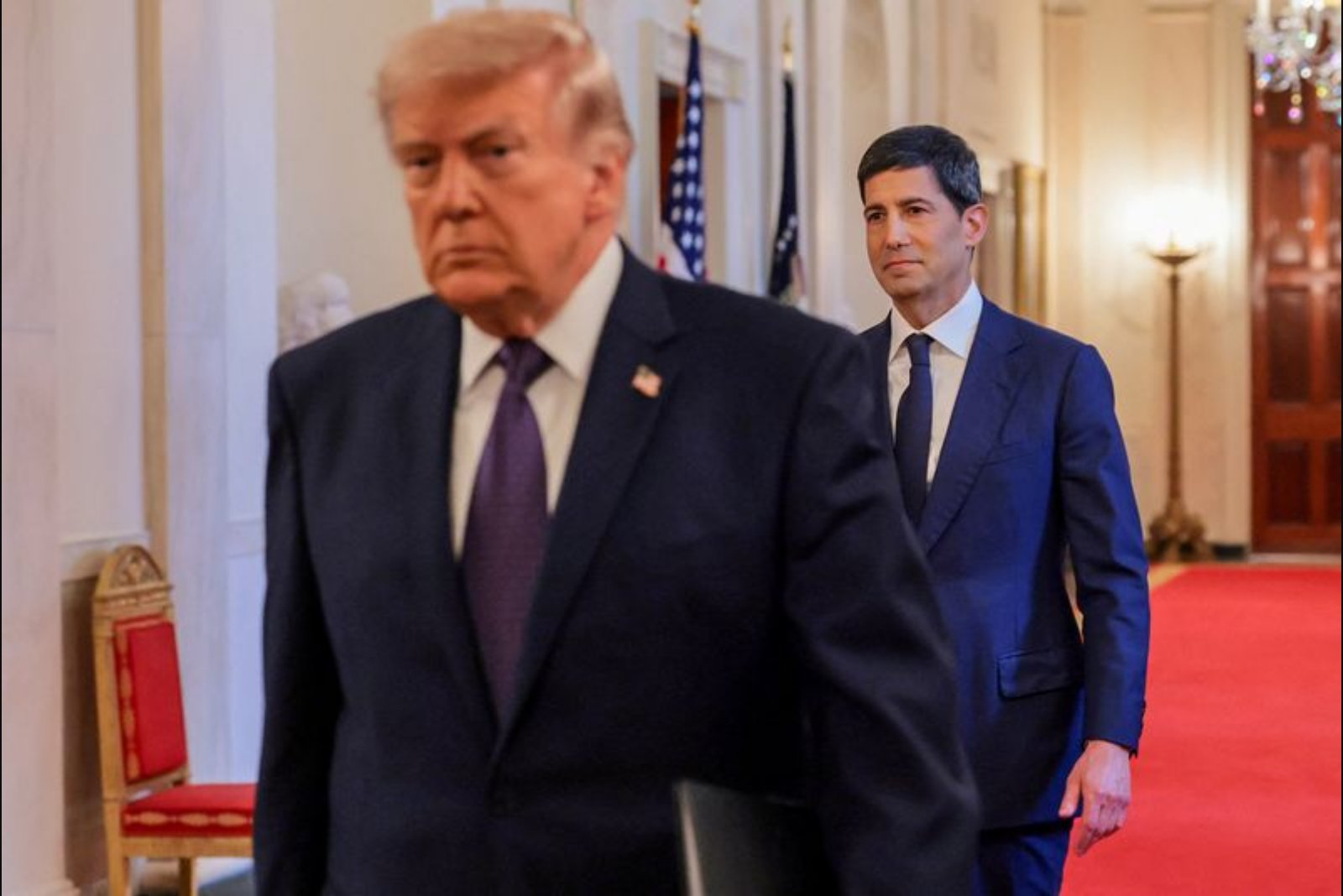
WASHINGTON, May 25 - The arrival of Kevin Warsh at the helm of the U.S. central bank marks a clear shift in the political relationship between the White House and monetary policy. Where President Donald Trump could once point to Jerome Powell as a leader imposed on his administration, Warsh now occupies the chair by the president’s choice - a fact Trump underscored at a White House swearing-in that brought together cabinet secretaries, Supreme Court justices and senior White House advisers.
Addressing the gathering in extended remarks, Trump urged the new Fed chief to strike his own path. "Do your own thing and do a great job," the president said, adding that a booming economy is desirable and he does not want it "stifled." The optics of the ceremony served as a reminder that policy outcomes under Warsh will increasingly reflect on Trump politically and not merely on technocratic debates inside the Fed.
Political stakes and public mood
Trump campaigned and won a second term pledging to reduce prices and tackle broader affordability concerns for American households. Since then, however, his standing on the economy has deteriorated. A consumer sentiment reading posted roughly 90 minutes before Warsh’s swearing-in signaled an overall sour mood across the country. The drop in confidence extended to independents - a group crucial in the fast-approaching midterm congressional elections - and even among Republicans, where sentiment fell to the lowest level recorded so far in Trump’s second term.
Concrete pressures are mounting. The 30-year mortgage rate has climbed back above 6.5 percent, a nine-month high that continues to weigh on an already subdued housing market. Broad price levels also remain elevated; the inflation gauge the Fed uses to pursue its 2 percent target has accelerated from 2.3 percent year-on-year in March 2025 to 3.5 percent most recently. At the pump, the national average price for a gallon of gasoline was $4.55 as of Friday - up from under $3 before Mr. Trump’s late-February actions toward Iran.
Political accountability and monetary trade-offs
With Warsh now the president’s choice for Fed chair, Trump can no longer treat monetary policy outcomes as the result of a predecessor’s selection. That linkage complicates political messaging as the Republican Party heads toward midterm elections, where voters sensitive to rising prices may weigh their choices accordingly.
Addressing inflation typically requires tightening monetary policy - a remedy that often takes the form of higher interest rates. Higher rates are seldom politically popular and could clash with what Trump wants for the short-term economy. How Warsh navigates the delicate balance between tamping inflation and avoiding growth-sapping steps will matter both for markets and for the president’s electoral prospects, though the precise influence of Warsh’s early tenure on midterm fortunes is uncertain.
From adversary to ally: the change in narrative
During his predecessor’s tenure, Jerome Powell functioned as a convenient target for presidential criticism. Some observers argued Powell was an easy scapegoat for broader economic problems that were not fully within the Fed chair’s control. Richard Stern, who studies economic policy at the conservative Advancing American Freedom think tank, put it bluntly: "Powell was a really great scapegoat for Trump for issues that had nothing to do with Powell." Stern added that the affordability problem and price increases likely will persist for many years and are largely independent of actions either Trump or Warsh could take.
Warsh, 56, brings to the role a varied résumé. He served as a Fed governor from 2006 to 2011 and later pursued a career that included work in law and finance. His mentors have included noted figures from economics and public service, and his ties to the private sector - including years working with investor Stanley Druckenmiller - contributed to his prominence. The president has voiced regret that Warsh was not chosen for the Fed chair role in 2017, and those political and social connections ultimately helped secure the appointment.
An unwieldy institution and a new approach to debate
Even with a chair in place who is politically aligned with the White House, the Federal Reserve remains a diffuse institution by design. The Board of Governors in Washington comprises seven members, and policy deliberations also involve 12 regional Fed presidents. In recent decades, the chair has often guided policy through efforts to build consensus, but Warsh has signaled a different style. He has advocated for a more combative form of internal debate - one that generates more explicit dissent and could spring surprises on financial markets by steering away from the forward guidance the public has come to expect.
Those dynamics may already be taking shape. The April Fed meeting produced the highest number of dissents in over three decades, and the meeting minutes revealed a majority of officials who believe additional rate increases may be necessary - a stance that diverges from what the president had said he hoped to see and from some signals Warsh had offered prior to his confirmation.
The current policy debate brings together a heterogeneous set of officials - academic PhD economists, high-level market professionals and the Fed’s prior leader Powell - who could have differing views from Warsh on the next moves. Among the six other governors, three were appointed by former President Joe Biden, and at least one, Lisa Cook, is a target of a White House effort to remove her. Such composition underscores the potential for internal disagreement as the Fed confronts rising inflation.
Markets and investor expectations
Investors appear to be preparing for the possibility that interest rates will need to rise further to counter renewed inflation pressures. Yields on long-dated bonds - which influence borrowing costs for households and businesses - have already been climbing. For consumers, that means higher borrowing costs for mortgages and other loans; for financial markets, it signals potential volatility and shifts in valuations.
Amid these uncertainties, market participants and individual investors alike are seeking stronger data to guide decisions. Institutional-grade analysis and insights purportedly help inform portfolio choices, though no solution guarantees success. The debate over the Fed’s path under Warsh will likely remain a central input in investment decision-making as the inflation outlook and policy responses evolve.
What lies ahead
Warsh’s early months as Fed chair will be closely watched for evidence of how he intends to build authority within an institution designed for shared governance. How he handles internal dissent, whether he embraces more overt debate and how the Fed communicates its policy intentions will shape market expectations and political narratives alike. For the president, the Fed’s performance will no longer be easily divorced from his own stewardship of the economy.
That linkage matters because key economic variables - inflation, mortgage rates and consumer sentiment - remain sensitive and politically salient. If upward pressure on prices persists, the resulting policy trade-offs and their distributional effects could influence the political landscape as voters head to the polls.