
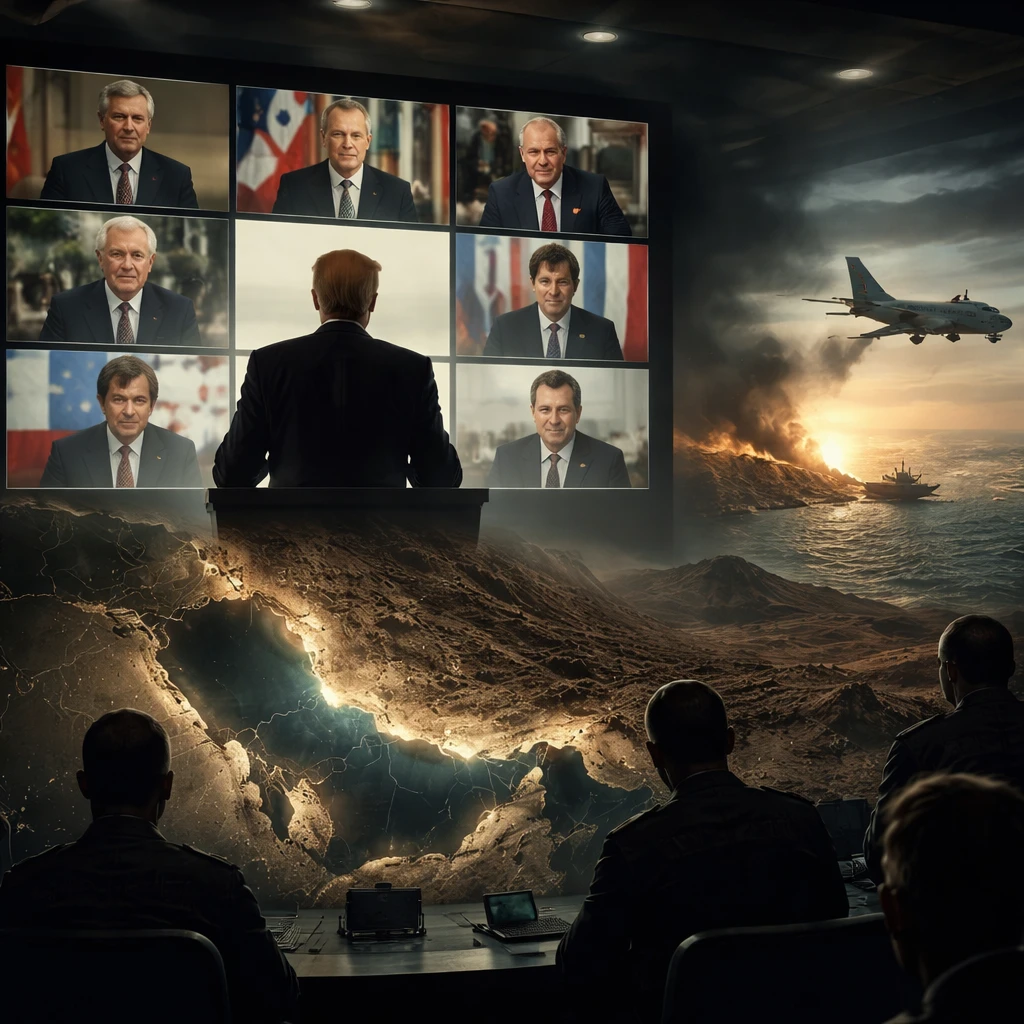
U.S. President Donald Trump told other G7 leaders during a virtual meeting this week that Iran was "about to surrender," according to officials briefed on the call, who relayed the comments to a news outlet. During the Wednesday morning discussion, the president described the effects of a recent U.S. military operation and portrayed Tehran as weakened and internally unstable.
On the call, Trump said he had "got rid of a cancer that was threatening us all," and highlighted the results of the operation referred to by U.S. authorities as "Epic Fury." He also told allies that Iran’s political standing had deteriorated to the point where it was unclear who could formally declare surrender.
"Nobody knows who is the leader, so there is no one that can announce surrender," Trump said during the virtual meeting, according to the officials.
Those remarks arrived as violence in the Middle East was entering a second week, with continued exchanges of drones and missile strikes across the region. The conflict dynamic has kept pressure on several markets and raised questions about the path forward for diplomatic or military de-escalation.
On Friday, the president reiterated a confrontational tone toward Iran’s leadership, calling them "deranged scumbags" and saying it was his "great honor" to have killed them. At the same time, the U.S. is confronting domestic scrutiny following the loss of a U.S. military aircraft in the area.
U.S. Central Command reported that a KC-135 refueling aircraft went down in western Iraq at about 2 p.m. Eastern Time on March 12. Of the six crew members aboard, four have been confirmed dead and rescue operations continued at the time of the statement. Central Command said the circumstances of the incident are under investigation and that initial findings indicate the loss of the aircraft was not caused by hostile fire or friendly fire.
Beyond battlefield developments, Tehran has pursued a strategy of threatening the Strait of Hormuz and stoking higher oil prices as a means of leverage. Analysts cited in the reporting warned that there is no straightforward military fix to re-opening the strait should it be disrupted.
Vital Knowledge analyst Adam Crisafulli summarized the market challenge in a morning note on Friday, observing that stocks face a dilemma. Crisafulli said that while the U.S. might be trying to find an exit path from the confrontation, the administration does not fully control how the conflict evolves. He noted a cautious restraint on both sides that could either open room for compromise or allow further escalation.
Crisafulli pointed to specific restraints that have so far limited broader damage: U.S. and allied forces have not targeted Iran’s oil infrastructure in a material way, Iran continues to export oil through Hormuz, and Iran’s proxy forces such as the Houthis in Yemen have so far remained largely on the sidelines.
The combination of ongoing military exchanges, political uncertainty in Tehran, and the unexplained loss of a U.S. aircraft has produced a tense regional environment with implications for energy markets, defense logistics, and financial markets sensitive to geopolitical risk.
Summary
President Trump told G7 leaders that Iran was "about to surrender," citing a U.S. operation called "Epic Fury" and saying Iran’s leadership was too unsettled to formally capitulate. The comments came as missile and drone exchanges continued, a U.S. KC-135 tanker crashed in western Iraq with four confirmed dead, and analysts warned that threats to the Strait of Hormuz are keeping oil-market risks elevated.
Key points
- President Trump described Iran as on the verge of surrender and credited the U.S. operation "Epic Fury" for weakening the threat.
- Regional hostilities continue, including drone and missile strikes, and a U.S. KC-135 refueling plane went down in western Iraq with four of six crew members confirmed dead; an investigation is underway and the loss was not attributed to hostile or friendly fire in the Central Command statement.
- Threats to the Strait of Hormuz are pushing oil-price risk higher, and analysts say there is no clear military solution to fully reopening the waterway if it becomes obstructed.
Risks and uncertainties
- Escalation risk - Ongoing exchanges of missiles and drones could broaden hostilities, affecting defense and security sectors as well as markets exposed to geopolitical shocks.
- Energy-market disruption - Iran’s threats to the Strait of Hormuz raise the potential for higher oil prices and supply interruptions, impacting energy companies and commodity-sensitive sectors.
- Operational and investigative uncertainty - The cause of the KC-135 crash remains under investigation, creating uncertainty for military logistics and operational readiness assessments.