
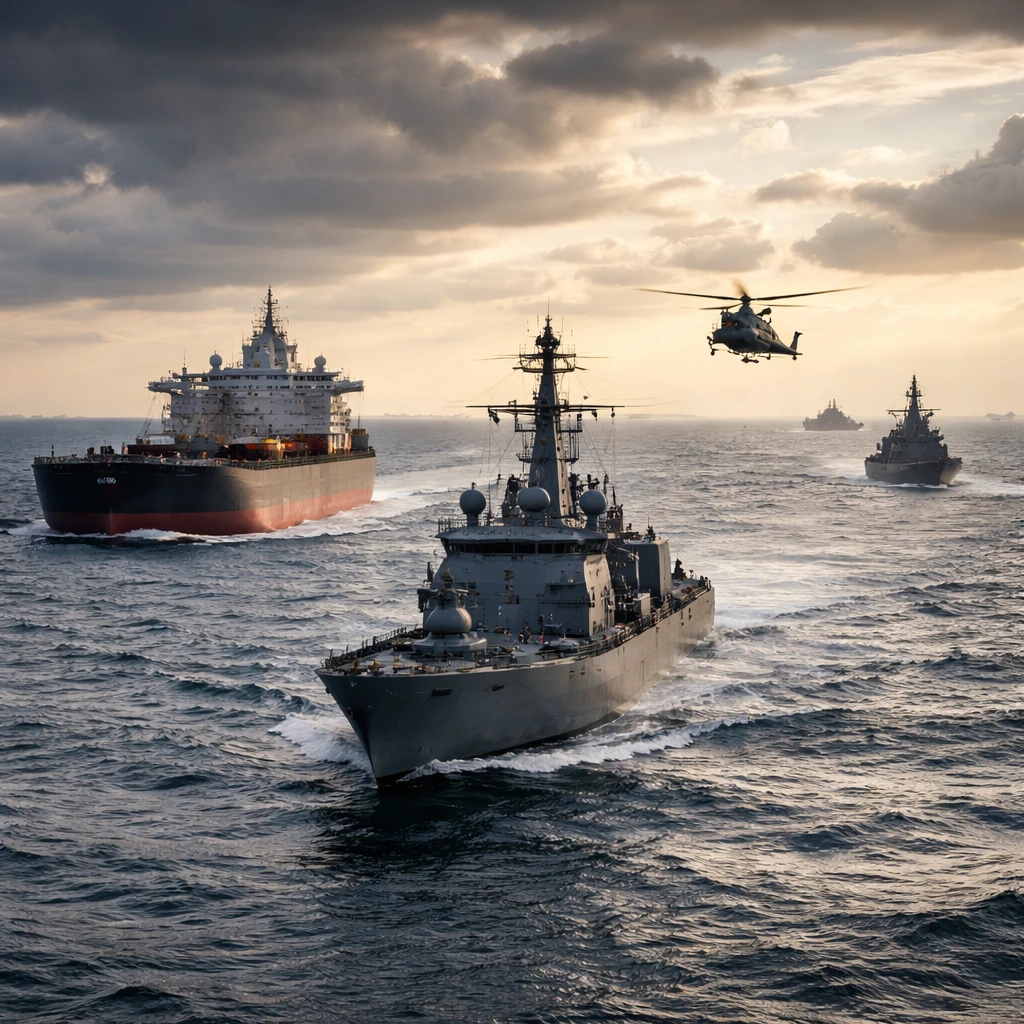
President Donald Trump said on Sunday evening that conversations were ongoing with other nations about joint efforts to intervene in the Strait of Hormuz, where Iran has shut down the waterway in response to military actions by the U.S. and Israel.
"We are talking with other countries about working with us, policing the strait," Trump told reporters aboard Air Force One, adding that he believed the United States was receiving a "good response." He declined to identify any specific countries that had committed to intervening in Hormuz.
Trump characterized keeping the strait open as a "very small endeavor," and asserted that Iran possessed "very little firepower left." He said Tehran was running low on missile and drone supplies and that U.S. strikes had "decimated" Iran's drone manufacturing capabilities.
The president also renewed his public appeal for China to take action in the Strait of Hormuz, pointing to Beijing's substantial reliance on Iranian oil as a basis for Chinese involvement.
Sunday's remarks followed a call the prior day from Trump for other nations to dispatch warships to ensure the passage through the strait remains navigable. Approximately 20% of global oil supplies transit the channel. According to the president's account, Iran has effectively blocked the strait as a retaliatory measure against U.S. and Israeli operations.
Trump had earlier told the Financial Times that the North Atlantic Treaty Organization would face a "very bad" future if U.S. allies failed to take action in Iran. He also warned that he might delay a late-March summit with China's Xi Jinping.
On the prospect of an imminent end to the conflict, Trump repeated his belief that the Iran confrontation will conclude soon. Iranian authorities, by contrast, have largely dismissed expectations of a quick resolution, saying Tehran remained "stable and strong," and prepared to defend itself.
U.S. forces struck Kharg island over the weekend, an oil export terminal of significance to Iran, and the president raised the possibility of additional strikes against the island.
Oil markets moved sharply in March, with Brent crude clearing $100 a barrel after the start of the U.S.-Israel military campaign involving Iran. In the immediate aftermath of the president's comments on Sunday, crude prices pared earlier gains and were trading flat during Asian market hours on Monday.
The situation remains fluid: the president is discussing coalition action to keep a vital maritime artery open, Iran maintains its closure of the channel, and energy markets are responding to both the physical disruptions and the public statements of leaders on the scene.