
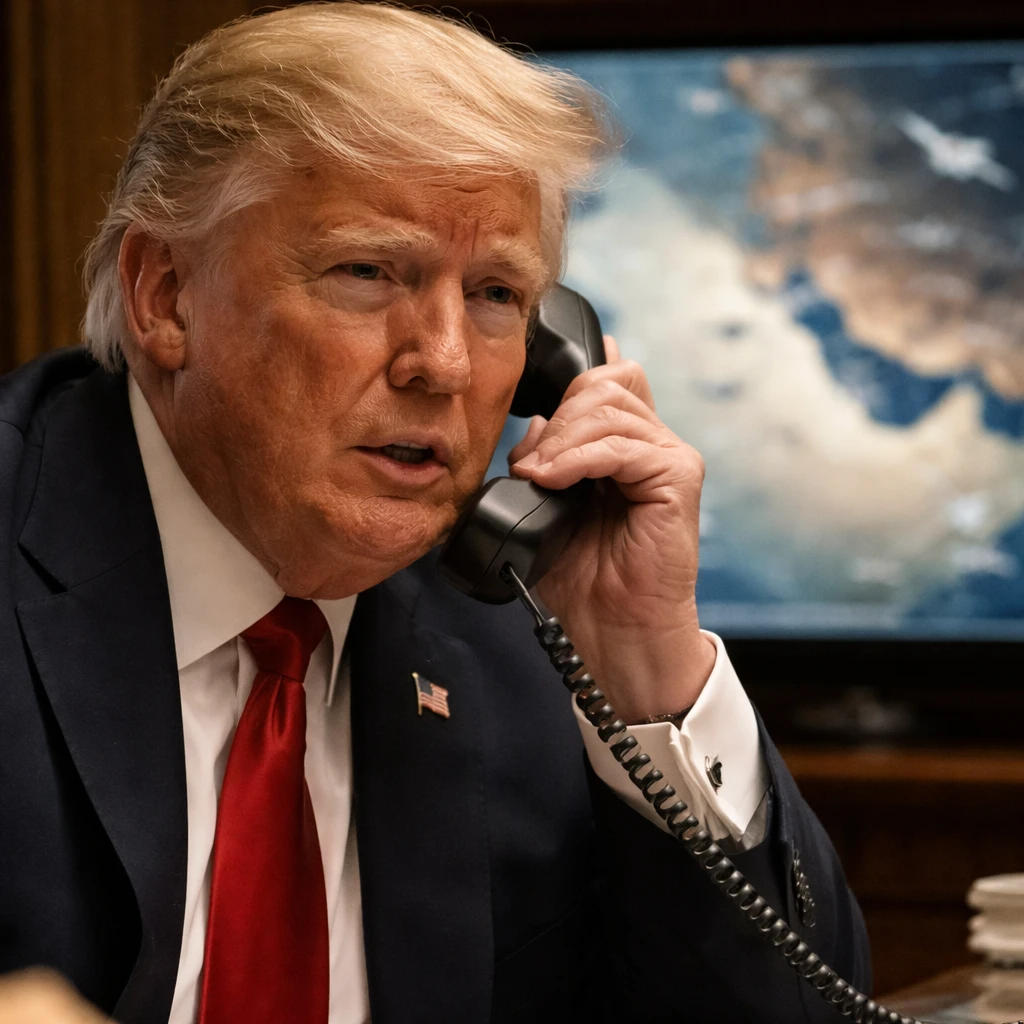
President Donald Trump told Politico on Tuesday that Iran is losing crucial armaments and is running low on the means to fire them, and he said he would consider dealing with some members of any reconfigured Iranian leadership that survives the current conflict.
In a phone interview that lasted roughly four minutes, Trump described Tehran's military capabilities as being steadily degraded. "They're running out and they're running out of areas to shoot them, because they're being decimated," he said. "They're running out of launchers."
The assertion that Iran is running low on launchers and other munitions did not appear in a Pentagon briefing on Monday, nor was it publicly stated by other administration officials, according to the available record of official remarks.
The comments arrive as the United States and other parties in the Middle East prepare for more missile and unmanned aerial vehicle strikes, which the article describes as continuing waves of retaliation since the conflict erupted early on Saturday. On Tuesday, the U.S. Embassy in Riyadh, Saudi Arabia, was struck twice by unmanned aerial vehicles, an attack that caused part of the building's roof to collapse. The State Department confirmed that drones had hit the embassy.
On defense logistics and supply, Trump said the United States has large stocks and production capacity for ammunition. "We have unlimited of the middle- and upper middle- ammunition and things. We save it and we build it," he said. He also described defense manufacturers as accelerating production under emergency directives, saying, "The defense companies are on a rapid tear to build the various things we need. They're under emergency orders. We're making it fast."
Senator Richard Blumenthal (D-Conn.) warned separately of potential equipment shortfalls, saying there is a "potential desperate and disastrous shortage of THAAD and Patriot systems that are necessary to protect our embassies, our bases, our civilians." That concern highlights questions about the availability of missile defense assets to shield diplomatic facilities, military installations, and civilian populations from incoming strikes.
Regarding the duration of the conflict, Trump offered divergent possibilities, suggesting it could last "four or five weeks" or alternatively be over in "a few more days." He also indicated openness to engaging with a newly configured Iranian government should one come to power as a result of the fighting. When asked if it is too late to consider talks with new leaders, Trump replied, "Nope, not too late. 49 [senior Iranian leaders] were killed, don't forget, so that goes pretty deep, right? New ones are emerging. A lot of people want the job. Some of them would be very good."
The comments paint a picture of U.S. officials assessing both the state of Iran's remaining military capabilities and the potential political fallout that could produce new negotiating partners. At the same time, confirmed attacks on diplomatic facilities and warnings about defense system availability underscore persistent security and logistical challenges for U.S. interests in the region.