
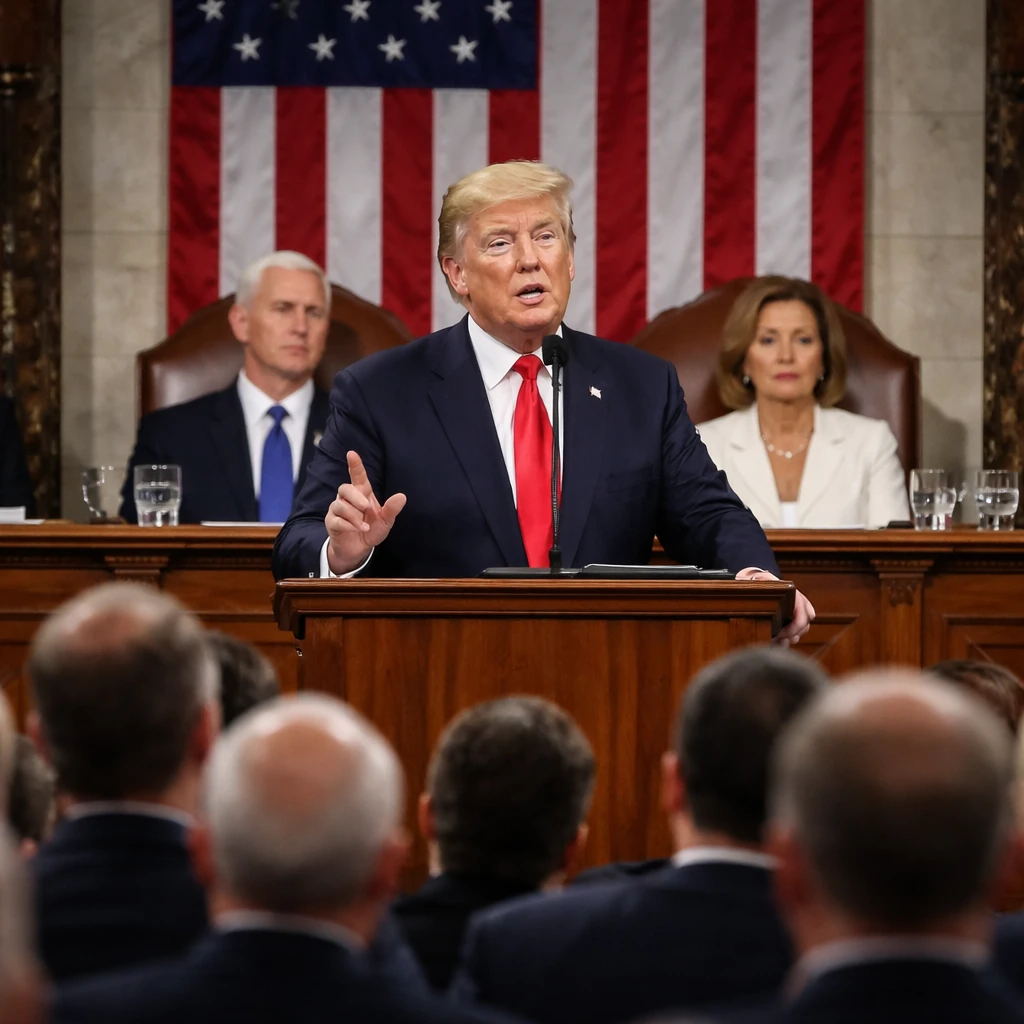
President Donald Trump on Tuesday evening criticized the Supreme Court's recent decision that constrained his tariff program, but said he will press forward with duties without needing approval from Congress.
Speaking during the State of the Union address, Trump described the court's ruling as "unfortunate" and defended the role that tariffs played in what he called U.S. economic strength in the prior year.
"Despite the disappointing ruling, these powerful... (tariffs) will remain in place under fully approved and tested alternative legal statutes," Trump said, without identifying the specific legal framework he had in mind.
He added plainly that "Congressional action will not be necessary."
During the address the president also maintained that trade agreements his administration negotiated with major economies remain intact, and that a prospective new deal would be "far worse for them."
Trump reiterated a long-voiced promise about the fiscal role of tariffs, repeating that duties collected would effectively replace the current income tax system.
"The tariffs will... substantially replace the modern day system of income tax," he said.
The remarks followed a significant setback for the administration last week, when the Supreme Court ruled that the president exceeded his authority in imposing tariffs under the International Emergency Economic Powers Act. In response to that ruling, the president announced new levies first at 10% and then at 15% under Section 232 of the Trade Expansion Act. Observers noted, and the administration has acknowledged, that the president's ability to impose further tariffs under Section 232 will be tightly constrained because additional duties are expected to require Congressional approval.
That limitation appeared in practice on Tuesday, when the new tariffs took effect at 10% rather than the 15% the president had previously touted.
Trump's remarks came as part of the longest State of the Union address on record, running one hour and 48 minutes.
Across a wide-ranging speech, the president covered immigration, trade, the state of the U.S. economy, and administration efforts intended to lower the cost of living. He intermittently attacked Democratic lawmakers and criticized former President Joe Biden.
He repeated an earlier claim that he had stopped eight wars since taking office and touched on ongoing negotiations with Iran. On economic matters, he pointed to recent strength in equity markets and attributed gains to his trade policies, including tariffs.
Turning to technology policy and the development of artificial intelligence, Trump said he has instructed major technology firms to construct dedicated power plants for their data centers. The president framed that directive as a consumer protection measure designed to shield households from higher utility costs.
Those remarks and the administration's ongoing tariff posture underscore the legal and political friction surrounding trade policy following the Supreme Court's ruling and the subsequent use of Section 232 measures. The president's public insistence that further Congressional involvement is unnecessary stands in contrast to expectations set by legal constraints cited after the court's decision.
As the administration implements the adjusted tariff schedule and pursues alternative legal avenues, observers will be watching how the measures intersect with market responses, technology sector energy policy, and broader trade negotiations.