
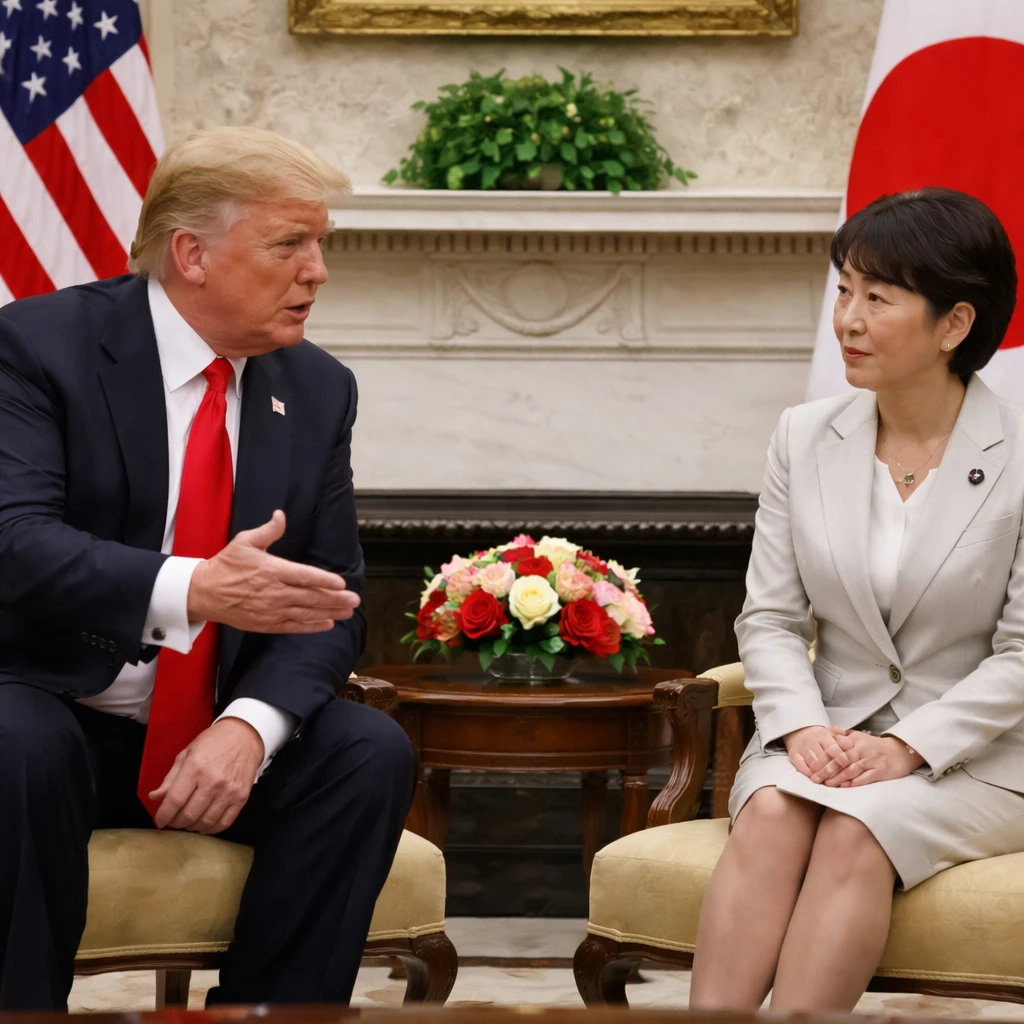
President Donald Trump welcomed Japanese Prime Minister Sanae Takaichi to the White House on Thursday, applauding Tokyo for what he described as strong backing of U.S. measures against Iran while also generating a tense moment in public remarks.
During remarks at the meeting, the president praised Japan for "stepping up to the plate," and contrasted Tokyo's response with that of NATO members. He said the United States has a "tremendous support and relationship with Japan on everything."
A reporter asked why Washington had not notified Japan and other European allies before conducting strikes on Iran. In response, Mr. Trump directed a question at Prime Minister Takaichi, saying, "Who knows better about surprise than Japan? Why didn't you tell me about Pearl Harbor?" The prime minister gave no reply to that comment.
Mr. Trump also said the United States does not "need anything" from Japan or other countries, though he added it was appropriate for partner nations to "step up." He noted that roughly 45,000 American service members are stationed in Japan and said the U.S. spends significant sums on the country.
Prime Minister Takaichi did not answer the president's Pearl Harbor reference at the meeting. She did, however, express agreement with Mr. Trump's position that Iran must never be permitted to possess nuclear weapons, a point the president has cited as central to starting the war on Feb. 28.
The exchange follows a separate set of comments from Mr. Trump earlier in the week. On Tuesday, he took to social media to criticize allies, singling out NATO and naming Japan, Australia, and South Korea, and wrote, "WE DO NOT NEED THE HELP OF ANYONE!" in reference to assistance in the Iran conflict.
Context and implications
- The White House meeting combined public praise for Japan's support on Iran with a confrontational rhetorical moment when the president referenced Pearl Harbor.
- The president emphasized the level of U.S. military presence and financial commitment in Japan, noting about 45,000 U.S. troops stationed there and significant spending.
- Prime Minister Takaichi did not respond to the Pearl Harbor remark but expressed concurrence with the U.S. stance that Iran must not acquire nuclear weapons.
Key facts
- The meeting took place at the White House on Thursday.
- Mr. Trump praised Japan's support for U.S. efforts related to Iran and contrasted Tokyo's response with NATO allies.
- A reporter's question about notifying allies before strikes on Iran prompted Mr. Trump's Pearl Harbor reference; Prime Minister Takaichi did not reply.
- On Tuesday, Mr. Trump posted criticism of allies on social media and said the U.S. did not need their help in the Iran conflict.