
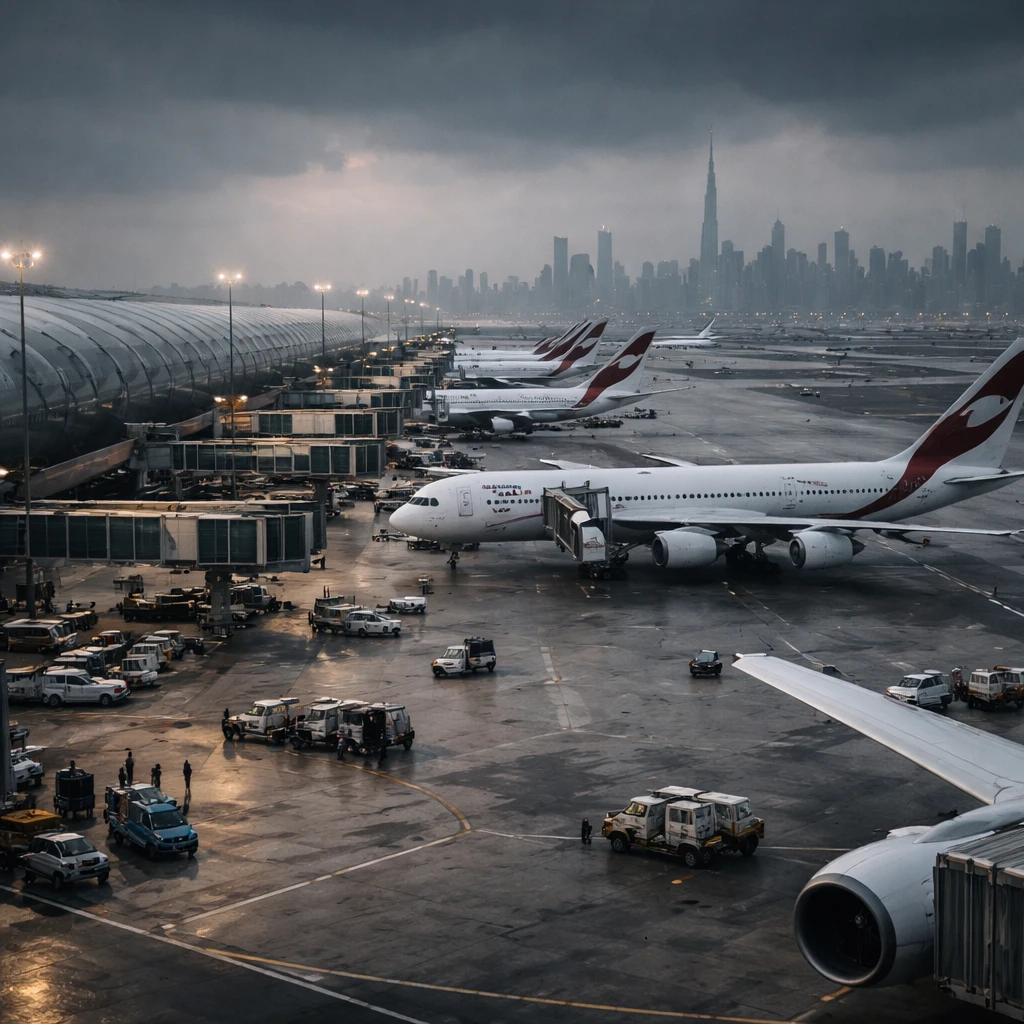
The Middle East’s role as a central aviation connector was abruptly interrupted when a suspected Iran aerial strike struck Dubai International Airport on Sunday, forcing the world’s busiest international hub to suspend operations and leaving hundreds of thousands of travelers stranded.
Flight tracking data show more than 2,300 flights were canceled across a 24-hour period along a corridor stretching from Bahrain to Tel Aviv. In Dubai specifically, departures were hit especially hard, with over 90% of scheduled outbound flights called off. The size and scope of the interruption are extraordinary - the Persian Gulf has dealt with temporary airspace curbs before, but a sweeping suspension of this scale is described as unprecedented and signals a marked escalation in the conflict involving Iran, Israel, and the U.S.
All three of the region’s major carriers grounded flights. Emirates and Etihad both initially planned to reassess operations by Sunday afternoon, while Qatar Airways halted its network entirely "until further notice." The decision by these airlines to keep aircraft on the ground removed key transfer points that normally sustain continuous east-west travel flows.
The shutdown is generating immediate congestion and cancellations far beyond the Gulf. India’s civil aviation authority reported that local carriers were forced to cancel more than 850 flights over the weekend as the ripple effects moved outward. Because Dubai and Doha function as vital bridging hubs between Europe, Asia and Australia, closing those nodes effectively severs primary routings for intercontinental passengers and air freight.
There is no straightforward bypass. Re-routing around the Gulf adds multiple hours to itineraries and materially increases fuel usage, rendering many long-haul connections uneconomic. The result is a growing backlog of passengers and baggage, and airports along alternate routings are struggling to estimate when normal schedules might resume.
This incident also marks a significant shift in the tactical picture. For years, infrastructure in the United Arab Emirates was widely regarded as a relatively secure base for global commerce. The apparent strike on Dubai International suggests that major civilian transport hubs are now being viewed as high-value targets. By disrupting operations at Dubai, the attackers have hit a city whose economy and connectivity are predicated on serving as a global crossroads.
The consequences extend into global trade. Large volumes of high-value and time-sensitive goods move in the belly-hold of passenger aircraft. With passenger jets grounded, those cargo flows are curtailed, increasing pressure on supply chains and contributing to inflationary stresses until normal air services can be restored.
For now, the aviation sector is in tactical paralysis pending a clear de-escalation. Airlines, airports and freight-dependent industries face acute scheduling uncertainty as they adjust networks, and many travelers and shippers must wait for authorities and carriers to determine when routes and airspace will be safe to reopen.
Summary
A suspected Iran aerial strike on Dubai International Airport forced a halt to operations on Sunday, canceling more than 2,300 flights across a Gulf-to-Middle East corridor and grounding the region’s largest carriers. The shutdown led to mass cancellations in India and curtailed belly-cargo movements that underpin time-sensitive global trade.