
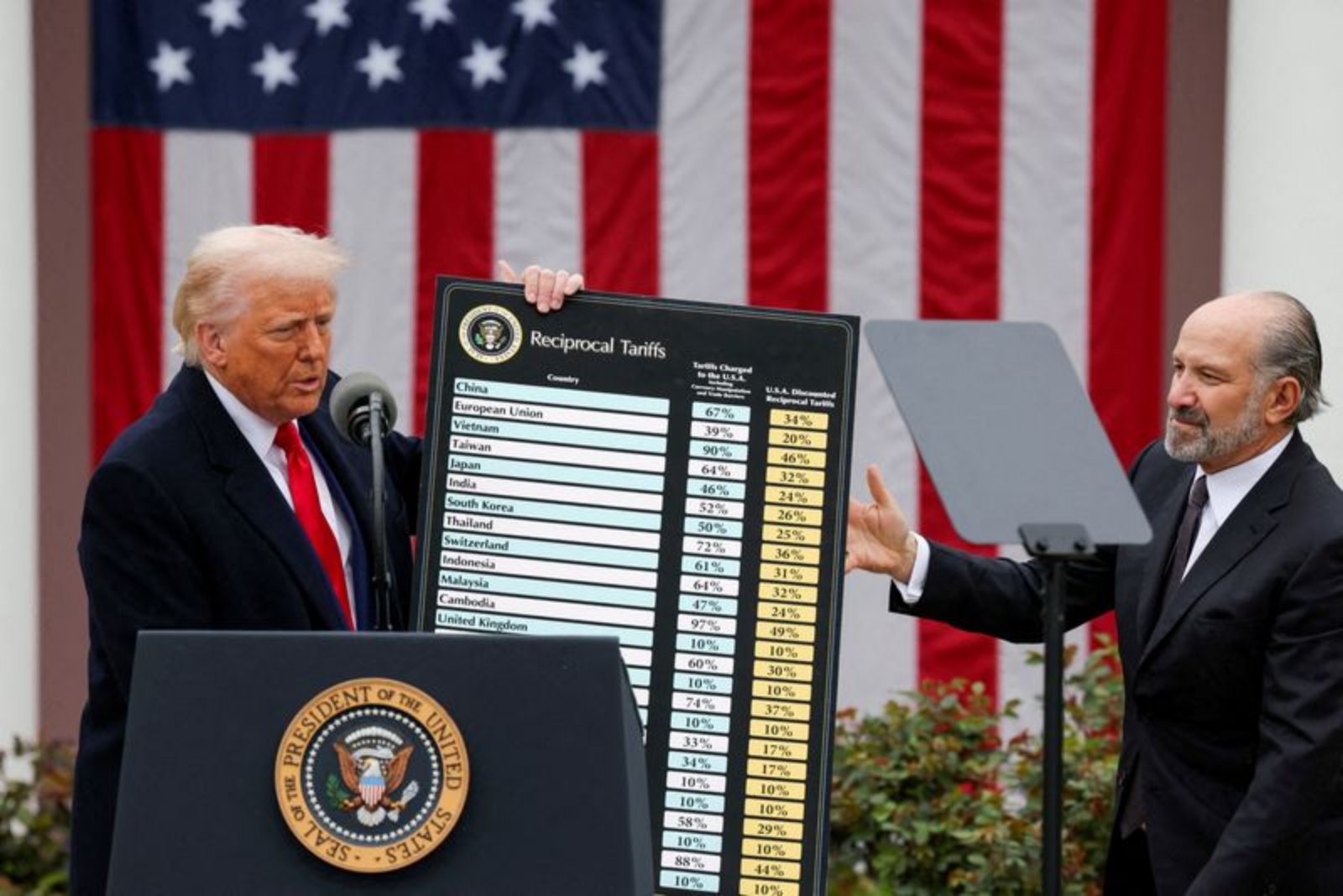
Washington - The U.S. Supreme Court on Friday rejected the president's use of a 1977 statute to impose sweeping import taxes on most trading partners, concluding that the move exceeded executive authority. The decision, issued in a 6-3 opinion written by conservative Chief Justice John Roberts, upholds lower court rulings that found the International Emergency Economic Powers Act - IEEPA - did not furnish the clear congressional authorization the president relied upon.
Roberts wrote that "the president must 'point to clear congressional authorization' to justify his extraordinary assertion of the power to impose tariffs," and added: "He cannot." The court's majority therefore struck down the tariffs that the administration had instituted under IEEPA, a law historically used to regulate commerce during declared national emergencies.
Legal challenge and plaintiffs
The Supreme Court reached its conclusion in litigation brought by commercial plaintiffs affected by the tariffs and a group of 12 U.S. states, most governed by Democratic executives. The states named in the suits are Arizona, Colorado, Connecticut, Delaware, Illinois, Maine, Minnesota, Nevada, New Mexico, New York, Oregon and Vermont.
Prior to the Supreme Court's action, the U.S. Court of Appeals for the Federal Circuit sided with five small import businesses in one challenge and with the coalition of states in another. Separately, a federal judge in Washington had ruled in favor of a family-owned toy maker, Learning Resources, in a related case.
Scope and administration rationale
The president had invoked IEEPA to place tariffs on goods from nearly every U.S. trading partner without explicit congressional approval, a first in the statute's history. Administration officials framed the tariffs as essential to U.S. economic security, arguing they were necessary to defend U.S. interests and to counteract what the president described as long-standing unfair treatment by other countries.
In statements, the president asserted that without these tariffs "the rest of the world would laugh at us because they’ve used tariffs against us for years and took advantage of us," and warned that without them the country would be "defenseless and ruined." In February and March of 2025 the administration also invoked IEEPA to target China, Canada and Mexico, citing the trafficking of fentanyl and other illicit drugs into the United States as part of the declared national emergency underpinning those actions.
Financial dimensions and potential refunds
Economists and budget analysts have produced estimates of the revenue collected under the IEEPA-based measures. The Penn-Wharton Budget Model estimated that the duties imposed under IEEPA amounted to more than $175 billion based on available collection data. The administration has not released tariffs collection figures since December 14. The court's decision raises the prospect that some portion of those collections could be subject to refund if they are tied directly to the IEEPA authority invalidated by the justices.
More broadly, the Congressional Budget Office estimated that if the entire set of current tariffs - including those enacted under IEEPA - were left in place, they could produce roughly $300 billion annually over the coming decade. Government figures also show that total U.S. net customs duty receipts reached a record $195 billion in fiscal 2025, which ended on September 30.
The administration had previously forecast that the IEEPA-based tariffs would bring in trillions of dollars over the next decade. Those forecasts, together with the more immediate collection estimates, underline the fiscal consequences of the court's ruling and the potential magnitude of refunds if earlier collections are invalidated.
Administration response and legal alternatives
Treasury Secretary Scott Bessent and other senior officials signaled that the administration would pursue alternative statutory pathways to preserve as many of the tariff actions as possible. Among the options cited are a law that allows tariffs to be imposed on imports deemed to threaten U.S. national security and a separate statutory provision that permits retaliatory measures - including tariffs - against trading partners the Office of the U.S. Trade Representative determines have engaged in unfair trade practices.
Officials acknowledged, however, that these alternative authorities do not replicate the breadth and immediacy that IEEPA afforded. The ability under IEEPA to apply tariffs swiftly across a wide range of goods and to many trading partners was a key feature of the administration's approach. Other statutory avenues may be narrower in scope and slower to implement, meaning they might not replicate fully the administration's prior tariff posture within a comparable timeframe.
Policy use and international reaction
The IEEPA-based tariffs had been a central element of the administration's broader trade strategy. They were used both as leverage to extract concessions and to renegotiate trade terms, and as a punitive tool in response to political disputes between the United States and other countries. Targets and justifications for tariffs under the administration included a range of issues - from concerns about illicit drug flows to objections to actions taken by foreign governments on matters unrelated to trade.
Those actions frequently prompted visits by world leaders to Washington and the negotiation of side agreements that included large investment pledges or expanded market access for U.S. firms. At the same time, the aggressive use of import duties strained relationships with numerous trading partners, including long-standing allies.
Statutory context and history
IEEPA was enacted by Congress and signed into law in 1977. Historically, it has been deployed to impose sanctions and to freeze assets in response to international crises; prior uses were not centered on broad tariffs. The statute does not explicitly reference the word tariffs. The Justice Department had defended the administration's approach by arguing that IEEPA allows the president to "regulate" imports to address declared emergencies.
Congress placed certain constraints on presidential authority when it adopted IEEPA, creating a legal framework that, according to the Supreme Court majority, did not provide the sweeping tariff authority the administration claimed.
Litigation specifics
The litigation before the Supreme Court comprised three underlying lawsuits. The Federal Circuit's rulings supported both a set of small import businesses and the coalition of states. A separate district court ruling favored Learning Resources, a family-owned toy company, in its challenge.
Following oral arguments in November, the president stated he would consider contingency plans - what he termed a "game two" approach - should the court rule against his IEEPA-based tariff program. The administration's officials have since referenced other statutory measures they could use to maintain tariffs, though those avenues vary in legal scope, speed and likely breadth of application.
Implications for markets and trade policy
The Supreme Court's decision curtails a significant lever of unilateral executive power over trade policy, at least insofar as it was grounded in IEEPA. The ruling is consequential for fiscal estimates tied to tariff receipts, for firms and states that challenged the administration's actions, and for the administration's ability to deploy rapid, wide-ranging trade measures in the future without additional congressional authorization.
The full practical impact will depend on how the administration pursues alternative authorities and on any subsequent litigation or administrative actions tied to collection, remission or refunding of tariffs levied under the invalidated IEEPA claims.
Promotional content included in the record
Which stock should you buy in your very next trade? AI computing powers are changing the stock market. Investing.com's ProPicks AI includes dozens of winning stock portfolios chosen by our advanced AI. Year to date, 2 out of 3 global portfolios are beating their benchmark indexes, with 88% in the green. Our flagship Tech Titans strategy doubled the S&P 500 within 18 months, including notable winners like Super Micro Computer (+185%) and AppLovin (+157%). Which stock will be the next to soar? Pick Stocks with AI