
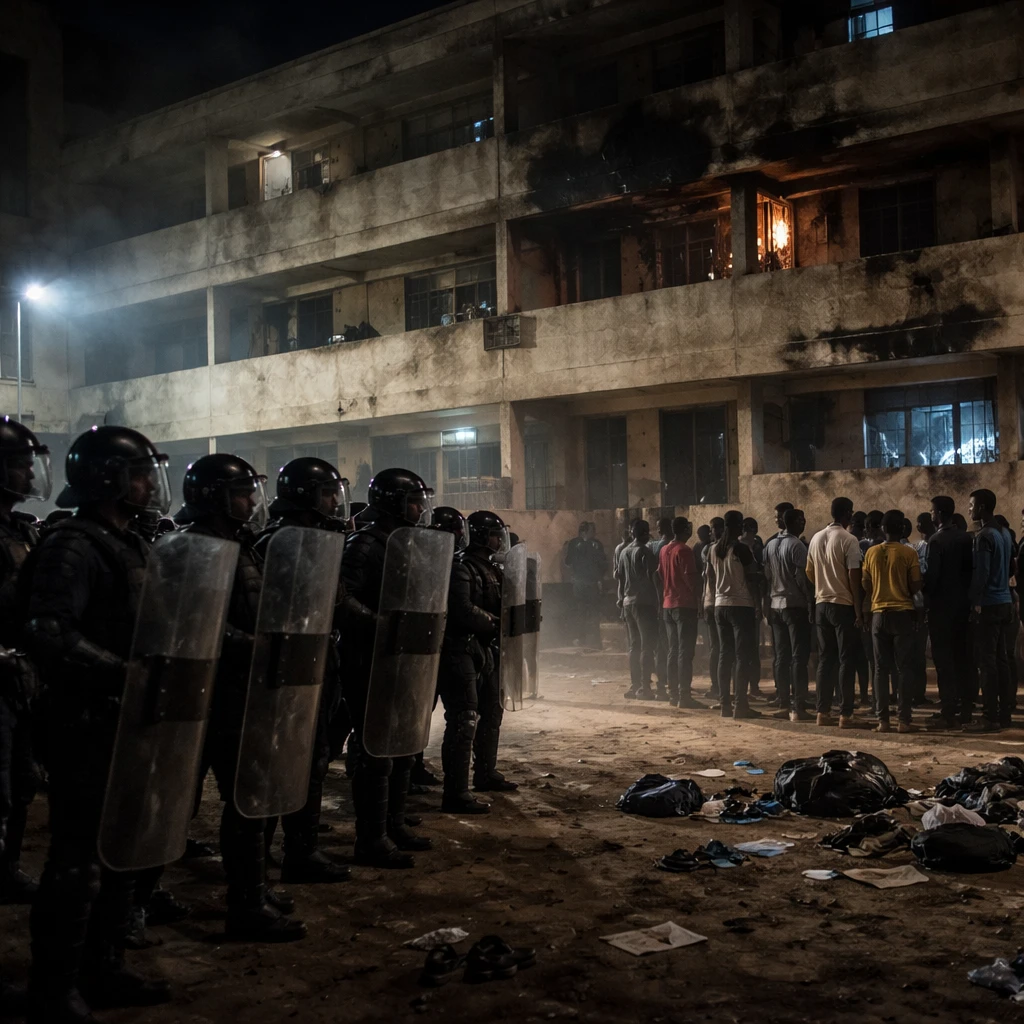
Amadou Bilo Diallo, a 23-year-old journalism student, was sheltering with five roommates and a few friends in his university dormitory when police entered the building and began using batons and shields against people inside. Diallo said he escaped with injuries to his head and feet. Others living in the same residence reported being hospitalised after either suffering beatings or jumping from upper floors to flee a fire that erupted during the incident. One of the residents, Abdoulaye Ba, a second-year dental surgery student, died from the injuries sustained that day.
"There was nothing we could do," Diallo said. "They were men in uniform - we couldn’t resist, we couldn’t fight back." The episode at Senegal’s flagship university unfolded amid demonstrations by students who said they had not received full financial aid payments. The unrest underscores growing tensions between a new populist leadership and the young people whose street protests helped bring it to power in the last electoral cycle.
The physical clash coincides with a fiscal reckoning for the state after authorities uncovered roughly $13 billion in borrowing that had been misreported by the previous administration. That discovery pushed Senegal’s debt-to-GDP ratio sharply higher and forced the current government to prioritise certain payments in the face of constrained finances.
Political context and shifting expectations
President Bassirou Diomaye Faye secured victory in the 2024 election following years of youth-led demonstrations directed at the former president, Macky Sall. Faye’s campaign benefited from support by opposition leader Ousmane Sonko, who was later appointed prime minister. For many young voters, the duo’s promises had raised expectations that now feel unmet.
Pathe Baila Barry, a classmate of Diallo who said he was beaten during the dormitory raid, captured the sense of betrayal. "It’s a shame - we weren’t expecting this, especially coming from this regime," he said.
Officials say the magnitude of the budget gap discovered after the administration change compelled difficult trade-offs. After the previously hidden liabilities were disclosed in September 2024, Senegal’s debt ratio rose to 132% of gross domestic product, compared with 78% in 2023. The International Monetary Fund suspended a $1.8 billion lending arrangement following the revelation.
Prime ministerial and presidential aides have defended the need to reorient fiscal priorities. "Managing a state is like managing your own bank account," Aminata Toure, a senior adviser to President Faye, said in an interview. "Sometimes you have to focus on priorities; that doesn’t mean that you are not interested in the rest."
Student aid, budget adjustments and public contention
Student groups report that many first-year students have received substantially less than the amounts they were expecting. Rather than the 155,000 CFA francs they say they were owed, first-year students were paid 75,000 CFA francs for recent months. The government maintains it is not in arrears but has adjusted the payment timetable.
Higher education ministry documents indicate that financial aid to students was allocated at more than 78.8 billion CFA francs in the 2026 budget - approximately $142 million - a sum about 11% lower than in 2024. The reduced line for student support is one element of broader fiscal tightening.
Measures adopted amid the fiscal squeeze include a 1% tax on cash transactions in grocery stores and a 0.5% tax on bank transactions. Teachers’ unions have mounted nationwide strikes, citing staff shortages, concerns about salary fairness and the new taxes. The government’s pause and audit of several construction projects after taking office has left the status of many reviews unclear and contributed to a slowdown in the sector.
Official statistics cited in a January economy ministry report show that the formal-sector workforce contracted by 5.2% between October 2024 and October 2025. Construction sector representatives said the industry has been particularly hard hit. "We are at more than 17,000 direct job losses in the formal sector," said Oumar Gueye, a delegate at the National Union of Construction Workers (SNTC/BTP).
Clash at the university and official responses
Authorities said that more than 100 students were detained during the dormitory raid this month, and the university has remained closed for more than two weeks. Video footage shows officers beating a person outside one student residence while other officers look on.
Interior Minister Mouhamadou Bamba Cisse defended the actions of security forces, saying the use of force was necessary to protect public property and alleging that some students had intended to ransack a campus restaurant. The student association representing the faculties of medicine, pharmacy and dentistry - where Ba had been enrolled - has disputed the official account of his death.
The public prosecutor, Ibrahima Ndoye, said an investigation would be concluded soon but indicated that available evidence does not support the claim that Ba was beaten to death. The prosecutor stated that Ba died after a fall from a fourth-floor window.
For many students, the government’s handling of the episode has eroded trust. "This government is here today thanks to us," said Assane Dia, an economics student. "We couldn’t imagine that after only two years in office, Sonko could do this to students."
Economic and social reverberations
The campus incident spotlights the social consequences of fiscal adjustment amidst an opaque debt legacy. Student anger over reduced bursaries and delayed payments is symptomatic of wider hardship: slower hiring in the formal economy, higher unemployment in sectors linked to paused infrastructure projects, and new transaction levies that affect consumer spending and banking activity.
Political leaders have publicly rejected debt restructuring and signalled a preference for prioritising repayments to international investors. That posture, coupled with the frozen IMF programme and reduced domestic expenditures, frames the government’s constrained policy space and helps explain the contested allocation of resources that has inflamed tensions on campus and beyond.
Conclusion
The deadly confrontation at Senegal’s university illustrates how fiscal shocks and politically charged expectations can translate into street-level disputes. As the administration balances claims on scarce budgetary resources, students and public-sector workers continue to press grievances over pay, services and the sequencing of payments. The unfolding investigation into the dormitory raid and the broader economic adjustments are likely to shape political relations between the government and the younger constituencies that helped bring it to power.