
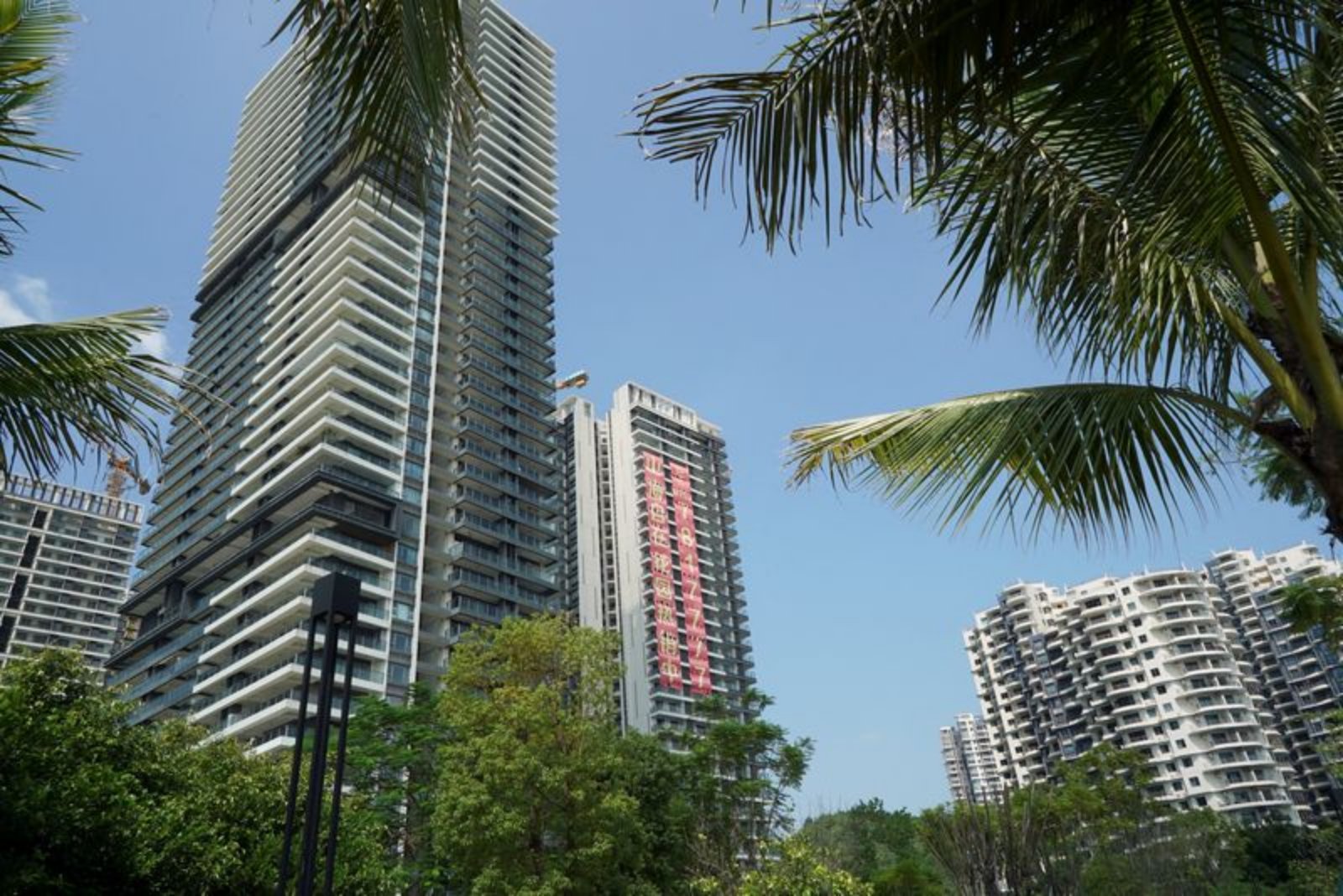
Chinese state-owned companies and municipal agencies have started buying foreclosed residential projects across several provinces, in what analysts describe as an early and tentative application of government guidance intended to tackle a long-standing oversupply in the housing market. Public tender documents and auction records show state firms winning a portion of the foreclosed property sales listed online, frequently at prices significantly below the estimated project values.
Visible but limited purchases
An examination of announcements on Alibaba’s auction platform reveals that a small share of foreclosed property tenders over the past year have been awarded to entities administered by state or local governments. Where transaction values are disclosed, winning bids were priced between 19% and 43% below the tender documents’ estimated values. Several of the assets involved were still under construction when won.
The full number and total value of purchases by state firms could not be determined from publicly available information, and analysts emphasize the scale remains limited for now. Still, they say the activity signals the start of a gradual and likely protracted effort to reduce an estimated housing inventory described in tender documents as roughly 3,000 square kilometres - a figure the documents note is almost twice the size of Greater London.
Specific transactions and local plans
Publicly cited transactions provide concrete examples of how state-related buyers are acquiring distressed units at steep discounts. One tender document shows that Huzhou Chanfeng Enterprise Management Partnership, established in the same month as its purchase and administered by a city in eastern China, paid 139.30 million yuan for 37 apartments on Hainan island in September. The estimated market value listed in the tender was 248.7 million yuan.
In another Hainan example, Wuzhishan City Housing Security Service Center, a local government agency, bought six apartments in November for 1.18 million yuan, about 20% below the estimated value stated in the tender documents. The Wuzhishan agency told Reuters it planned to convert those units into affordable housing for young people and newly arrived residents.
State-linked buyers also emerged in southern mainland China: in Guangzhou, the housing services firm Guangzhou Nansha City Operations purchased 62 units in December for more than 52 million yuan in total. According to tender documents, each unit was acquired at roughly two-thirds of the price of previous secondary market transactions.
Other named winners of foreclosed property tenders include Ma’anshan Jinyuan Urban Operations Management, Dali Prefecture Sports and Tourism Development, Fuzhou Gulou District Jianxin Investment and Huangshan Tourism Development. Reuters was able to locate contact details only for firms based in Huangshan and Guangzhou, and those entities did not reply to requests for comment. Other local government departments overseeing purchases did not respond to comment requests.
Policy and financial rationale
Analysts say the bidding activity by state firms aligns with a 2024 directive encouraging state-owned enterprises to buy distressed property and repurpose it as affordable housing. That policy had previously been met with caution by state firms because of the financial risks involved and did not immediately generate widespread purchases.
Where foreclosed properties trade at substantial discounts, rental yields naturally increase, which can make purchase-and-rent strategies more feasible for the state sector. John Lam, head of Asia property research at UBS, was quoted as saying that discounts allow state-owned enterprises to "make the math work." Lam characterized the policy as shifting assets from private households or developers - entities facing some of the highest financing costs in the economy - into the state sector, which typically has cheaper access to liquidity.
The participation of firms from the tourism sector among purchasers suggests some foreclosed projects might be repositioned for visitors rather than long-term residents, an adjustment analysts note is consistent with repurposing assets in response to price dynamics and local demand patterns.
Potential impacts on prices and the broader economy
Analysts argue that state-firm purchases could partially offset weak private demand, thereby easing supply pressure on prices and slowing the pace of further home price falls. That easing effect could reduce how sharply the property sector continues to weigh on China’s economic growth, a drag that has been present since 2021.
However, several experts caution the approach has trade-offs. In many foreclosed tenders, state bidders were the only participants, a pattern that indicates little private appetite for these assets even at discounted prices. That environment implies the process of recognising and writing down the real magnitude of losses could be prolonged, stretching out how long the market takes to reach a true bottom.
Sam Radwan, chief executive of Enhance International, offered a metaphor to describe the effect: "You’re simply putting your finger in a hole in the dam." He warned that delaying the recognition of losses could extend economic weakness tied to the real estate downturn. Radwan also flagged the possibility that the crisis is so deep that it may persist for decades, or even become generational, language he used to describe the scale of oversupply and the pace of adjustment.
Market indicators and the pace of liquidation
Other statistics of the foreclosed market underscore the slow pace of sales and the depth of discounts. The China Index Academy reported that of 719,000 properties listed for auction, only 169,000 were sold in 2025, about 4% fewer than in 2024. The average discount on those sales remained roughly 26%.
These figures illustrate an oversupply dynamic that analysts say could be drawn out. Comparisons drawn by some analysts point to other episodes where authorities sought softer adjustments rather than sharp write-offs, with the implication that China’s approach - which so far involves municipal purchases and liquidity advantages for state entities - could substantially lengthen the timeframe needed for price discovery and balance-sheet repair.
Bankrupt developers in China have not, in many cases, been liquidated. Debts associated with unfinished projects remain recorded on the books of banks and other institutions as assets rather than liabilities, complicating the process of resolving non-performing exposures in a way that would clear the market more quickly.
Analyst perspectives and uncertainties
Some economists and property researchers see the current state-firm activity as more project- and city-specific than a nationwide, coordinated rescue of the housing market. Zichun Huang, an analyst at Capital Economics, suggested the phenomenon is not yet a broad national pattern but appears more concentrated on individual projects and cities.
Analysts also warn that because state entities frequently face little competition when they bid, the prices they pay will often reflect distressed valuations rather than market-clearing values. That raises the prospect that the accumulated stock of troubled assets could change hands at levels that do not fully recognise prior losses, thereby prolonging the overall market adjustment.
Illustrative exchange rate
The tender documents and transactions referenced use the exchange rate stated in the reporting context: $1 = 6.9401 Chinese yuan renminbi.
Conclusion
State-owned firms and municipal agencies have begun to appear among buyers of foreclosed residential projects in China, often acquiring units at wide discounts and in some cases planning to convert them to affordable housing or tourism-related uses. The intervention aligns with a 2024 policy push and could help blunt further home-price declines and the property sector’s drag on growth. At the same time, analysts caution that this method of managing distressed assets may extend the timeframe for the market to find a genuine bottom, because many transactions occur at deep discounts with limited private-sector participation.