
Economy February 9, 2026

S&P Lowers 2026 China Home‐Sales Forecast as Market Weakness Deepens

Ratings agency now sees a 10%-14% drop in property sales next year, flagging oversupply, price falls and growing reliance on state intervention

By Nina Shah
S&P Lowers 2026 China Home‐Sales Forecast as Market Weakness Deepens

S&P Global Ratings has cut its forecast for China’s 2026 property sales, now expecting a 10% to 14% decline versus its October projection of a 5% to 8% drop. The agency flagged entrenched oversupply, further price declines, weakening buyer confidence and continued developer construction that has left new completed housing unsold for the sixth successive year. S&P said only government intervention - such as purchasing unsold units for affordable housing - has the capacity to meaningfully absorb excess inventory.

Key Points

  • S&P now projects a 10% to 14% decline in China property sales for 2026, down from its October forecast of a 5% to 8% drop.
  • Persistent oversupply and falling prices are expected to push home prices down a further 2% to 4% this year, continuing a trend seen in 2025 and undermining buyer confidence. Sectors impacted include developers, construction, residential real estate and banking.
  • Developers have continued construction despite weak sales, producing a sixth straight year of completed but unsold housing; state purchases for affordable housing are highlighted as one of the few options with sufficient scale to absorb excess inventory.

S&P Global Ratings has reduced its projection for China's property sales in 2026, saying it now expects sales to fall between 10% and 14% compared with its October forecast of a 5% to 8% decline.

"This is a downturn so entrenched that only the government has capacity to absorb the excess inventory," S&P analysts wrote in a Sunday report. The agency said the state could step up purchases of unsold homes to convert them into affordable housing, although it noted that existing efforts so far have been limited.

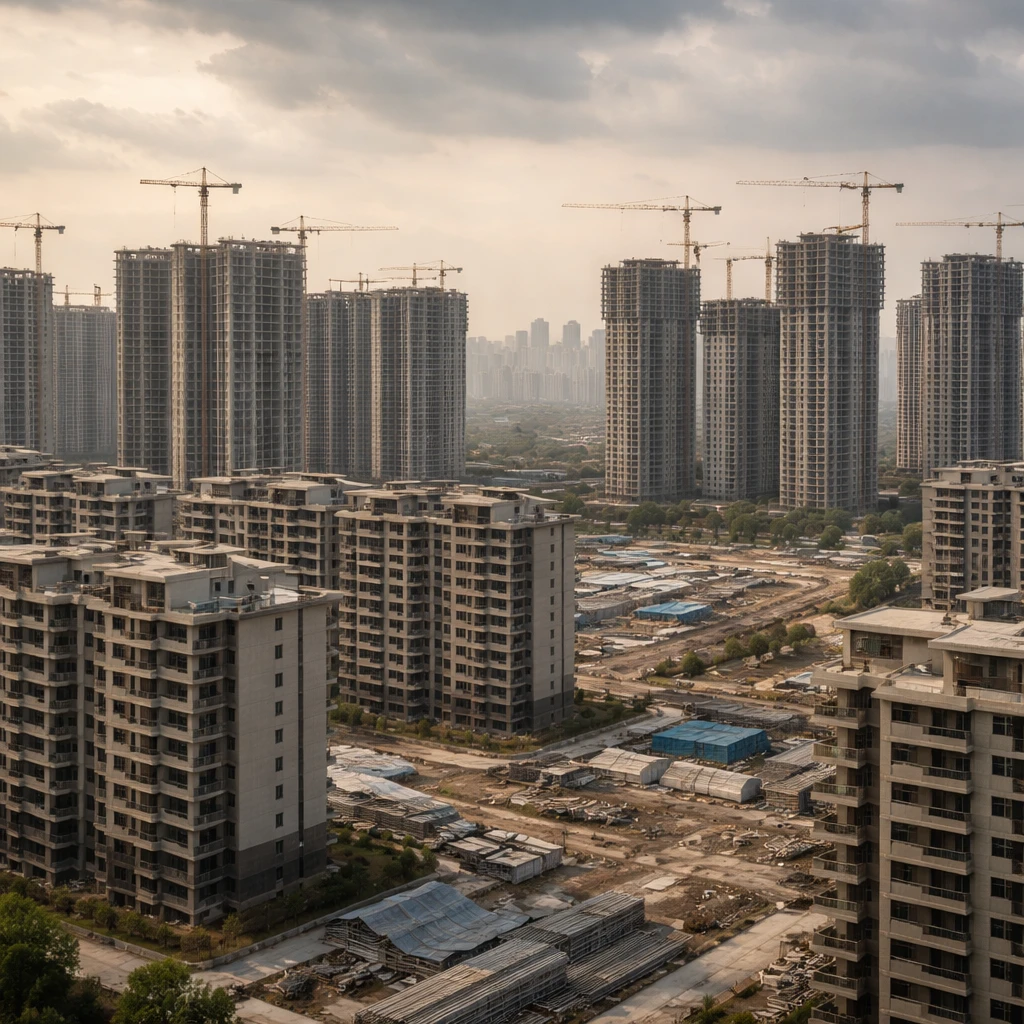
China's real estate sector, which at one point accounted for more than 25% of the economy, has experienced a marked contraction. Annual sales volume has been halved over four years as a result of the sector's deterioration. The initial slump followed Beijing's clampdown on developers' high-leverage expansion strategies, and demand from homebuyers has remained subdued.

S&P highlighted persistent oversupply as a central problem and said it expects prices to decline another 2% to 4% this year, after similar drops in 2025. "Falling prices erode homebuyers' confidence," the report said. "It's a vicious cycle with no easy escape."

The ratings agency called attention to the worsening price picture in several large cities during the fourth quarter of 2025. Beijing, Guangzhou and Shenzhen all recorded home price declines of at least 3% in 2025. By contrast, Shanghai was the lone major city to post growth, with prices up 5.7% in 2025 versus 2024.

Despite weakening sales, developers kept up construction activity. That combination has produced a sixth straight year in which newly completed homes remain unsold, according to S&P.

The deterioration of the property market accelerated through 2025. S&P's outlook shifted over the year: in May it forecast a 3% decline in sales, revised that in October to an 8% fall, and actual sales ultimately fell 12.6% to 8.4 trillion yuan, or $1.21 trillion. That outturn is less than half the 18.2 trillion yuan in annual sales recorded in 2021.


Implications

S&P's downgrade signals further stress for developers, construction firms and related financial institutions, while the broader economy faces headwinds given the sector's sizable share of GDP. The agency's emphasis on government capacity to absorb inventory underscores the limited role private demand currently plays in restoring balance to the market.

Where recovery is possible depends heavily on policy action and the pace at which excess supply can be brought into use or removed from the market.

Risks

  • Policy dependence - The report indicates only government-scale intervention can absorb excess inventory, creating execution and financing risks tied to the scale and speed of state action. This affects local government finances and social housing programs.
  • Price feedback loop - Continued price declines can further erode buyer confidence and reduce transactions, compounding stress on developers, construction suppliers and lenders exposed to the property sector.
  • Concentrated urban weakness - Significant price drops in big cities such as Beijing, Guangzhou and Shenzhen heighten financial and market risks in regional property markets and may have localized effects on employment and related service sectors.

More from Economy

USMCA Goods Largely Exempted From New 10% Global Tariff, But Review Threat Looms Feb 20, 2026 U.S. Trade Office to Open Broad Section 301 Reviews Covering Major Partners Feb 20, 2026 Supreme Court Term Spotlight: High-Stakes Cases Shaping Law and Policy Feb 20, 2026 Trump Vows Fresh 10% Global Tariff After Supreme Court Limits His Trade Authority Feb 20, 2026 Supreme Court Ruling Narrows Presidential Tariff Options, Treasury Secretary Says Feb 20, 2026